I live in Colorado. So, I'm no stranger to ice and snow. Unfortunately, I hate snowy weather! Why? I hate driving on bad roads. The college I attended had horrible winter roads. They built it on top of a massive hill. But it was in a smaller town. So, they seldom plowed the streets. Every year people would get stuck. A few times, someone even slid through the intersection at the bottom of the hill. They couldn't stop! It was terrifying! So, I only drove when I couldn't avoid it.
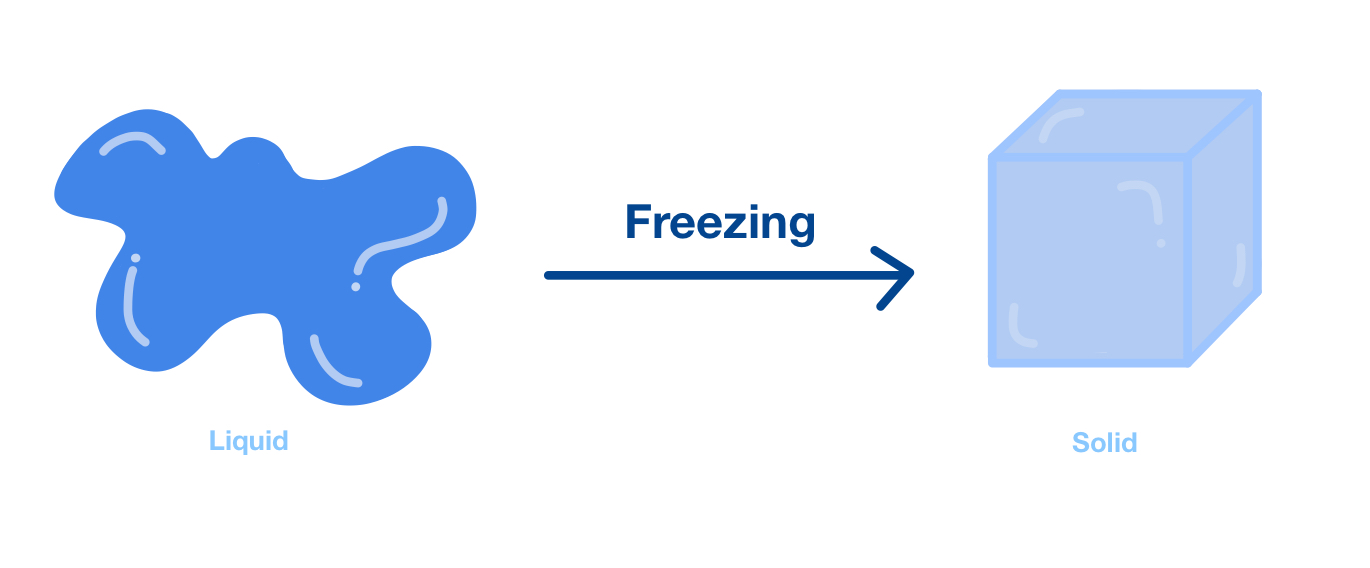
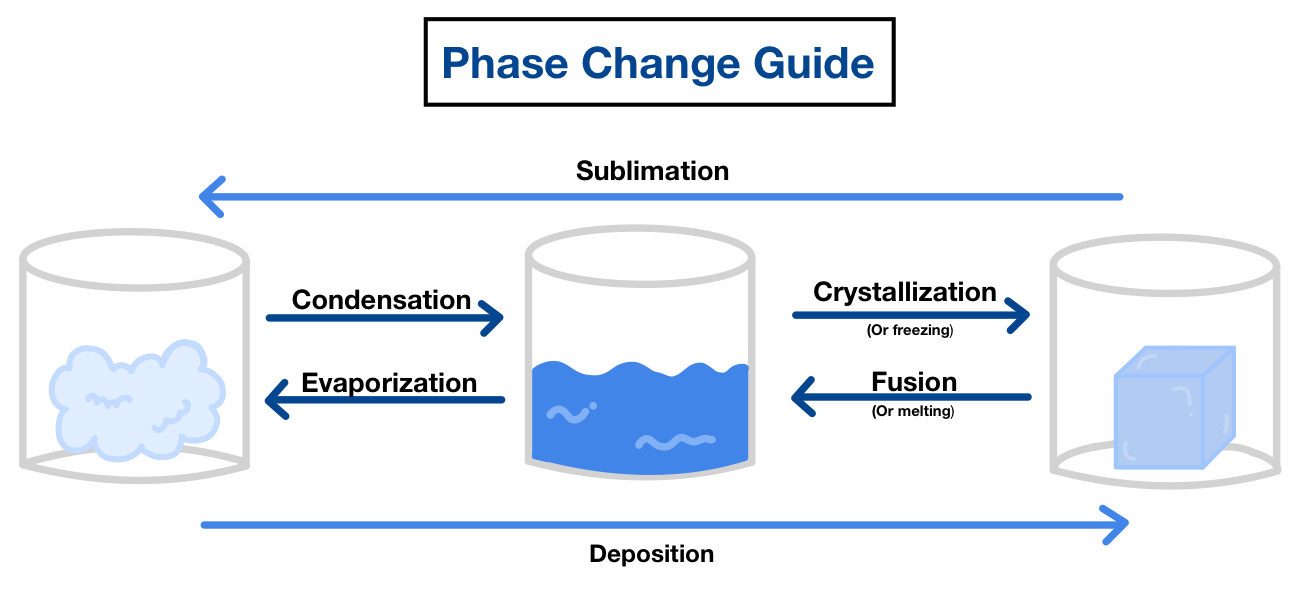
We've been exploring the phases of matter. We've individually examined solids, liquids, and gases. In this lesson, we'll begin to study phase changes. We'll start with freezing.
A Molecular Perspective on Freezing
What happens when a liquid freezes? Remember, liquid molecules don't have a uniform arrangement. They are free to move past one another. That's why they take on the shape of their container. These properties contrast with solids. In a solid, the particles have a fixed arrangement and position. So, how do we convert free-moving particles to rigid ones? We remove energy!
Let's consider the energetics of the phases of matter. They are always a balance between the kinetic energy and Van der Waal's forces. The intermolecular attractions want to hold the molecules together. The kinetic energy keeps the molecules separated. In gases, kinetic energy predominates. That's why there is a lot of empty space between gas molecules. In liquids, the two are balanced. So, the molecules move past one another. But they are still condensed. In solids, intermolecular attractions dominate. So, the molecules can't move past one another. Remember, we measure the average kinetic energy with the temperature. So, to freeze a liquid, we lower the temperature.
The freezing temperature depends on the strength of the intermolecular forces. Why? We need to balance the intermolecular forces and kinetic energy. The greater the attraction between molecules, the less they move. So, we don't need to lower the temperature as much. Molecules that only experience dispersion forces have unbelievably low freezing points. For example, let's consider carbon dioxide. The carbon-oxygen double bond would be polar based on the electronegativities. But carbon dioxide has a linear geometry. So, it's a nonpolar molecule and only experiences dispersion forces. Its freezing point is −78oC. In contrast, we could consider water. It freezes at 0oC. Why? It experiences hydrogen bonding. Water's hydrogen bonds are unbelievably powerful. So, we don't have to reduce the kinetic energy as much.
What about polar covalent molecules? They have a wide range of freezing points. It generally depends on the strength of their dipole. But there are other factors. For example, consider the molecule's size. The molecular mass is a good proxy for size. Larger molecules tend to have lower freezing points. Why? Because it's challenging to get them to come together. For example, if you study organic chemistry, you'll encounter massive molecules. They often have various branching points. It's analogous to a tree. It's hard to get them to stay together even with dipole-dipole interactions. Often molecules like this have a freezing range. They often become a jelly-like consistency before they actually freeze solid. What's an example? You might have seen car grease getting stickier in cold weather.
Why Water is Unique
We can't talk about freezing without talking about water. It's unique because ice is less dense than liquid water. Often, when liquids freeze, they contract. So, they have more mass within a smaller volume. They become denser! Water's density changes because of water's hydrogen bonds. The hydrogens have partial positive charges. The oxygen is more electronegative. So, it pulls electron density toward itself. It also has two electron lone pairs. So, it has a large partial negative charge. Each hydrogen can interact with one of the electron lone pairs on another molecule. But, the two hydrogens don't interact with lone pairs on the same molecule. So, each hydrogen interacts with a different water molecule. As water freezes, the molecules align into a crystal lattice. The lattice actually expands the space between the molecules. So, water becomes less dense.
Freezing and Energy
What happens when we hit the freezing temperature? You might think that we instantaneously transition from liquid to solid. But we actually have to rearrange the molecules into a fixed arrangement. If you look at a heating and cooling curve, you'll see flat lines at the transition temperatures. The flat line is the enthalpy of freezing. We have to withdraw energy to rearrange the molecules. The rearrangement alters the electrostatic interactions. We're changing the potential energy! How do we do it? We pull heat from the system into the surroundings. We're removing energy. So, freezing is an exothermic process.