Read · 4 min
Imagine that you're in the chemistry lab. You're about to do a combustion reaction experiment. Let's be honest it's fun to burn stuff in the chemistry lab. But, what if you're teacher asked you to collect the carbon dioxide gas. What would you do?
Gases are notoriously hard to handle. If they escape into the air, they immediately diffuse. Even if you did manage to collect the gas, they have exceedingly small densities. How would you measure their mass? It would be challenging. So, typically we measure the volume of the produced gas. Then, we can use the ideal gas law to find the moles of produced gas.
How to Measure Gas Volume
So, how do we measure a gas's volume? We have to use a eudiometer! A eudiometer is a long test tube with volumetric markings. To use a eudiometer, we start by filling it with water. Next, we plug the open side and submerge it in a water-filled beaker. Once the tube is underwater, we undo the plug. The atmospheric pressure pushes down the beaker's water, equalizing the eudiometer's pressure. So, the water stays in the eudiometer.
When we are ready for our reaction, we run a plastic tube into the eudiometer. The other end of the plastic tube connects to our reaction vessel. During the chemical reaction, the gas travels through the plastic tube. You can recognize the reaction because the gas bubbles through the water into the top of the eudiometer. The gas pushes the water down into the beaker. So, we can read the volumetric marks. Both the gas and the air push against the water. So, we also know that the gas pressure is equal to the atmospheric pressure.
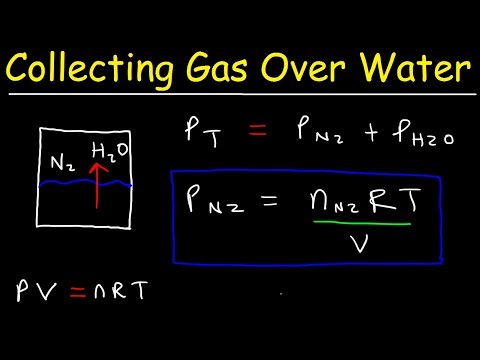
Unfortunately, there is one problem! When the gas displaces the water, it creates space above the water. So, some of the water will vaporize. Our volume of gas is a mixture of the gas and [water vapor]. What can we do? We'll have to turn to Dalton's law.
The Partial Pressures of Water Vapor
To determine the amount of gas you collected, you'll need to know the partial pressure of water vapor. At STP, water's vapor pressure is 0.023 atm. But what if you're not at STP? If you're in a lab setting, you can often look up the values you need. Make sure you know your location's temperature and pressure. You may need to ask your teacher to pull out a thermometer and barometer. On a test, your teacher should give you the value.
How would you calculate the vapor pressure at a different temperature and pressure? Unfortunately, the calculations for a substance's vapor pressure are complicated. Physical chemists use a semi-empirical formula. Part of the equation is theoretical. The theoretical piece is adjusted based on experimental evidence. If you want to learn more, research the Antoine vapor pressure equation.
Limitations of Water Displacement
Gas collection by water displacement does have some limitations. You can only collect gases that are insoluble in water. Noble gases and diatomic elements are the most common. Polar gases are much more soluble in water.
Let's look at some examples. Ammonia has a solubility of just over at and . If you haven't seen these units before, they are a molality. In comparison, Argon is and hydrogen is . As you can see, the amount of argon or hydrogen gas that would dissolve is comparatively tiny. So, we can ignore it.
Example Problems
Gas collection by water displacement is an experimental technique. But, your teacher may ask you to solve problems based on it. Let's look at an example.
The reactions of the alkali metals with water create hydrogen gas. Let's say we react magnesium with excess water. At STP, we collect 739.0 ml of gas over water. Find the starting mass of magnesium.
The question is a gas stoichiometry problem. So, we need to follow the steps for a stoichiometry problem.
- Step 1 is to write the chemical equation.
- Step 2 is to balance the equation.
- Step 3 is to do any needed conversion.
- Step 4 is to calculate the moles of the reactant. But that's what we have to solve! So, we need to work backward and find the moles of the product.
- First, we use Dalton's law.
- Next, we can use the ideal gas law to find the moles of hydrogen.
-
Step 5 is to find the limiting reagent. In this case, we know that water is in excess. So, magnesium is limiting.
-
Step 6 is to convert the moles of the reactant to moles of the product. In this problem, we have to work in the opposite direction.
- The mole ratio is 2:1.
- Step 7 is to answer the problem.
- We need to convert moles to mass.
- The molar mass of magnesium is .