Read · 4 min
I want you to imagine a collision. What comes to your mind? I'm a huge NFL football fan! Unfortunately, my favorite team is the Broncos. They are playing terribly again this year. The first thing that came to my mind was a big-time tackle. NFL players hit hard.
Did you know that right now, atoms and molecules are colliding with you? Our atmosphere primarily consists of diatomic nitrogen and oxygen. It also has a little bit of the noble gas, argon. All these are gases! Every second, you experience billions of collisions!
When we studied gases' physical properties, we mentioned the kinetic molecular theory. It assumes that gases are in constant random motion. Sometimes, they collide with each other. Other times, they collide with their container. When a gas molecule hits its container it exerts a force.
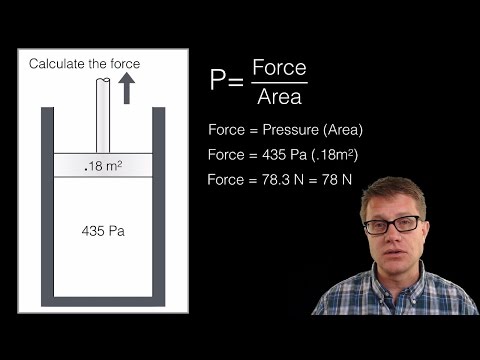
Let's consider averaging the exerted force over the container's area. Our unit would be newtons per square meter (). That's the same as a pascal! We know that pascals are the SI units of pressure. So, a gas's pressure is how much force the collisions exert on the gas's container.
Gas Laws dealing with pressure:
Let's explore some of the gas laws. All the gas laws listed below consider the pressure.
Boyle's Law: Robert Boyle developed his law way back, in 1662! It relates a container's volume to the internal gas's pressure. He discovered that volume and pressure are inverses. So, if you increase volume, pressure decreases. And if you decrease volume, pressure increases.
Let's think about the collisions. Imagine that we have one mole of gas. That one mole of gas exerts a certain pressure. When we increase the volume, the gas particles have to travel further to hit the container. We would have fewer collisions. So, we have less pressure. Now, let's decrease the volume. The gas has less space to move. So, it impacts the container more often. More collisions equal more force. So, the pressure increases.
Gay-Lussac Law: The Gay-Lussac law looks at pressure's dependence on temperature. They learned pressure and temperature are directly related. When we heat a gas, we increase its translational kinetic energy. The molecules are moving faster. So, they collide more, and the pressure increases. When we cool a gas, we decrease its movement. Less movement means fewer collisions. Therefore cooling lowers the pressure.
Combined Gas Law: The combined gas law looks at pressure, volume, and temperature. Sometimes, when we change one variable, multiple variables respond. For example, let's increase the volume. From Boyle's law, we know that our pressure would decrease. According to Gay-Lussac, if our pressure drops, so does our temperature. The combined gas law lets us relate the three variables. If we know two of them, we can solve for the third.
Ideal Gas Law: The ideal gas law is a combination of all the gas laws. We didn't talk about Avagadro or Charles' laws because they did not look at pressure. But, it includes those. We write the ideal gas law as . The P is pressure, V is volume, n is moles, R is the gas constant, and T is temperature.
The ideal gas law allows us to see the relationship between all the gas laws. If the equation's right side increases, then something on the left also increases. For example, if we increase the number of moles, the right side of the equation gets larger. If we have a constant volume, then we must have raised the pressure. That makes sense! If we have more gas particles, we will have more collisions. More collisions mean higher pressure.
Chemistry in the Real World: Crushing a 55 Gallon Drum
I want you to imagine a 55-gallon metal drum. Start by pouring a gallon of water into it. Now place it over a fire. As it heats, the water begins to change phases. Remember, boiling happens when the vapor pressure equals the atmospheric pressure. Vaporizing the water pushes the air out of the drum. When all the water has boiled, place the cap on the drum. The drum needs to be airtight. After sealing the drum, put it in an ice bath or spray it with a hose. Spraying it with a hose is easier. The rapid cooling of the drum causes the water to condense. As the water vapor becomes a liquid, the pressure in the drum drops. From the ideal gas law, we know that decreasing the moles of water vapor lowers the pressure. Eventually, the metal drum will implode! The atmospheric pressure is much stronger than the internal gas pressure.
If you want to do this experiment on a smaller scale at home, you can use a soda can. First, fill the soda can with a small amount of water. Next, heat the can on the stove. Wait until you see steam coming out of the can. Using a pair of tongs, place the soda can in a bowl of ice water. Just like the metal drum, it will collapse.
Why Don't I Implode?
You might be wondering why people can resist air pressure. If it can crush a metal drum, you would think we'd implode. But, remember the drum only broke when the internal pressure dropped. Inside every cell in your body, there is cytoplasm. The cytoplasm is a fluid that exerts pressure on the cell membrane. Between cells, there is the interstitial fluid. Our cells balance the atmospheric pressure. So, we don't implode!