Geographic Isolation — Definition & Examples

Before this, knowReproductive Isolation — Definition & Examples

Illustrated · 1 min

How Does Geographic Isolation Cause Speciation?

When a population is separated because of a geographic feature, like distance, a canyon, a river, or a mountain range, those two subgroups of the population are no longer able to reproduce together.
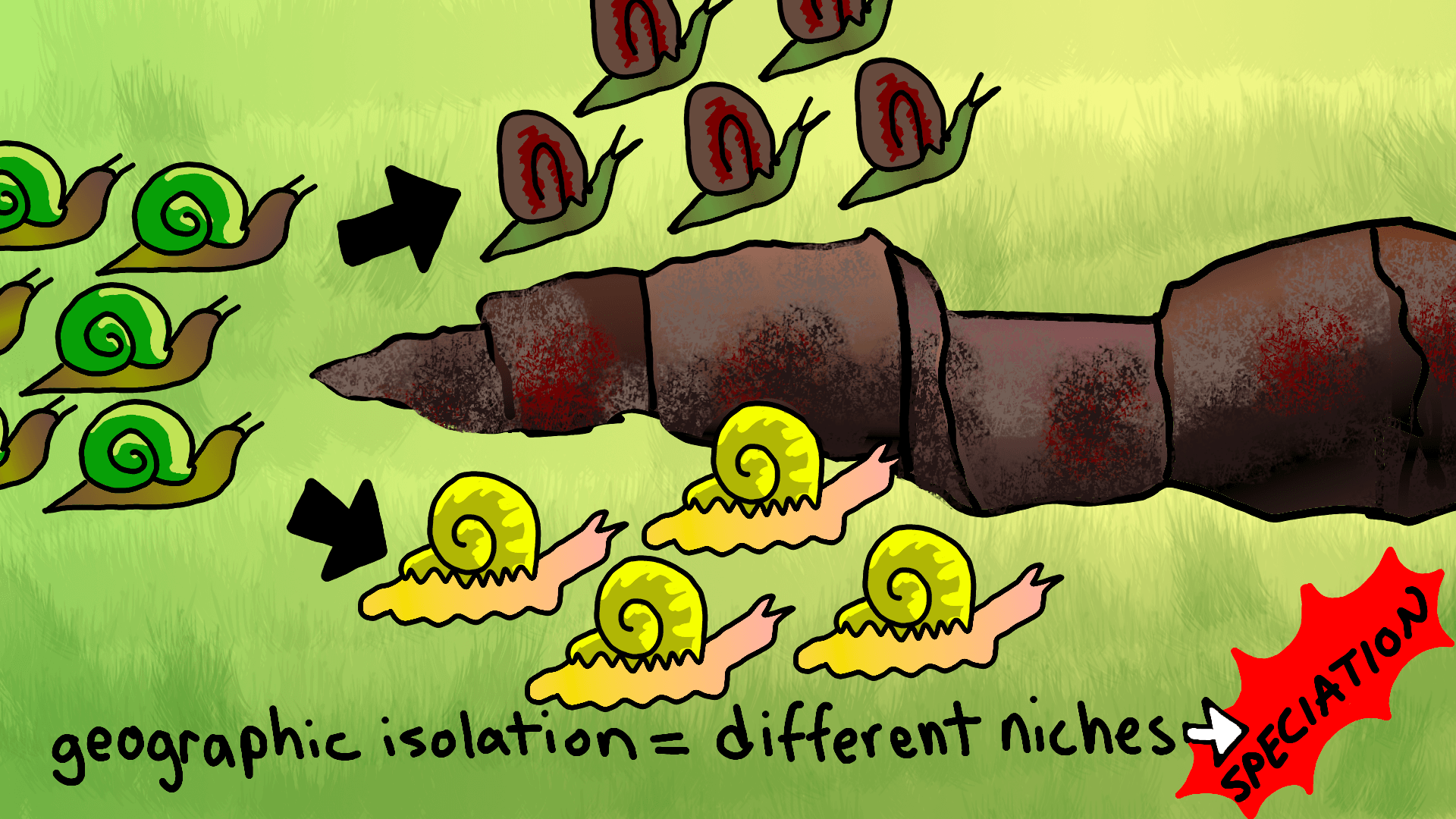
The image shows green snails splitting into two groups because of a canyon. The snails on the top have dark shells. The snails on the bottom have bright, shiny shells.

Image source: By Sarah Morgan

Since the two groups are in their own unique ecosystems and each experience unique pressures, they will adapt to their environment over time and can eventually become very different from each other. This has the end result of speciation.

For example, if snails slowly travel beyond a big canyon, the snails on one side will adapt to that environment and the snails on the other side will do the same with their environment. On one side, dark shells might hide them from predators. On the other side, bright coloring might let them stay cool in strong sunlight.

Over time, the two populations become more genetically differentiated and might become two distinct species with independent geographic ranges.


Illustrated · 1 min

Physical Separation

When two populations of the same species are prevented from mating by a barrier or distance, they are experiencing geographic isolation.

Barriers can be created by changing environments, like shifting mountains and rivers. They can also be produced by natural disasters, like forest fires, earthquakes, and floods.

Isolation stops the exchange of genetic material between the two populations. They start to evolve separately from each other because their environments are different. Differences in climate and food sources can create selective pressures unique to each population. Eventually, the two populations might become different species, but not always.

A map of where in the Galápagos Islands you can find different species of finches

Image source: By Gabi Slizewska

A classic example of geographic isolation involves the Galápagos finches. Populations of finches found on the different islands of Galápagos evolved separately and therefore split into nearly 15 different species. They all look different and utilize different food sources.

As strange as it seems, this type of isolation can still happen in human populations. Particularly, this has happened with isolated tribes around the world. For example, there is still a tribe in the Amazon that has not made contact with the rest of Brazil, much less the rest of the world. Although we know nothing about these people, we can only imagine that their allele frequencies and acquired mutations are very different from ours.

Illustrated · 2 min

How Isolation Leads to Speciation

Geographic isolation is an isolating mechanism in nature. Over long periods of time, it can lead to speciation. As the name suggests, it happens when populations of a species become separated, well, geographically. This can be a physical barrier that prevents the organisms on either side from breeding (like a mountain range or river), or it can even be a large distance between the two ends of the population's range.

Here's an example of geographic isolation:

This cartoon drawing shows an example of geographic isolation. The image shows about 20 cartoon faces inside of a black rectangle, representing their habitat. Most of the faces are purple, a few are blue and a few are red.

Image source: By Sylvia Freeman

We'll call this cartoon face species "little dudes". The rectangle represents the range of their habitat. As you can see, there is some phenotypic variation in the little dudes' coloration. Although the majority of the little dudes are purple, some are red and some are blue. In this hypothetical example, the different colors have no effect on an individual's fitness, so there's no particular selective pressure favoring any one phenotype.

This cartoon drawing shows an example of geographic isolation. The image shows about 20 cartoon faces inside of a black rectangle, representing their habitat. Most of the faces are purple, a few are blue and a few are red. In this picture, the rectangle environment is fracturing into two parts, separating the cartoon faces into two populations.

Don't worry, no little dudes were harmed in the making of this explanation.

Image source: By Sylvia Freeman

But wait. What's this? Suddenly, the little dudes' habitat is split into two.

This cartoon drawing shows an example of geographic isolation. The image shows about 20 cartoon faces inside of two black rectangles representing their habitats. Most of the faces are purple, a few are blue and a few are red. In this picture, the rectangle environment has fractured into two boxes, separating the faces into two populations. By random chance, one population has more blue faces, while the other has more red. However, the majority of both populations is still purple.

Image source: By Sylvia Freeman

Immediately after the populations are split, the little dudes are still all the same species. Because they are one species, individual dudes from both sides could technically mate, if they were able to reach each other. But because of the physical separation, they can't cross over, allowing the two populations' gene pools to drift apart.

This cartoon drawing shows an example of geographic isolation. The image shows about 20 cartoon faces inside of two black rectangles representing their habitats. In this picture, the rectangle environment has fractured into two boxes, separating the faces into two populations. By random chance, one population has more blue faces, while the other has more red. Now, after some time has passed, one population is a mix of mostly blue and blueish-purple faces, while the other is a mix of mostly red and reddish-purple faces.

Image source: By Sylvia Freeman

Now, imagine some time has passed. As you can see, over generations of being separated the two populations of little dudes have started to diverge, or drift apart, genetically.

At this point, the two populations are in the process of speciation. They can technically still be considered one species as long as the two populations are able to reproduce and create fertile offspring (that is, if they weren't separated).

This cartoon drawing shows an example of geographic isolation. The image shows about 20 cartoon faces inside of two black rectangles representing their habitats. In this picture, the rectangle environment has fractured into two boxes, separating the faces into two populations. By random chance, one population has more blue faces, while the other has more red. After more time has passed, one population is now all blue faces, while the other is made up of all red faces.

Image source: By Sylvia Freeman

Here, even more time has passed. The two groups of little dudes have diverged even more. Now, even if the two populations were reunited they would no longer be able to interbreed, making them two separate species. The speciation process is complete.

Illustrated · 1 min

What's Geographic Isolation?

It's a mechanism of speciation that happens when populations of a species are divided by a geographic barrier.

One population is separated by mountain peaks and the other is separated by valleys. Over time, they become different species.

Image source: By Andrew Z. Colvin CC BY-SA 4.0, via Wikimedia Commons

Populations can become separated by rivers, mountains, or bodies of water. A pretty common example of geographic isolation is a population migrating to an island and becoming separated from the mainland population. This stops the gene flow between the groups of organisms. Over time, the two populations become reproductively isolated and they evolve separately.

A neat example is a type of squirrel that actually became two separate species because the Grand Canyon divided the populations.

Another famous example of this type of isolation is Darwin's Galápagos finches.

Vocabulary Review:\color{#8925AE}{\text{Vocabulary Review:}}

Speciation\color{#8925AE}{\text{Speciation}} : One species splitting into two distinct species

Isolating Mechanisms\color{#8925AE}{\text{Isolating Mechanisms}} : Types of isolation that lead to the formation of a new species

Behavioral Isolation\color{#8925AE}{\text{Behavioral Isolation}} : A portion of a species undergoes a behavior change and no longer mates with the other part of the species

Geographic Isolation\color{#8925AE}{\text{Geographic Isolation}} : A portion of a species becomes separated by geography and can no longer mate with the other part of the species

Temporal Isolation\color{#8925AE}{\text{Temporal Isolation}} : A portion of a species changes the time they are awake or time they breed and they can no longer mate with the other part of the species

Video

(Video) Speciation: Of Ligers and Men

by CrashCourse

Geographic isolation is the simplest mechanism of speciation. It can occur due to any natural divide such as a canyon, river, or an island. However, it does not always guarantee that a new species will form.

When a species becomes geographically separated for long enough, the groups will follow different evolutionary paths. After enough time separated with no genetic mixing, they will no longer be able to mate and will become different species. In this video, Crash Course discusses speciation. Understanding speciation is key to understanding evolution.

Illustrated · 1 min

Example of Geographic Isolation

Geographic isolation occurs when two populations of the same species are divided by some type of geographic event or object. This event or object physically prevents two populations from being in the same area, preventing them from mating.

As an example, let's look at a species of fish. These fish are all members of the same species, though some fish happen to have green scales and others happen to have pink scales. All the fish live in the east of the river.

One day, strong rain caused the river to flood, and the currents in the river became overpowering, sweeping some fish to the west of the river. Once in the west, the fish were unable to get back to the east.

This image shows a river with 14 fish, seven of which are pink and seven of which are green. They are all on the east of the river. After a flood, the picture shows the east of the river and the west of the river. The west of the river now has five green fish and two pink fish. The east of the river now has five pink fish and two green fish. The image says: "The group that got moved to the west happens to have more green fish that pink fish. Let's call the fish in the west Population A. The group that remained in the east happens to have more pink fish than green fish. Let's call this group Population B. Population A can only reproduce with other members of population A. Eventually, the ratio of green fish in the population is going to increase, while the population ratio of pink fish will decrease. Population B will have an increase in pink fish, and a decrease in green fish overtime."

Image source: By Alana Karras

As the picture describes, Population A happens to have more green fish than Population B. However, both groups are still members of the same species. Since the two populations will never be reunited, eventually the ratio of green fish will increase in Population A, and the ratio of pink fish will increase in Population B. Over time, each population will only have one color.

This image demonstrates Population A mating with other members of Population A. Eventually, all of Population A will be green. It then shows Population A overtime, with only green fish. Then, it demonstrates Population B mating with other members of Population B. Eventually, all of Population B will be pink. It then shows Population B overtime, with only pink fish.

When the populations are separate, they can only mate with members of the same population.

Image source: By Alana Karras

The two populations will continue to evolve separately. Eventually, they will become so different that they can no longer mate and reproduce successfully. At that point, they will be considered separate species. While the change in color alone would not lead to speciation, it demonstrates how differences in the populations can accumulate over time.

Type a concept, like “slope” or “photosynthesis”.

↑ ↓ to choose · Enter to openSearch explanations and problems

