Glycolysis (Cellular Respiration) — Summary & Steps

Before this, knowWhat Is Cellular Respiration? — Aerobic & Anaerobic

Illustrated · 1 min

The image shows the steps of glycolysis with the carbon-phosphorus interactions, the names of each molecule, and the names of each enzyme labeled. See below for more details.

Image source: By Gabi Slizewska

What Is Glycolysis?

Glycolysis is a set of anaerobic reactions, ones that does not need oxygen to be performed. It takes glucose and breaks it down into pyruvate. This has the result of creating two ATP, which can release energy.

Overall, this process creates four ATP, but it uses two ATP early in the reaction. This means that there is a net gain of two ATP.

The overall equation for this pathway is:

1 glucose + 2 ATP ⟶ 2 pyruvate + 2 NADH + 4 ATP + 2 H2O

What Are the Steps? What Enzymes Are Used?

Step 1: The process starts with phosphorylation of glucose, a 6-carbon sugar, into glucose-6-phosphate. The enzyme hexokinase removes a high energy phosphate group from an ATP and places it on a glucose, which results in an ADP and the glucose-6-phosphate.

Step 2: The molecule is made into an isomer by phosphoglucose isomerase, turning G6P into fructose-6-phosphate.

Step 3: F6P is phosphorylated. The enzyme phosphoglucose isomerase removes a phosphorus from an ATP and places it on F6P, which results in an ADP and fructose-1,6-biphosphate.

Step 4: The enzyme aldolase breaks F6P into G3P and DHAP (dihydroxyacetone phosphate).

Step 5: DHAP is converted into G3P by triose phosphate isomerase.

Step 6: The enzyme G3P-dehydrogenase removes hydrogens from each G3P and phosphorylates the molecules. In doing this, it converts two NAD+ into two molecules of NADH. This step creates two molecules of 1,3-biphosphoglycerate.

Step 7: The enzyme phosphoglycerate kinase removes a phosphorus from the 1,3-biphosphoglycerates. This converts two ADP into two molecules of ATP. This step creates two molecules of phosphoglycerate.

Step 8: The enzyme phosphoglycerate mutase moves the phosphorus into the center of the molecule.

Step 9: The enzyme enolase changes the orientation of the molecule. This step creates two molecules of phosphoenolpyruvate.

Step 10: Pyruvate kinase removes the final molecules of phosphorus, forming ATP molecules. This step creates two molecules of pyruvate, which can then be used in other reactions such as the Krebs cycle.

Illustrated · 1 min

A diagram of anaerobic glycolysis. Two ATP molecules are used to turn one molecule of glucose into two molecules of pyruvic acid, four NADH, and four ATP. Electrons from NADH are transferred to pyruvic acid, and NAD plus is used to restart the whole process.

Image source: By Gabi Slizewska

The glycolytic pathway can occur with or without oxygen, but it is slightly different in anaerobic conditions.

To begin, a molecule of glucose and two molecules of ATP are used to make two molecules of pyruvic acid (or pyruvate), four NADH, and four ATP. Now I'm gonna skip right to the part that's different when oxygen isn't around. If you'd like to see a detailed outline of the reactions that take place during glycolysis, check out one of the other explanations in this section.

Without Oxygen:

NADH is normally an electron donor molecule, meaning it transports and donates electrons from glycolysis to the electron transport chain. This process helps the cell make large amounts of ATP.

The problem is that the electron transport chain only works when oxygen is around. When oxygen isn't present, NADH returns electrons to the pyruvic acid which turns it into NAD+^+. The NAD+^+ is now an electron acceptor. This means that it can be used to carry out more glycolysis. It won't make as much ATP as the electron transport chain, but it will help keep the cell going. The pyruvic acid is then converted to other products, like alcohol or lactate, in a process called fermentation.

Illustrated · 1 min

What Does Glycolysis Produce?

Glycolysis is the first step in cellular respiration and it's the only one that doesn't require oxygen. It is anaerobic (it happens in the absence of oxygen).

In this pathway:

1 molecule of glucose\color{#E1528D}{\text{glucose}} is broken down and a net of 2 adenosine triphosphate (ATP\color{#FFA400}{\text{ATP}}) are produced.

  • 4 ATP\color{#FFA400}{\text{ATP}} are actually produced, but it costs the cell 2 ATP\color{#FFA400}{\text{ATP}} to carry out the reactions. So, the leftover gain of ATP\color{#FFA400}{\text{ATP}} is 2. That's why we say "net total (or yield) of 2 ATP\color{#FFA400}{\text{ATP}}".

It's important to keep track of the number of carbons involved in these reactions. Note that glucose\color{#E1528D}{\text{glucose}} has 6 carbons\color{#E1528D}{\text{6 carbons}} (6C). When it is split into 2 pyruvate\color{#13C2C2}{\text{pyruvate}} molecules, each of those molecules has 3 carbons\color{#13C2C2}{\text{3 carbons}} (so there's still a total of six).

Glycolysis reactants and products

Image source: By Hannah Bonville

The glycolytic pathway occurs in the cytoplasm, which means it doesn't require an organelle like the other two steps of cellular respiration do. That's why, this process also occurs in prokaryotes, like bacterial cells.

Here's a short summary of this process:

Glycolysis occurs in the cytoplasm. It does not require oxygen (is anaerobic). One glucose is broken into two pyruvate molecules. It produces a net gain of two ATP.

Image source: By Hannah Bonville

Key Vocabulary

  1. Cellular respiration
  2. Glycolysis
  3. ATP
  4. Anaerobic

Interactive · 2 questions

What Is Glycolysis?

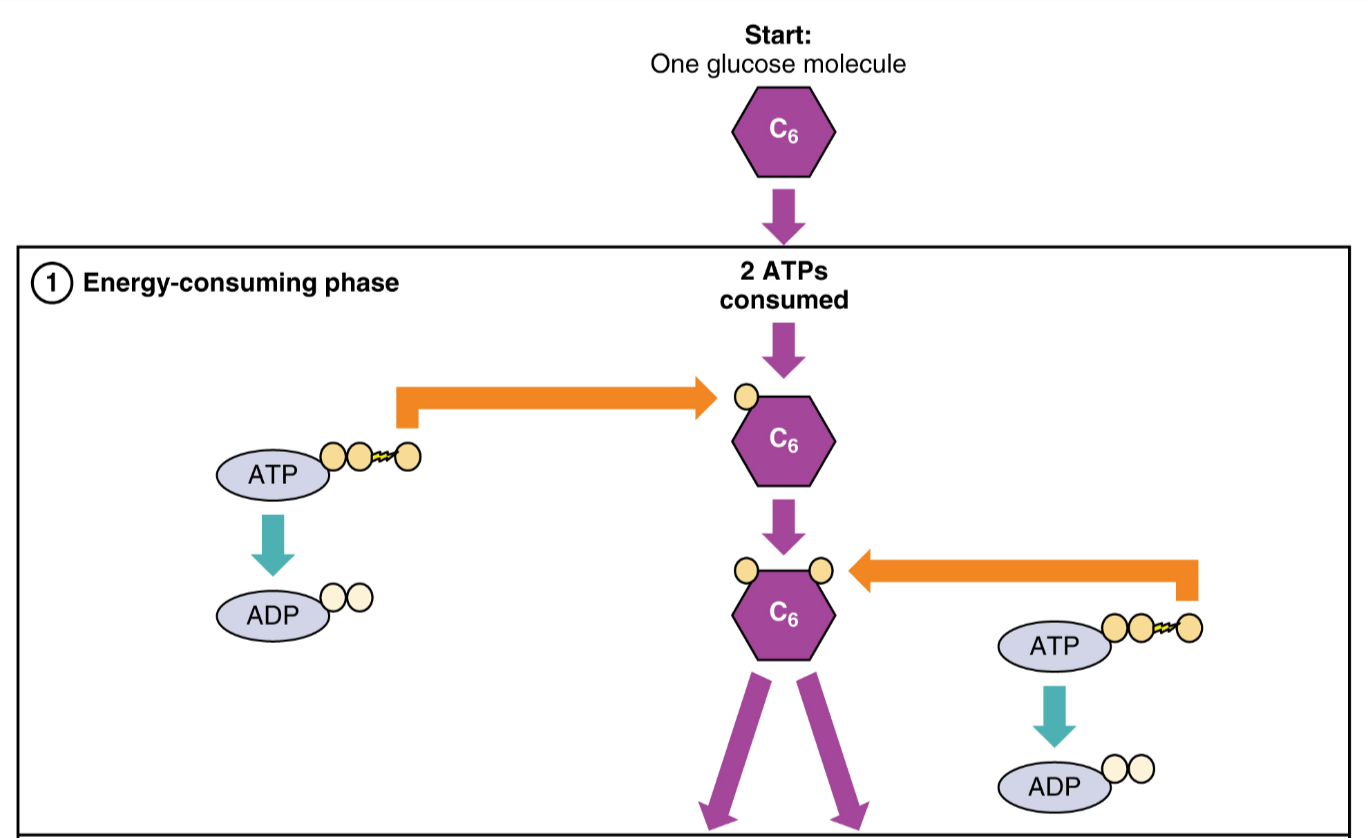
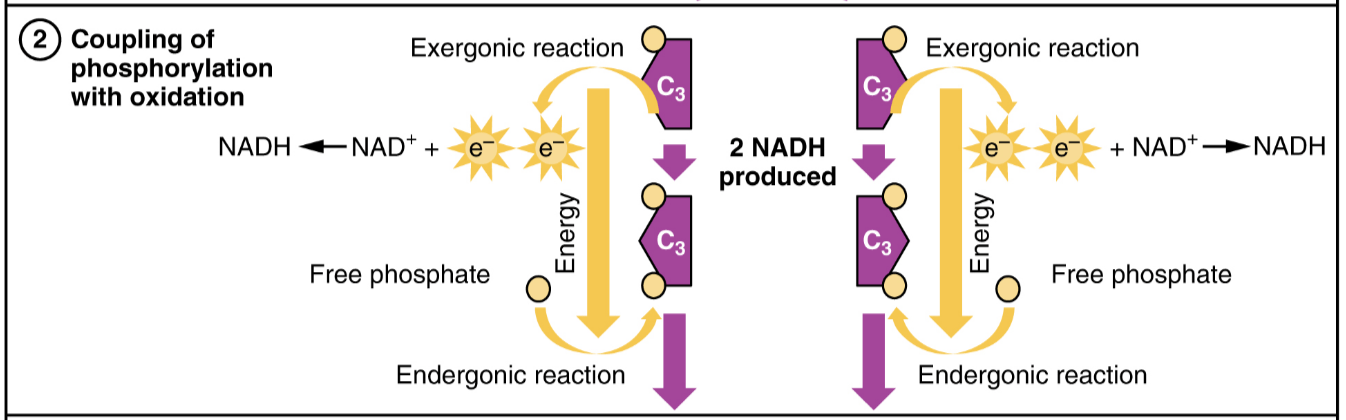
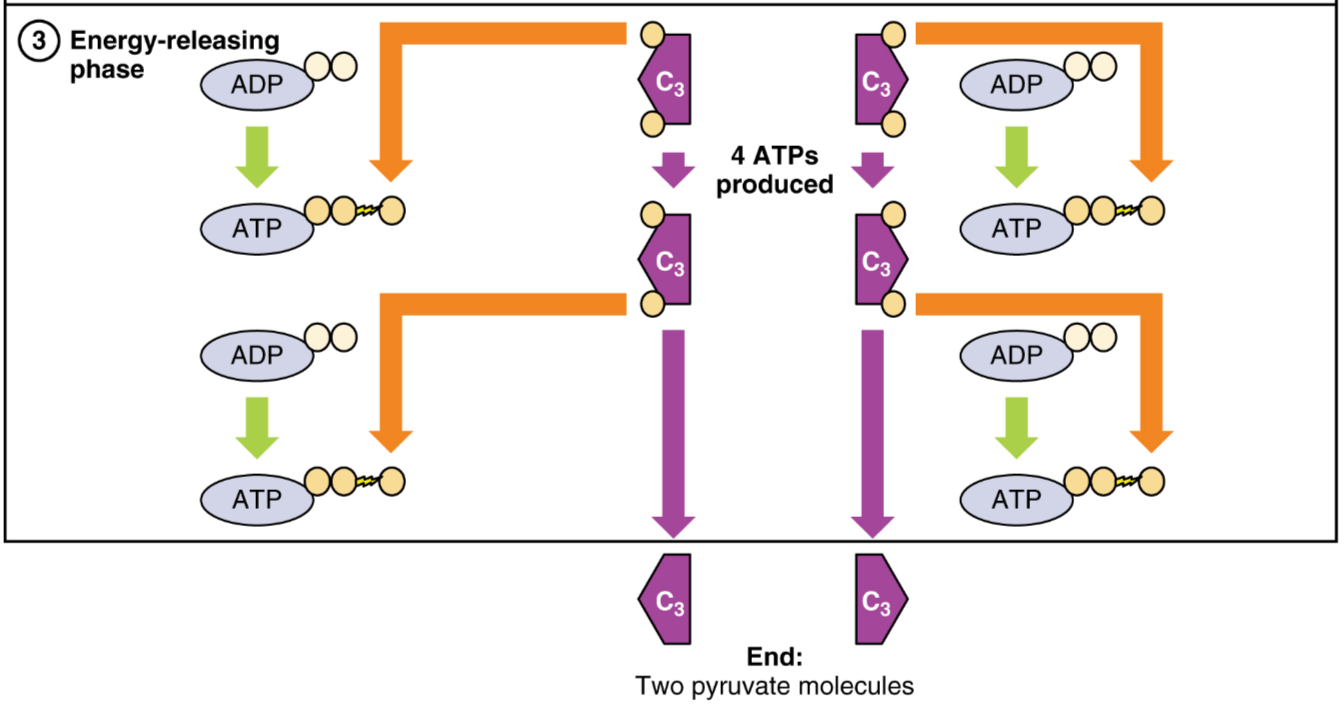
Glycolysis is the first step in cellular respiration. One molecule of glucose is broken down into two pyruvic acid molecules, releasing ATP and NADH. Remember that ATP and NADH are sources of energy for the cell.

Flowchart of the steps in glycolysis

Image source: By OpenStax College CC BY 3.0, via Wikimedia Commons

This process takes place in the cytoplasm of a cell. The rearrangement of the bonds within ATP, NADH, and the original glucose molecule releases energy that the cell can harvest.

Glycolysis literally means "splitting sugars". The prefix glyco- means sugar, while the suffix -lysis means to dissolve, split, or decompose. (Remember lysosomes?) The breaking down of glucose to harvest chemical energy (ATP) is a process known as catabolism. These steps do not require any oxygen, so it is an anaerobic process. Anaerobic means "without air", while aerobic means "with air".

Glycolysis is a/an woah‾\underline{\phantom{woah}} process.

Select all correct options.

Choose all correct answers

Video

(Video) Glycolysis Rap

by sciencemusicvideos

Glycolysis is an anaerobic process that takes place in the cytoplasm.

Overall, it takes a sugar molecule, called glucose and breaks it down into 2 pyruvate molecules, NADH, and 4 ATP (a net yield of 2 ATP).

Remember the steps with Mr. W's rap music video!

There are three main parts:

Investment:

In this part, 2 ATP molecules are needed to get the reactions of the pathway going.

Cleavage:

During this part, glucose (a 6-carbon sugar) is split into two 3-carbon molecules called pyruvate.

Harvest:

This is where the reactions produce 4 ATP. Since we originally needed an investment of 2 ATP, the total yield (or net) value is actually only 2 ATP.

Type a concept, like “slope” or “photosynthesis”.

↑ ↓ to choose · Enter to openSearch explanations and problems