
Illustrated · 2 min
Quoted from cut-the-knot.org (which quotes from The Princeton Companion to Mathematics):
In the course of an examination of friendship between children some fifty years ago, the Hungarian sociologist Sandor Szalai observed that among any group of about twenty children he checked he could always find four children any two of whom were friends, or else four children no two of whom were friends. Despite the temptation to try to draw sociological conclusions, Szalai realized that this might well be a mathematical phenomenon rather than sociological one. Indeed, a brief discussion with the mathematicians Erdös, Turán, and Sós convinced him this was the case.
Graph theory is the study of not graphs of functions (which you are probably familiar with), but rather a different kind of "graph", consisting of so-called "vertices" representing a bunch of people/things (such as children in a classroom), and so-called "edges" representing whether the people/things are related in a given way.
For example, given a "classroom of around twenty children", you could look at the "graph of friendship" where we draw an edge whenever two people are friends.
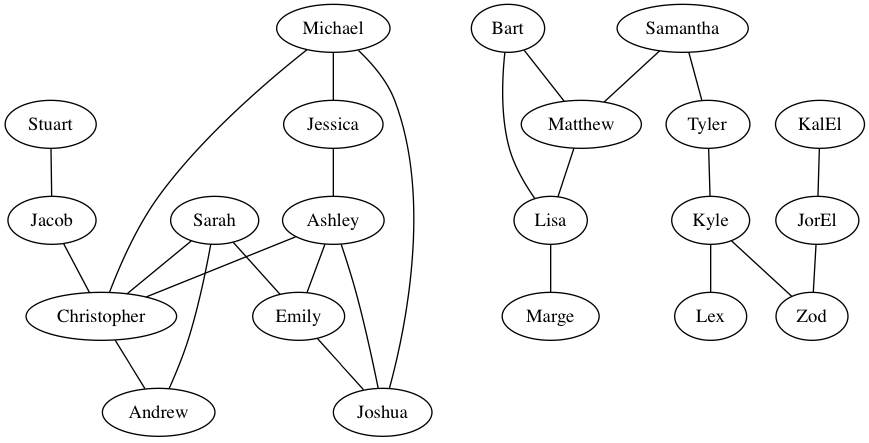
In the "graph of friendship", we assumed friendship is mutual, so---for example---Stuart and Jacob both see each other as friends, but neither Jacob nor Sarah sees the other as a friend. So the "graph of friendship" is what we call an "un-directed graph".
You could also think about so-called "directed graphs", which are graphs where we also care about the directions of the edges: which way the relations point. Some relations in life indeed go one direction. For example, maybe you're learning about definitions of lines, angles, and circles...
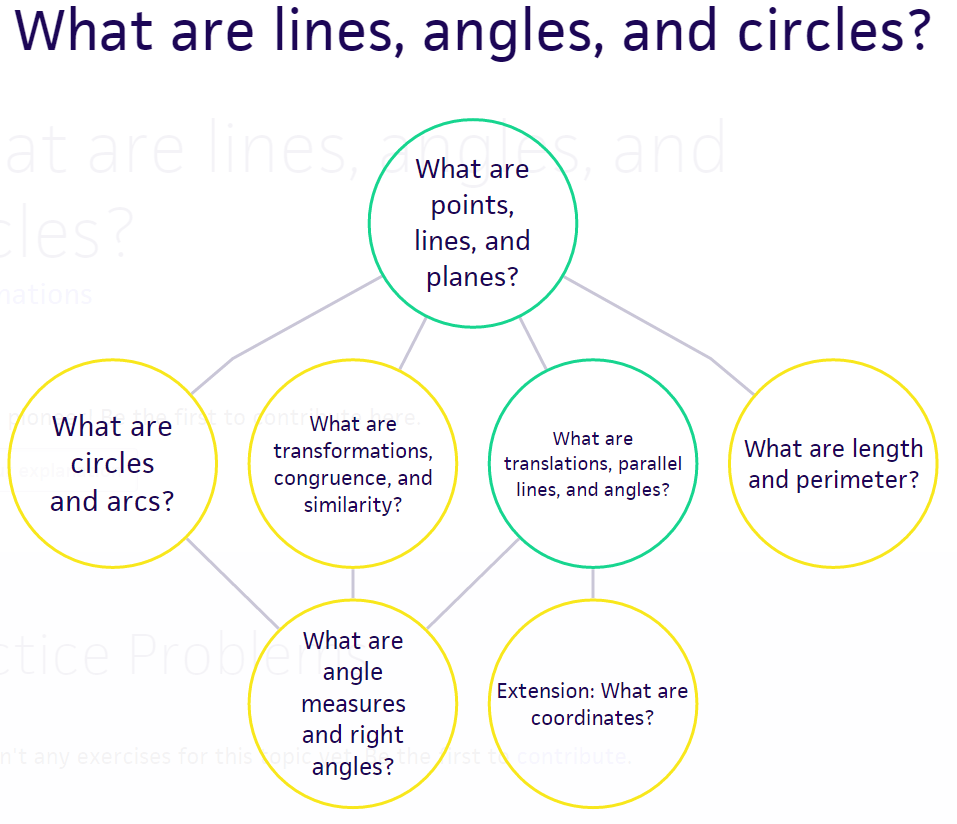
This is a "directed graph of pre-requisite relations": you might want to know what points and lines are before learning what length and perimeter are, for instance, but you definitely don't need to know what length and perimeter are before learning about points and lines!