(Video) Writing the Equation of a Hyperbola Given Foci
by Brian McLogan
In this video by Brian McLogan, you will learn to write the equation of a hyperbola using foci.
Summary
You are given the following data:
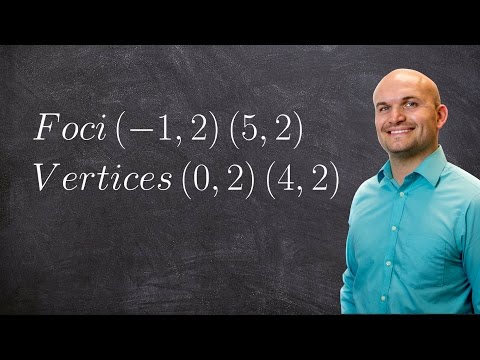
Foci at (−1,2) and (5,2) and vertices at (0,2) and (4,2). Plotting these points will tell you that all the foci and vertices lie on a horizontal line. Therefore, the transverse axis is horizontal.
We know that the standard form equation looks like:
a2(x−h)2−b2(y−k)2=1
From here, follow along with the video to find the center, a, and c, which will help you map to the standard form.
We’ve learned that a hyperbola is formed when a plane cuts through a double cone.
A hyperbola has two special points called foci (the plural of focus). For any point on the hyperbola, the absolute value of the difference of the distances to the two foci is always the same.
This special rule helps define the shape of a hyperbola.
Because of this property, we can describe a hyperbola using its foci and even construct it geometrically.
We will need to know the foci, (F1 and F2) and the distance between them (2c). The coordinates of the foci can be called F1(x1,y1) and F2(x2,y2).
We will also need to know the center of the hyperbola. We know that the hyperbola is the midpoint of the segment connecting the foci. Therefore, we can use the midpoint formula:
center=(2x1+x2,2y1+y2)
In the previous lesson, we learned extensively about the foci. We know that the formula for the distance between foci is 2c:
c=2distance between foci
Now, we will pick an arbitrary point on the hyperbola, P, with coordinates (x,y). We can apply the locus definition. The locus says that the distance from point P to each focus should differ by a constant. We can express this as:
∣PF1∣−∣PF2∣=2a
, where a is the distance from the center to each vertex of the hyperbola.
With all this information, we can now using the distance formula.
∣PF1∣=(x−x1)2+(y−y1)2∣PF2∣=(x−x2)2+(y−y2)2
If we plug in this information,
(x−x1)2+(y−y1)2−(x−x2)2+(y−y2)2=2a
You can use your algebra training to simplify this complicated equation, but it's easier to do when you have numbers.
In the Real World
Hyperbolas appear in the real world in many surprising ways. Some types of radio and GPS signals use hyperbolas to help find locations based on distances from two points. Certain telescopes use hyperbolic mirrors to focus light clearly. In architecture, cooling towers at power plants are shaped like hyperbolas because the shape is strong and stable. Hyperbolas also appear in physics when studying the paths of objects that move very fast or escape gravity.
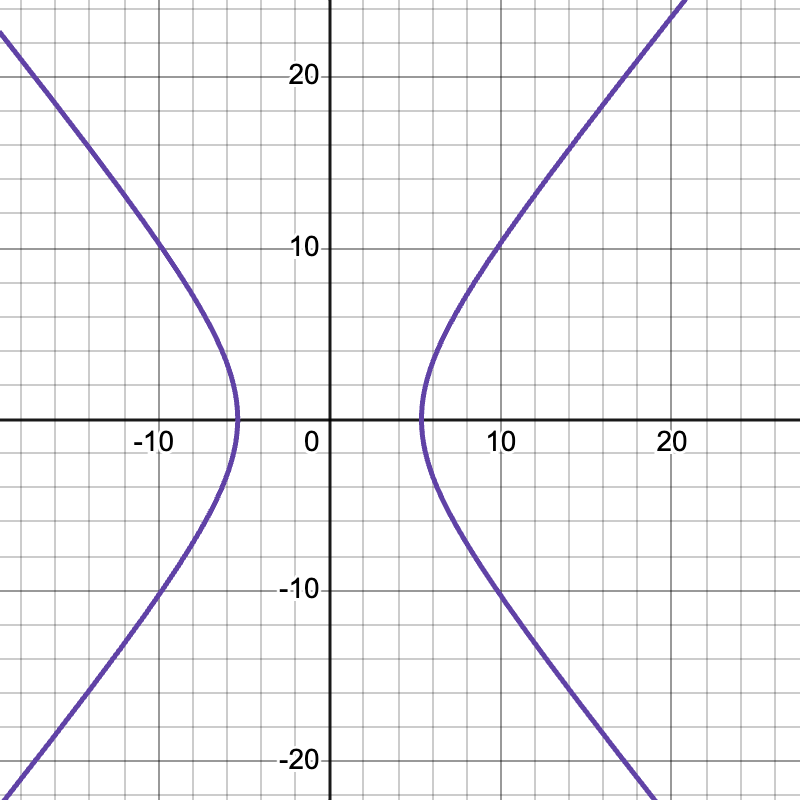
Given the foci F1(−3,0) and F2(3,0) of a hyperbola, the distance between them being 6, and the distance from the center to each vertex is a=5. Graph the hyperbola.
This is not enough information to be able to graph the hyperbola! We will need to use some math techniques to graph the hyperbola.
We know:
Coordinates of F1: (−3,0)
Coordinates of F2: (3,0)
Distance between F1 and F2: 2c=6→c=3
###Center
The center of the hyperbola is the midpoint of the segment connecting the foci. Using the midpoint formula:
center=(2−3+3,20+0)=(0,0)
###Locus
Using the locus definition of a hyperbola, we know that:
∣PF1∣−∣PF2∣=2a
We can substitute the coordinates of the foci and the distance from the center to the vertices:
(x+3)2+y2−(x−3)2+y2=2×5
###Simplify and Solve
We can simplify this equation:
((x+3)2+y2)−2(x+3)2+y2(x−3)2+y2+((x−3)2+y2)=100
After much more algebraic manipulation, we find that the equation of the hyperbola is:
28.81x2−42.9836y2=1