
Graph Hyperbolas from Standard Form

Before this, knowCharacteristics of a Hyperbola

Read · 1 min

Graphing Hyperbolas

The standard form equation of a hyperbola centered at the origin is:

x2a2−y2b2 OR y2b2−x2a2\frac{x^2}{a^2} - \frac{y^2}{b^2} \text{ OR } \frac{y^2}{b^2} - \frac{x^2}{a^2}

, where aa and bb are positive constants. The hyperbola has a vertical transverse axis if a>ba>b and a horizontal transverse axis if b>ab>a.

To graph a hyperbola from its equation in standard form, first you want to identify the center. We've already learned that the center of a hyperbola is at (h,k)(h,k), where hh is the constant that is subtracted from xx. kk is the constant that is subtracted from yy.

Next, you want to determine the transverse axis. If a>ba>b, the transverse axis is along the xx-axis, and if b>ab>a, the transverse axis is along the yy-axis.

Then, you want to find the vertices. The vertices of the hyperbola are located at (h±a,k)(h \pm a, k) if the transverse axis is horizontal, or (h,k±a)(h,k\pm a) if the transverse axis is vertical.

Next, you can find the foci. The foci of the hyperbola are located at (h±c,k)(h \pm c,k) if the transverse axis is horizontal, or (h,k±c)(h,k\pm c) if the transverse axis is vertical, where cc is calculated using the equation c2=a2+b2c^2 = a^2 + b^2.

Lastly, determine the asymptotes! The asymptotes are lines that the hyperbola approaches as x or y tends to positive or negative infinity. The slopes of the asymptotes are ±ba\pm \frac{b}{a} if the transverse axis is horizontal, or ±ab\pm \frac{a}{b} if the transverse axis is vertical. The asymptotes pass through the center of the hyperbola.

With all this given information, you can now plot the points and sketch the hyperbola!

Remember that the shape of the hyperbola is determined by the difference in the squares of xx and yy, which is why one term is subtracted from the other in the standard form equation. The larger denominator will determine the direction of opening of the hyperbola.

Video

(Video) Graph Hyperbolas from Standard Form

by Anusha Rahman

In this video by Anusha Rahman, you will learn how to graph a hyperbola from a standard equation.

Summary

We know that a hyperbola is a type of conic section, which is the curve formed from the intersection of a plane and a double cone. It looks like two mirrored, curved lines that are symmetrical across two perpendicular lines, called the axes. We have vertical hyperbolas and horizontal hyperbolas.

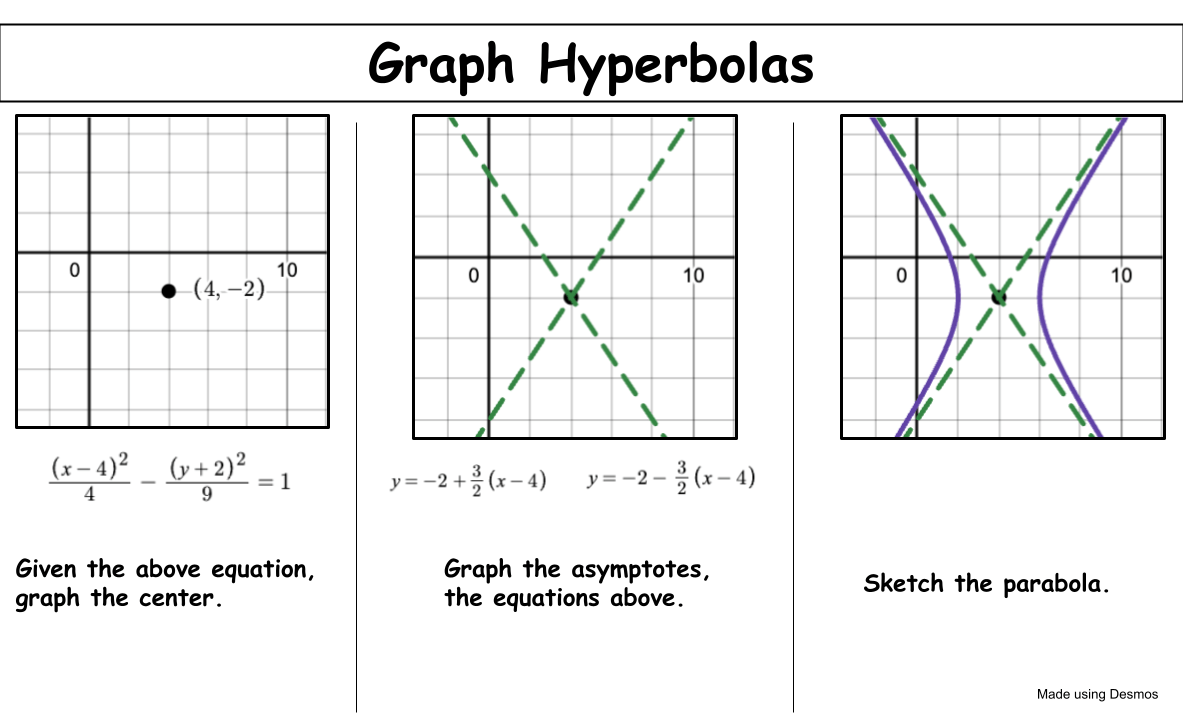
Looking at the first example, which we can see is translated from the origin. Graphing a hyperbola involves plotting the center point and then using the values of aa and bb to determine the vertices, foci, asymptotes, and the general shape of the hyperbola.

Steps:

  1. Identify the center

  2. Determine the vertices

  3. Draw the asymptotoes

  4. Sketch the shape of the hyperbola

Illustrated · 1 min

Graph Hyperbolas from Standard Form

We've extensively covered the hyperbola - understanding that it has two branches that open away from each other.

For a horizontal hyperbola:

(x−h)2a2−(y−k)2b2=1\frac{(x - h)^2}{a^2} - \frac{(y - k)^2}{b^2} = 1

For a vertical hyperbola:

(y−k)2b2−(x−h)2a2=1\frac{(y - k)^2}{b^2} - \frac{(x - h)^2}{a^2} = 1

In both forms, (h,k)(h,k) is the center of the hyperbola.

These depend on whether the transverse axis is parallel to the xx-axis or yy-axis. A vertical hyperbola uses the second form of the equation, and its asymptotes of the hyperbola are straight lines passing through the center.

Graph hyperbolas

Made using Desmos

From the center, use aa to go left/right or up/down along the transverse axis, depending on which variable comes first. This gives you the vertices - the points where the branches begin. We can use bb to move perpendicular to the transverse axis. This forms a rectangle, which helps you to sketch the shape. Draw diagonals through the rectangles, the asymptotes.

When a hyperbola is centered at (0,0)(0,0), the equations of the asymptotes are the following:

y=±abx OR y=±baxy=\pm \frac{a}{b}x \text{ OR } y=\pm \frac{b}{a}x

If the hyperbola is not centered at the origin, everything is centered around (h,k)(h,k) instead of (0,0)(0,0). The asymptotes pass through the new center and are written using the following formula:

y−k=±ab(x−h)y-k = \pm \frac{a}{b}(x-h)

You can then sketch the branches of the hyperbola. They curve away from each other and get closer to the asymptotes but never touch them. The branches open left/right if xx is first and up/down if yy is first in the equation.

Once you've practiced this topic a bit more, you can move into hyperbola transformations.

Type a concept, like “slope” or “photosynthesis”.

↑ ↓ to choose · Enter to openSearch explanations and problems