Video
By Alex Federspiel

+1 contributors
Contributors

(Video) Reciprocal Functions
by Textbook Tactics
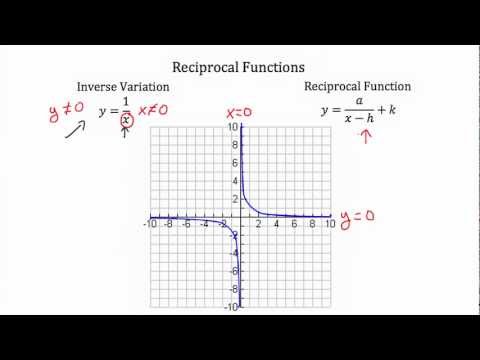
Here's a video by Textbook Tactics explaining the reciprocal function.

Video
by Textbook Tactics
Here's a video by Textbook Tactics explaining the reciprocal function.
Illustrated · 1 min
Reciprocal functions are functions that are the multiplicative inverse of a function. We can mathematically demonstrate a reciprocal function by saying that the reciprocal of the function is: . The reciprocal of a function is not the same as the inverse of a function. A function inverse is the reflection over the line . To find the inverse of a function, you flip all of the and values.
For any given function, , the general form of the reciprocal function allowing for transformations is,
with the following key characteristics:
Vertical asymptote at:
Horizontal asymptote at:
The denominator of a reciprocal function cannot be
Domain is all real numbers, except
Let's look at a couple of examples.
First, we'll look at the classic, . The reciprocal of this function is . The following graphs demonstrate the original function and the reciprocal function.

Made using Desmos
The purple graph on the left is the function . Its reciprocal function, is in green on the right. You'll notice that the green function does not touch the -axis. This graph gets closer and closer to the -axis, but never reaches it. The horizontal and vertical asymptotes of the green function are the axes.
Illustrated · 1 min
Reciprocal functions are the multiplicative inverse of a function!

Image source: by Anusha Rahman
If we want to look for the reciprocal of a function, we can use the following formula,
, where considers a horizontal translation, considers a vertical translation, and considers a dilation (stretch or compression).
Rational functions can have discontinuities where the function is not defined.