Grow and Develop — Characteristics of Life

Illustrated · 1 min

What Is Development?

Living things share seven important features: they undergo growth and development, reproduce, respond to their environments, are made of cells, maintain homeostasis, inherit traits, and have a metabolism.

Image source: By Chris Packard (modified by expii) CC BY-SA 4.0, via Wikimedia Commons

All living things grow during their lifetime, whether it is an increase in size or a change in shape. Unicellular organisms usually just increase in size throughout their lives. There is little change in their features.

Multicellular organisms typically undergo a process known as development.
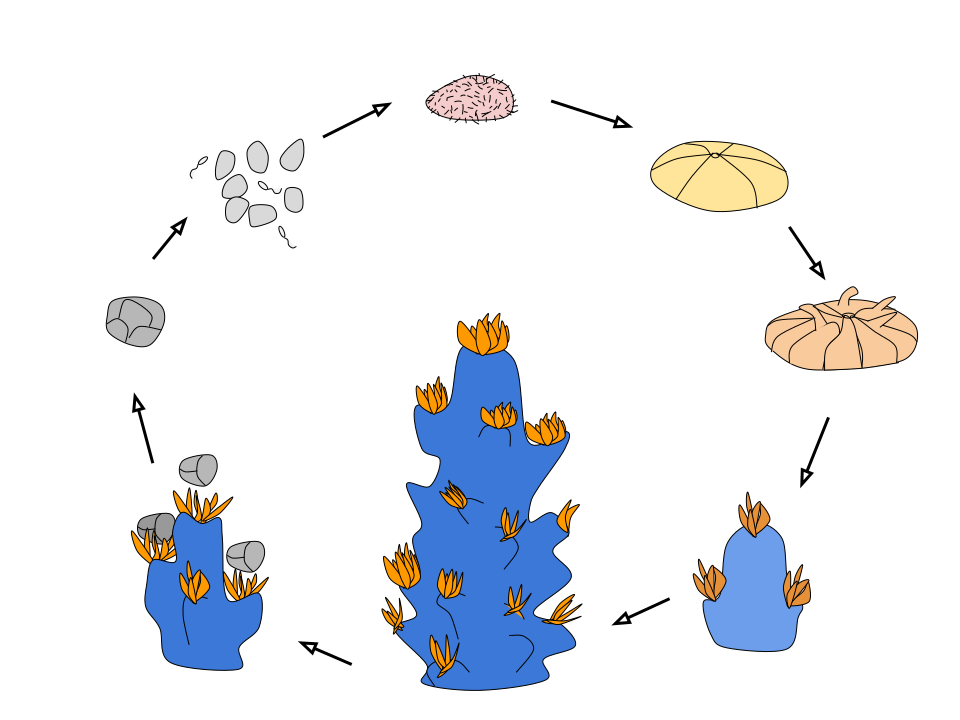
Life Cycle

Image source: By Andcelano CC BY-SA 4.0, via Wikimedia Commons

Development is a more complicated process than just getting bigger. A fertilized egg divides over and over, eventually becoming an embryo. During this period, a variety of specialized cells are formed such as brain cells and liver cells. The embryo gradually grows and matures until it reaches adulthood. This can be a slow change or can happen quite rapidly.

Tadpoles grow and develop into adult frogs.

Image source: By Arthur Bartholemew [Public domain], via Wikimedia Commons

Frogs have to deal with a lot of development. They change from tadpoles into adult frogs. Humans develop from babies that can't even crawl to adults that can climb mountains.
Vocabulary Review:\color{#8925AE}{\text{Vocabulary Review:}}

Cell\color{#8925AE}{\text{Cell}} : Smallest unit of life

Development\color{#8925AE}{\text{Development}} : How organisms grow and mature through cell division

Illustrated · 1 min

What Is Growth and Development?

Something must grow and develop in order to be considered a living thing (an organism).

In our everyday lives, we tend to use the terms "grow" and "develop" interchangeably. But the truth is that they have different meanings. This difference becomes particularly important in biology.

Let's take a look:

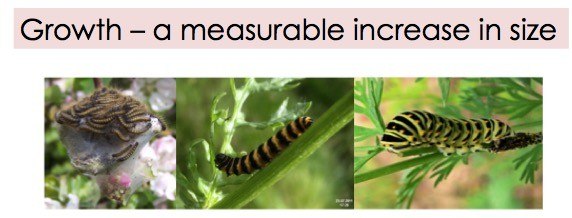
Growth is a measurable increase in size.

Image source: By CrackerjackWannabe [Public domain], via Wikimedia Commons \\ Image source: By Jensbn~commonswiki assumed (based on copyright claims) CC BY-SA 3.0, via Wikimedia Commons \\ Image source: By unknown author CC0, via pxhere.com

In the picture above, we can see that the caterpillar has grown. It has physically increased in size.

Often, growth of a multicellular organism occurs as more cells are created. In unicellular organisms (like bacteria), growth still occurs. The single cell increases in size.

Development is a transformation in structure, like a caterpillar becoming a butterfly.

Image source: By Nick Hobgood CC BY-SA 3.0, via Wikimedia Commons

Development is a little different. Whereas an example of growth is a little caterpillar growing into a big caterpillar, an example of development is a caterpillar transforming into a chrysalis (in the cocoon) and then into a butterfly.

Development requires a transformation in structures. This pretty much always requires changes in cells, like a loss or gain of cells. For this reason, most biologists will tell you that development only occurs in multicellular organisms, not in unicellular ones.

Key Vocabulary:

  1. Grow
  2. Develop
  3. Organism
  4. Multicellular

Video

(Video) Growth, Development, and Reproduction

by SJOwens Science

This video uses the life cycle of an oak tree to illustrate the growth and development that defines living things.

Illustrated · 1 min

Summary of Growth and Development

All living organisms must undergo some form of growth and development at a point in their life cycle.

Frogs develop and grow from eggs, which grow into tadpoles and then into adult frogs.

Life cycle of a frog

Image source: By LadyofHats CC0, via Wikimedia Commons

Growth and development are not the exact same thing. Development is more complex than growth. When organisms develop, they might change shape and their cells might change to become all different types of cells.

Multicellular vs. Unicellular Organisms

  • Growth and development is much easier to see in multicellular organisms, which have very complex life cycles and go through many stages of cell development.
  • Multicellular organisms also experience differentiation during development. This is when groups of cells become unique and perform different functions.
  • Single-celled organisms grow slightly right before reproduction. Many of them are able to grow different structures in order to respond to things that are happening around them. For example, E. coli will grow an appendage in order to transfer genetic material to other E. coli bacteria.
Organisms grow and develop. Growth is simpler than development. Development is a change in shape and function.

Image source: By Valeri Natole

Type a concept, like “slope” or “photosynthesis”.

↑ ↓ to choose · Enter to openSearch explanations and problems


