
Illustrated · 3 min
Heat Capacity of Water
What is Heat Capacity?
-
Heat capacity is the amount of heat required to raise the temperature of an object by one unit.
-
The specific heat capacity is the heat required to raise one gram of a substance by one temperature unit.
- To calculate the specific heat capacity, use the formula: .
- is the specific heat capacity.
- is the total heat energy.
- is the mass.
- ΔT is the change in temperature.
- A negative temperature change means the process is exothermic. A positive temperature change means its endothermic.
- When do we use specific heat capacity?
- The specific heat capacity calculation is most commonly used in calorimetry experiments. A calorimeter is an instrument that measures the enthalpy change of a combustion reaction.
- We also use it for phase changes. See our lessons on heating and cooling curves and the phase change diagram of water for more information.
- What does a high/low heat capacity mean?
- A high heat capacity means that the substance requires lots of heat in order to raise or lower the temperature by one unit. Having a high heat capacity means that the substance also retains heat better than substances with lower heat capacities.
- A low heat capacity means that the substance does not require a lot of heat in order to raise/lower the temperature by 1°C. A low heat capacity means that the substance does not retain heat as well as substances with a higher heat capacity.
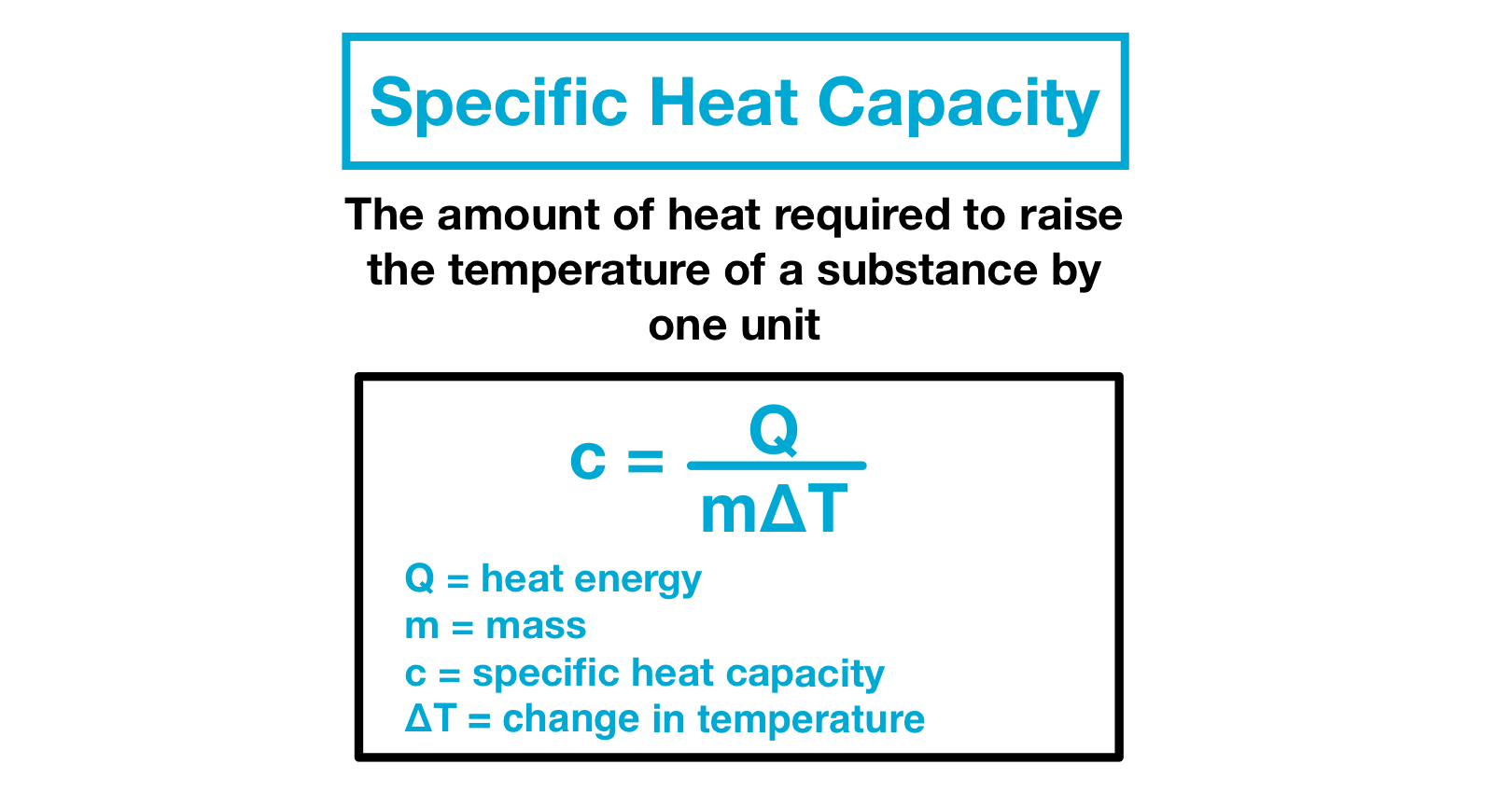
Image source: Caroline Monahan
Heat Capacity of Water
-
The specific heat capacity of water is , , or 1 calorie (cal).
-
Water has a very high heat capacity compared to other substances. So, it takes more energy to raise the temperature of water by 1 degree than other substances. This also means that water will retain heat better than other substances.
- If you left 100°C water and 100°C Iron out for 5 minutes, the iron would have lost more heat than water would. So, the iron would be cooler than the water because water retains heat better.
- Why does water have such a high heat capacity?
- There is a huge electronegativity difference between the oxygen and hydrogen atoms. So, the oxygen atom pulls the electron density towards it.
- The polarity in conjunction with its bent molecular geometry creates a permanent dipole.
- Water's hydrogen bonding means there are more electrostatic interactions between its molecules compared to other liquids. So, water can absorb more energy before vaporizing. That's why it's often used as a coolant. For example, when we study nuclear chemistry, we'll see that it's used as a coolant in nuclear power plants.
- Why is this important?
- The heat capacity of water is actually very important. The heat capacity of water plays a role in our climate, and it's the reason why many places are habitable.
- Because it takes a lot of energy to gain/lose temperature, it makes water habitable because it does not constantly fluctuate in temperatures. This allows marine life to live in the ocean!
- Also humans are composed of about 70% water, and this is also a reason why our own body temperatures do not fluctuate that much!



