Heredity (Genetic Code) — Characteristics of Life

Illustrated · 1 min

What Is the "Universal Genetic Code"?

All living things possess genetic information that they can pass on to their offspring.

In fact, every living thing keeps its genetic information in DNA (deoxyribonucleic acid) or RNA (ribonucleic acid).

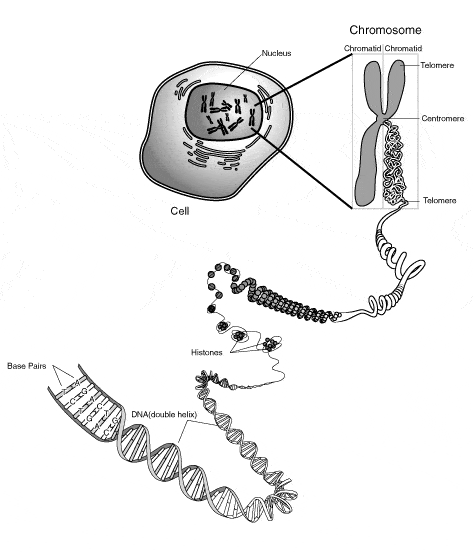
DNA and RNA are the universal genetic code for life.

Image source: By Sponk CC BY-SA 3.0, via Wikimedia Commons

This is why we call DNA and RNA the universal genetic code. Literally every organism on Earth has their genetic code written in this same "language". That's why scientists can take the genetic material from one animal and put it into another animal in genetic engineering.

This shared genetic code supports the idea that all organisms evolved from a common ancestor a really long time ago.

A flower, bacteria, mushrooms, a woman, a hippo, a trilobite, a fish, and a beetle are shown.

Despite how different all of these organisms look, they all have their genetic information written in the same language (DNA/RNA). Humans have DNA, fish have DNA, hippos have DNA, mushrooms have DNA... Pretty cool when you think about it.

Image source: By Mario Janakis

Inherited Traits

You know how people say, "I got my eyes from my dad" or "I got my curly hair from my grandmother"? They're talking about inherited traits. Things that get passed from parents to offspring in DNA are inherited. Inherited traits can also be called hereditary.

Recall that in organisms that use asexual reproduction, offspring are clones of their parents. They inherit DNA that is identical to their parent's.

On the other hand, in organisms that use sexual reproduction, offspring inherit a combination of their parents' DNA.

Key Vocabulary:

  1. Offspring
  2. DNA/RNA
  3. Universal genetic code
  4. Hereditary

Video

(Video) DNA Spells Evolution

by NOVA PBS Official

Are all living things related? The answer is yes, and the evidence is DNA. This video explains how passing down DNA from generation to generation led to the multitude of species we have today.

Interactive · 1 question

Heritable Traits

Living things share seven important features: they undergo growth and development, reproduce, respond to their environments, are made of cells, maintain homeostasis, inherit traits, and have a metabolism.

Image source: By Chris Packard (modified by expii) CC BY-SA 4.0, via Wikimedia Commons

Heredity is the passing of characteristics from one generation to another.

Organisms that reproduce through asexual methods end up having the same genetic features as their parents. They are pretty much clones of their parent. However, living things that reproduce through sexual methods get half of their DNA from each parent.

Two corgis reproduce and create a puppy.

Image source: By Małgorzata Miłaszewska CC BY-SA 3.0, via Wikimedia Commons \\ Image source: By Damon D'Amato CC BY 2.0, via Wikimedia Commons \\ Image source: By Michel van der Vegt CC0, via pixabay.com

What is heredity?

Choose one answer

Illustrated · 1 min

Summary of Heredity

All living organisms must be able to reproduce and pass information to their offspring through genes.

  • Genes are composed of deoxyribonucleic acid (DNA) and provide the information for the production of a new organism. This genetic makeup leads to observable traits.

  • All living things share the same universal genetic code: DNA.

  • The passing of genes to offspring causes the offspring to have traits similar to those of the parents. This is what causes children to look like their parents.

A silhouette of a family of five.

Image source: By Gordon Johnson CC0, via pixabay.com

Scientists Who Observed Heredity

There are a few very important scientists who made use of this concept to explain how different traits get passed down and how evolution occurs.

Illustrated · 1 min

Why Is DNA Considered the Universal Genetic Code?

DNA is considered a universal genetic code because every known living organism made of cells has genes consisting of DNA. Bacteria, fungi, cats, plants, and you: every organism uses DNA to store genetic information.

What Is DNA?

Just like how computers use 0's and 1's to code information that can become as complex as a video game, DNA is a simple system with four bases that can create very complicated products. The main four bases of DNA are adenine, tyrosine, cytosine, and guanine. You often see the bases referred to by their first letters: A, T, C, and G, respectively.

Every living organism uses a system where DNA is transcribed into RNA and then is translated into a protein product. Basically, every three pieces of DNA become one amino acid. The amino acid it becomes depends upon that three-letter sequence. Pretty much every organism uses the same translation system of DNA sequences to order amino acid chains. The exception is some bacteria, which have a few unique amino acids.

The image shows an amino acid codon chart with corresponding RNA sequences.

This table shows the relationships between strings of DNA bases and amino acids. \\ Image source: By Mouagip [Public domain], via Wikimedia Commons

Since every living organism uses this system, it is considered to be a universal genetic code. And because all cells come from parent cells, cells are able to inherit DNA from their parent cells. This process is known as heredity. For example, if a dog has a thick fur coat and it has puppies that also have thick fur coats, then you know those puppies inherited DNA that coded for that type of fur.

Type a concept, like “slope” or “photosynthesis”.

↑ ↓ to choose · Enter to openSearch explanations and problems