Heterotroph — Definition & Examples

Illustrated · 1 min

What Are Heterotrophs?

Like we talked about with autotrophs, the word heterotroph comes from Greek.

Take a look at how each part of the word translates:

"Hetero" means other and "troph" means food or feeding. So, heterotroph roughly means "something which gets its food through some other means".

Image source: By Hannah Bonville

So, a heterotroph is an organism that feeds on others. Put less weirdly, these organisms must consume other organisms in order to survive.

For this reason, they are also called consumers. In a food chain or food web, you will see consumers in higher trophic levels than autotrophs, such as plants.

Rabbits, lions, foxes, snails, and dogs. These are all heterotrophs, which are also called consumers.

All heterotrophs here. Notice the lack of green. Remember that green things from the ground are autotrophs.

Image source: By Olga1969 CC BY 4.0, via Wikimedia Commons \\ Image source: By user:Robek, repositioned by user:Wulfstan CC BY-SA 3.0, via Wikimedia Commons \\ Image source: By Umberto Salvagnin CC BY 2.0, via Wikimedia Commons \\ Image source: By Virginia State Parks staff CC BY 2.0, via Wikimedia Commons \\ Image source: By Charles Lam from Hong Kong, China CC BY-SA 2.0, via Wikimedia Commons \\ Image source: By pfly CC BY-SA 2.0, via Wikimedia Commons \\ Image source: By Pacman [Public domain], via Wikimedia Commons \\ Image source: By Gilbert Stuart [Public domain], via Wikimedia Commons

How Do They Get Energy?

Heterotrophs get energy by consuming other organisms.

Don't be fooled into thinking that this means they all have big teeth. All animals fit into this category. This includes things like butterflies, sea anemones, beetles, giraffes, and humans. If it eats, it's a heterotroph.

We break these organisms up into three different groups based on what they eat:
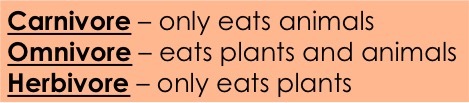
Carnivores eat only animals, while omnivores eat both plants and animals. Herbivores eat only plants.

Image source: By Hannah Bonville

There are ways to help remember these:

  • Carne means meat in a bunch of languages. Eating animals = eating meat
  • Omni means "all" in Greek. Omnivores eat everything (that is, "all" things).
  • Think of cooking with herbs. They are green plants. Herbivores eat plants.

Key Vocabulary:

  1. Heterotroph
  2. Consumer
  3. Metabolize
  4. Carnivore
  5. Omnivore
  6. Herbivore

Illustrated · 1 min

Types of Heterotrophs

This image shows types of heterotrophs in two rows. The first row shows a lion carnivore, elephant herbivore, and bear omnivore. The next row shows a raccoon scavenger, mushroom decomposer, and worm detritivore.

Image source: By Sarah Morgan

What Is a Heterotroph?

A heterotroph is a living organism that has to consume organic molecules in order to survive. They get these molecules by eating other living things.

What Types Are There?

  • Carnivores eat the meat of other animals.

  • Herbivores eat plants.

  • Omnivores can eat both meat and plants.

  • Scavengers eat things left behind by carnivores and herbivores. Scavengers can also be omnivores.

  • Decomposers break down dead plant or animal matter into soil.

  • Detritivores eat soil and other very small bits of organic matter.

Illustrated · 1 min

How Organisms Get Energy

Living things share seven important features: they undergo growth and development, reproduce, respond to their environments, are made of cells, maintain homeostasis, inherit traits, and have a metabolism.

Image source: By Chris Packard (modified by expii) CC BY-SA 4.0, via Wikimedia Commons

In order for an organism to be considered alive, it must be able to obtain materials from the environment and use those materials to produce energy in order to carry out cellular functions.

Autotrophs make their own food. They use energy from the sun to make complex organic compounds. They often use photosynthesis to turn sunlight, water, and carbon dioxide into glucose and oxygen.

Heterotrophs obtain their energy by using other organisms as their food source. They use cellular respiration to turn the food they eat into usable energy.

A young boy eats a radish.

A young boy (heterotroph) eating a radish (autotroph) for its energy.

Image source: By Bill Branson (Photographer) [Public domain], via Wikimedia Commons

Vocabulary Review:\color{#8925AE}{\text{Vocabulary Review:}}

Metabolism\color{#8925AE}{\text{Metabolism}} : Using chemical reactions to harvest energy for biological functions

Video

(Video) Heterotrophs vs. Autotrophs

by MooMoo Math and Science

Did you know that not all heterotrophs are the same? This video explains how these organisms fit into the energy exchange in an ecosystem. You'll also learn how they get energy and nutrients from what they eat, and what the different types of heterotrophs like to eat.

Autotrophs, on the other hand, produce their own energy from sunlight. They make organic substances that the heterotrophs later eat.

Learn about both autotrophs and heterotrophs with this video by MooMoo Math and Science.

Type a concept, like “slope” or “photosynthesis”.

↑ ↓ to choose · Enter to openSearch explanations and problems