Illustrated · 1 min
+4 contributors




What Are Heterotrophs?
Like we talked about with autotrophs, the word heterotroph comes from Greek.
Take a look at how each part of the word translates:

Image source: By Hannah Bonville
So, a heterotroph is an organism that feeds on others. Put less weirdly, these organisms must consume other organisms in order to survive.
For this reason, they are also called consumers. In a food chain or food web, you will see consumers in higher trophic levels than autotrophs, such as plants.

All heterotrophs here. Notice the lack of green. Remember that green things from the ground are autotrophs.
Image source: By Olga1969 CC BY 4.0, via Wikimedia Commons Image source: By user:Robek, repositioned by user:Wulfstan CC BY-SA 3.0, via Wikimedia Commons Image source: By Umberto Salvagnin CC BY 2.0, via Wikimedia Commons Image source: By Virginia State Parks staff CC BY 2.0, via Wikimedia Commons Image source: By Charles Lam from Hong Kong, China CC BY-SA 2.0, via Wikimedia Commons Image source: By pfly CC BY-SA 2.0, via Wikimedia Commons Image source: By Pacman [Public domain], via Wikimedia Commons Image source: By Gilbert Stuart [Public domain], via Wikimedia Commons
How Do They Get Energy?
Heterotrophs get energy by consuming other organisms.
Don't be fooled into thinking that this means they all have big teeth. All animals fit into this category. This includes things like butterflies, sea anemones, beetles, giraffes, and humans. If it eats, it's a heterotroph.
We break these organisms up into three different groups based on what they eat:
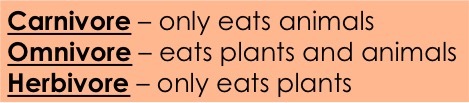
Image source: By Hannah Bonville
There are ways to help remember these:
- Carne means meat in a bunch of languages. Eating animals = eating meat
- Omni means "all" in Greek. Omnivores eat everything (that is, "all" things).
- Think of cooking with herbs. They are green plants. Herbivores eat plants.
Key Vocabulary:
- Heterotroph
- Consumer
- Metabolize
- Carnivore
- Omnivore
- Herbivore