Heterozygous vs. Homozygous — Differences & Similarities

Before this, knowDominant (Genetics) — Alleles, Genes & TraitsRecessive (Genetics) — Alleles, Genes & Traits

Illustrated · 1 min

What Is the Difference Between Homozygous and Heterozygous?

An organism that is homozygous has two copies of the same allele. An allele is one version, like a "flavor", of a gene. Humans and other diploid organisms have two copies of every gene. (By definition, diploid organisms have two copies of each chromosome.)

This is a cartoon illustration showing the difference between homozygous and heterozygous chromosome pairs. The pair of chromosomes on the left is homozygous, meaning they have the same alleles. The pair on the right is heterozygous, meaning they have different alleles.

Image source: By Sylvia Freeman

When learning biology, it's often helpful to break words down to remember definitions better. Homo- means same, while hetero- means different. -zygous means having a certain type of zygote (a specific combination of genetic material).

Homozygous means having two of the same allele.

Heterozygous means having two different alleles.

Illustrated · 1 min

Homozygous vs. Heterozygous

When trying to figure out a genotype, or genetic makeup for a single trait (gene), there are two types of allele combinations possible. The genotype is a fancy way of saying the letters we use to describe traits, like Bb. Capital letters show a dominant allele, while lowercase letters show a recessive allele.

The first type of combination is homozygous, which means there are two copies of the same allele for a trait. The genotype might look like BB for two dominant alleles or bb for recessive alleles.

The other possible combination is heterozygous, which means the genotype contains one of each allele, such as Bb.

Just try to remember that hetero- means different, and homo- means the same.

When alleles are homozygous, they are the same. They are codes for the same trait, found on the same spot on each chromosome. There are two homozygous alleles shown in the picture above, uppercase BB and lowercase bb. There are two heterozygous alleles in the picture too, each having one uppercase and one lowercase B.

Image source: By Darryl Leja, National Human Genome Research Institute [Public domain], via Wikimedia Commons

Vocabulary Review:\color{#8925AE}{\text{Vocabulary Review:}}

Chromosome\color{#8925AE}{\text{Chromosome}} : A chromosome is a long, single, coiled piece of DNA

Trait\color{#8925AE}{\text{Trait}} : A specific characteristic that is different from one individual to another

Gene\color{#8925AE}{\text{Gene}} : A segment of DNA that codes for a specific trait or protein

Allele\color{#8925AE}{\text{Allele}} : Genes of the same type that contain different kinds of information. Alleles can be dominant or recessive

Dominant\color{#8925AE}{\text{Dominant}} : The stronger of two expressed genes

Recessive\color{#8925AE}{\text{Recessive}} : The weaker of two expressed genes. Only shown if a gene is homozygous recessive

Heterozygous\color{#8925AE}{\text{Heterozygous}} : Two different kinds of allele, one dominant and one recessive

Homozygous\color{#8925AE}{\text{Homozygous}} : Two of the same type of allele, both dominant or both recessive

Punnet Square\color{#8925AE}{\text{Punnet Square}} : A method of determining the probabilities of which traits the offspring of two organisms will inherit

Read · 1 min

What Is the Difference Between Heterozygous and Homozygous?

Homo\color{#0CB1B1}{\text{Homo}}- means same; -zygous\color{#FFA400}{\text{zygous}} means having genetic material.

A homozygous individual carries two copies of the same allele.

Hetero\color{#50BF14}{\text{Hetero}}- means different; -zygous\color{#FFA400}{\text{zygous}} means having genetic material.

A heterozygous individual carries two different alleles.

Since an organism usually inherits one of each chromosome from its mother and one from its father, it will have two versions of every chromosome. Each chromosome contains many genes. The different expressions of a gene are called alleles.

For example, you and another person both have a gene for hair. However, you might have different alleles if you have different hair colors. While both genes make hair, different alleles could result in brown, red, blonde, or black hair.

If your parents both have brown hair, then you might inherit brown hair alleles from both of them. Since you would have two of the same brown hair alleles, you would be homozygous for that trait.

If one parent is blonde while the other has brown hair, you might inherit one blonde and one brown hair allele. Since you would have two different alleles, you would be heterozygous for that trait.

What if both parents have brown hair, but you somehow have red hair? This could be caused by being homozygous for a recessive trait.

Illustrated · 1 min

Homozygous or Heterozygous?

Two chromosomes are shown. The two have the same pink gene, which are homozygous. The first chromosome also has an orange gene where the second one has a green gene. Those genes are heterozygous.

Image source: By Gabi Slizewska

The traits we have depend on our genes. More specifically, they depend on our alleles. For each gene, we have two alleles. The combination of alleles you have for a certain trait determines how the trait is expressed.

You might have two identical alleles. This means that each of the two alleles are expressed in the same way, like blue eye color or a large nose. In this case you would be homozygous for the trait.

You might have two different alleles instead. This means that the two alleles are slightly different. For example, both alleles might code for eye color, but one codes for blue and the other codes for brown. In this case you would be heterozygous for the trait.

Illustrated · 2 min

Genotype and Phenotype

An organism has two sets of chromosomes, one from each of its parents. On these chromosomes, there are genes. Genes code for a bunch of different proteins that produce different effects.

An observable effect that a gene produces is called a phenotype. A phenotype is something like hair color or height. The genes that control the phenotype are called the genotype.

The genotype is like the code for a website, and the phenotype is what the website ends up looking like.

Both sets of chromosomes have the same genes, but these genes are not always identical. Alleles are different versions of genes that code for the specific characteristics we have. Alleles can either be dominant or recessive based on their likelihood of being expressed. One example is hair color: everyone has genes that determine what color your hair is, but these genes are slightly different between people, which produces different colors.

The genotype of an organism plus its environment equals the phenotype of the organism.

Image source: By Keith Chan CC BY-SA 4.0, via Wikimedia Commons

What Do Heterozygous and Homozygous Mean?

Because an organism has two sets of chromosomes, it usually only has two options to choose from when determining phenotype. If an organism has identical genes on both chromosomes, it is said to be homozygous. If the organism has two different alleles of the gene it is said to be heterozygous.

Homozygous

When someone is homozygous for a gene it means they have two copies of the same allele. This means that each one of their parents gave them the same allele for a gene. This is usually represented by two letters of the same case (uppercase or lowercase depending on dominance). For example, both BB and bb represent individuals who are homozygous. When an individual is homozygous for a gene, they will display that trait even if the allele is recessive. In the Punnett square below, the parent with the BB genotype and the offspring with the BB genotype are both homozygous.

Heterozygous

When a person is heterozygous for a gene it means that they carry two different alleles for it. This means that each parent gave them a different allele. With heterozygous individuals, they will show the characteristics of the dominant trait. This is why the parent and offspring in the Punnett square below with the genotype Bb have brown eyes instead of blue.

A Punnett Square shows the genotypes of offspring in a genetic cross. You can see here that two offspring are homozygous dominant while two are heterozygous.

Image source: By Purpy Pupple CC BY-SA 3.0, via Wikimedia Commons

Video

(Video) Homozygous vs. Heterozygous Genotype

by MooMoo Math and Science

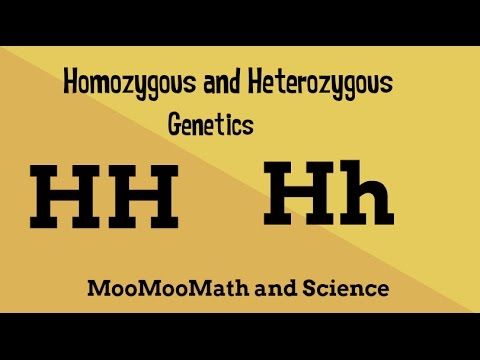
Heterozygous and homozygous in genetics refer to the alleles in a genotype. In this video, MooMoo Math and Science discusses the difference between homozygous and heterozygous by going through a worksheet.

Type a concept, like “slope” or “photosynthesis”.

↑ ↓ to choose · Enter to openSearch explanations and problems