High Specific Heat (Water) — Properties & Examples

Before this, knowWhy Does Water Support Life? — Overview & Examples

Illustrated · 1 min

Why Does Water Resist Heat Changes?

Recall that water is a polar molecule. This means that each water molecule has a positive end and a negative end. Let's take a look:

There are fewer free electrons at the hydrogen end of a water molecule. As a result, this is the positive pole. There are more free electrons at the oxygen end of a water molecule. As a result, this is the negative pole.

Image source: By Hannah Bonville et al.

Hydrogen bonds form between the positive pole of one polar molecule and the negative pole of another. Here's what that looks like with water molecules:
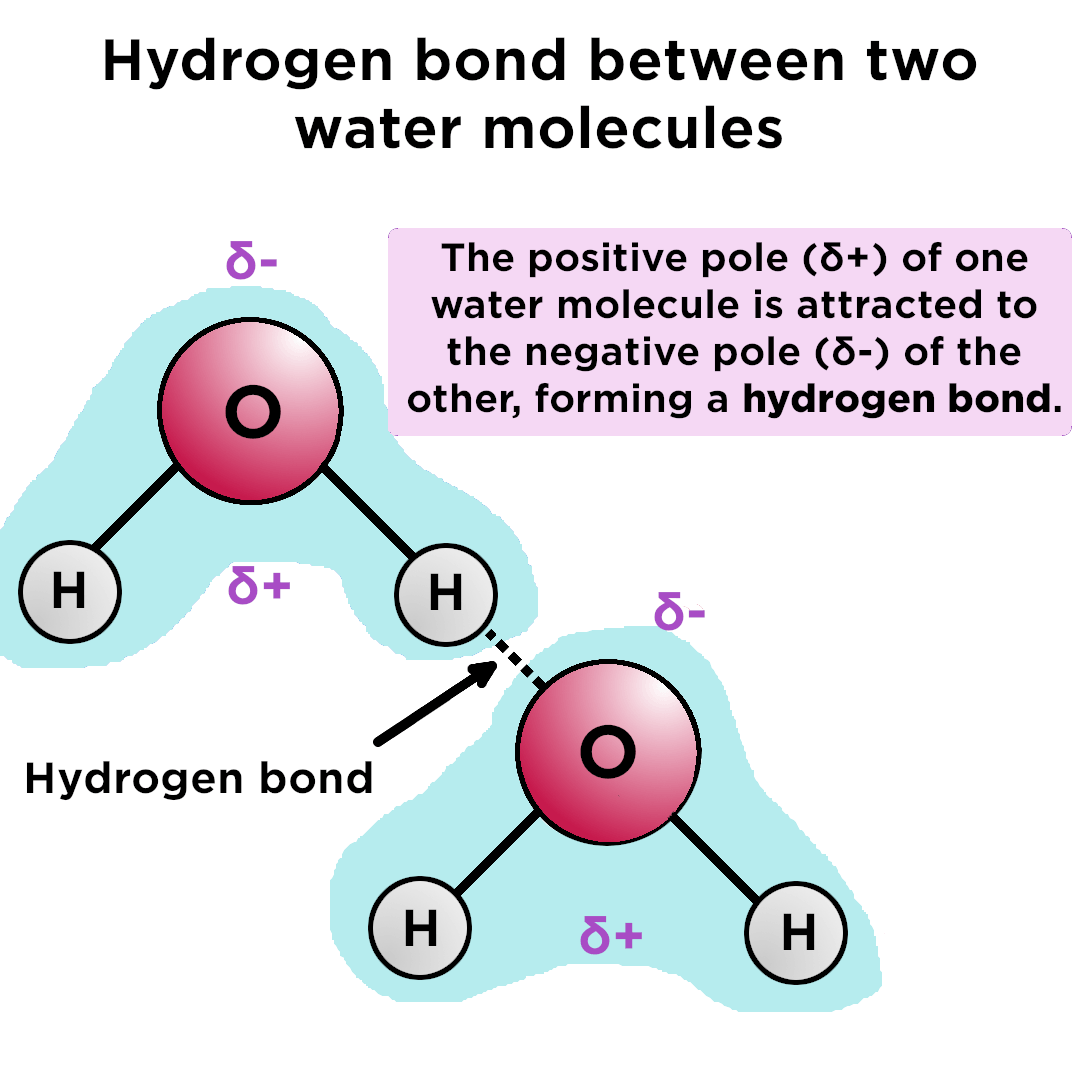
Hydrogen bonds form between the opposite poles of water molecules.

Image source: By Hannah Bonville et al.

In order to go from solid (ice) to liquid water, the molecules need to rearrange themselves. In order to go from liquid water to gas (water vapor), the molecules need to rearrange themselves. See a pattern here?

Any time water changes phase (whether it's solid, liquid, or gas), the hydrogen bonds between molecules need to break so the molecules can rearrange.

Here's where specific heat comes in.

It takes a lot of energy to break hydrogen bonds. This means it takes a lot of energy to rearrange water molecules from one phase to another.

It takes a lot of energy (heat) to rearrange water molecules from ice to liquid water to water vapor.

Moving between phases (for example, turning water from liquid into gas) requires energy to break apart the hydrogen bonds joining the molecules together.

Image source: By Clker-Free-Vector-Images CC0, via pixabay.com \\ Image source: By Clker-Free-Vector-Images CC0, via pixabay.com \\ Image source: By OpenClipart-Vectors CC0, via pixabay.com

From practical experience, water does not experience large temperature changes. It takes the addition of a lot of energy to heat up and the loss of a lot of energy to cool down. This is attributed to water's high specific heat.

Think of a lake. If the water went from 70°F to 40°F over the course of a few days, you'd have a lot of dead fish.

The slow changes in temperature allow organisms to adjust and adapt to the water around them.

Water changes temperature slowly.

Image source: By Kfasimpaur [Public domain], via Wikimedia Commons

Key Vocabulary:

  1. Specific heat
  2. Hydrogen bond
  3. Phases of matter
  4. Polar

Video

(Video) Heat Capacity

by ADLC Educational Media

Why do people run from the hot sand into the cool ocean on a sunny summer day? The cool, refreshing water temperature comes from water's high specific heat capacity. This refers to the amount of heat it can absorb before its temperature changes.

This quick video explains what is meant by specific heat or heat capacity. It shows how common substances (sand and water) absorb heat at different rates. Finally, we get to see this in action with a cool experiment at the end.

Illustrated · 1 min

What Is Specific Heat?

Specific heat is the amount of energy (in Joules) that is needed to raise the temperature of a substance by one degree Celsius.

Water has the highest specific heat of any liquid. It requires 4.184 Joules to raise the temperature of one gram of water by one degree Celsius. This is the most energy required to raise a liquid by one degree.

Water's high specific heat is very useful to life. If water did not have such a high heat capacity, the temperature of Earth would change violently with the changing of day to night. The oceans would become frigid at night and boil during the day. This world would be very difficult to survive in. Thankfully, a lot of energy is needed to change the temperature of water and we can enjoy a nice, cool ocean or lake even on the hottest summer day.

Image of hot water being poured out of a teapot into a cup.

It takes a lot of energy to boil water.

Image source: By Flickr CC0, via pexels.com

Interactive · 1 question

Specific Heat of Water

Water has a bizarrely high specific heat (in general, it's the highest of all liquids) due to hydrogen bonding between molecules. The specific heat is the amount of heat needed to raise a gram of water by one degree Celsius.

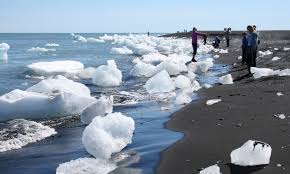
Ice on a beach with people.

Image source: By unknown author CC0, via pxhere.com

When heat (energy) is absorbed by water, the hydrogen bonds begin to break and the freed water molecules can move. This means that water can absorb heat (energy) before changing temperatures. The energy goes into breaking hydrogen bonds. It takes a lot of energy to make water increase in temperature. The reverse is true too; it takes a lot of energy to lower the temperature of water.

Basically, water really doesn't want to change temperature. We're pretty lucky to be made of mostly water because it's good at keeping our bodies at a constant temperature.

Which examples below illustrate water's high specific heat?

Choose all correct answers

Type a concept, like “slope” or “photosynthesis”.

↑ ↓ to choose · Enter to openSearch explanations and problems