Illustrated · 1 min
+5 contributors




Why Does Water Resist Heat Changes?
Recall that water is a polar molecule. This means that each water molecule has a positive end and a negative end. Let's take a look:

Image source: By Hannah Bonville et al.
Hydrogen bonds form between the positive pole of one polar molecule and the negative pole of another. Here's what that looks like with water molecules:
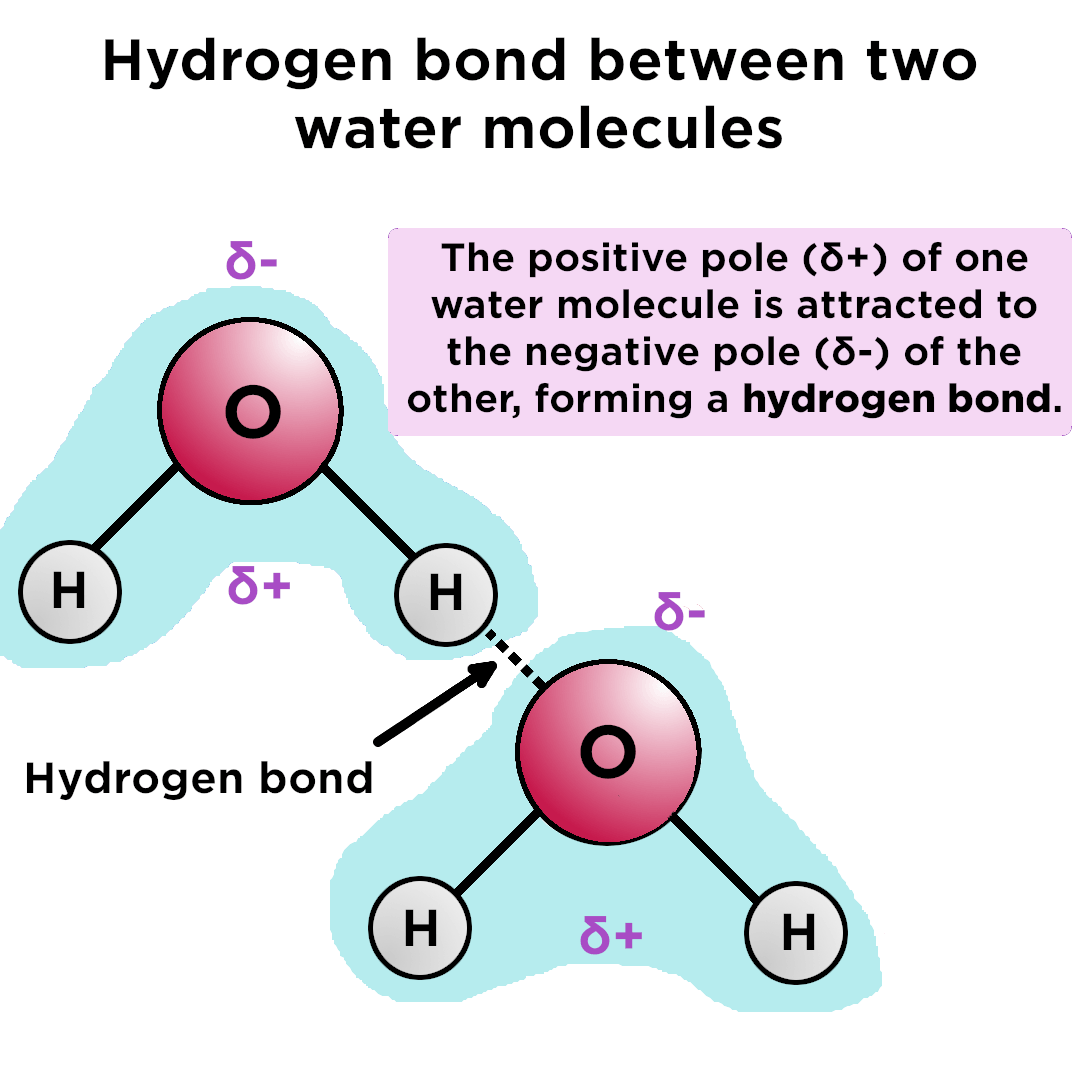
Image source: By Hannah Bonville et al.
In order to go from solid (ice) to liquid water, the molecules need to rearrange themselves. In order to go from liquid water to gas (water vapor), the molecules need to rearrange themselves. See a pattern here?
Any time water changes phase (whether it's solid, liquid, or gas), the hydrogen bonds between molecules need to break so the molecules can rearrange.
Here's where specific heat comes in.
It takes a lot of energy to break hydrogen bonds. This means it takes a lot of energy to rearrange water molecules from one phase to another.

Moving between phases (for example, turning water from liquid into gas) requires energy to break apart the hydrogen bonds joining the molecules together.
Image source: By Clker-Free-Vector-Images CC0, via pixabay.com Image source: By Clker-Free-Vector-Images CC0, via pixabay.com Image source: By OpenClipart-Vectors CC0, via pixabay.com
From practical experience, water does not experience large temperature changes. It takes the addition of a lot of energy to heat up and the loss of a lot of energy to cool down. This is attributed to water's high specific heat.
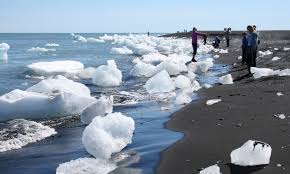
Think of a lake. If the water went from 70°F to 40°F over the course of a few days, you'd have a lot of dead fish.
The slow changes in temperature allow organisms to adjust and adapt to the water around them.

Image source: By Kfasimpaur [Public domain], via Wikimedia Commons
Key Vocabulary:
- Specific heat
- Hydrogen bond
- Phases of matter
- Polar