Homeostasis — Definition & Examples

Video

(Video) Homeostasis and Negative/Positive Feedback

by Amoeba Sisters

In this video, the Amoeba Sisters show how organisms, from humans to bearded dragons, use positive and negative feedback to keep themselves in stable states. They go through examples like heat loss and regulation, birthing contractions, and how the body maintains blood glucose levels. Don't forget to thank your nervous system for helping make all this happen.

Illustrated · 1 min

Goldilocks Homeostasis. One bowl of water is too hot. One is too cold. The last is just right.

Keeping your body "Just right".

Image source: By Valeri Natole

Illustrated · 1 min

Maintaining Balance

Homeostasis is all about maintaining a balance of factors that keep a cell functioning at its best. It's the ability of living organisms to keep a balance between things entering and leaving the cell. Cells work best when they are in a stable and appropriate environment with all the substances they could need.

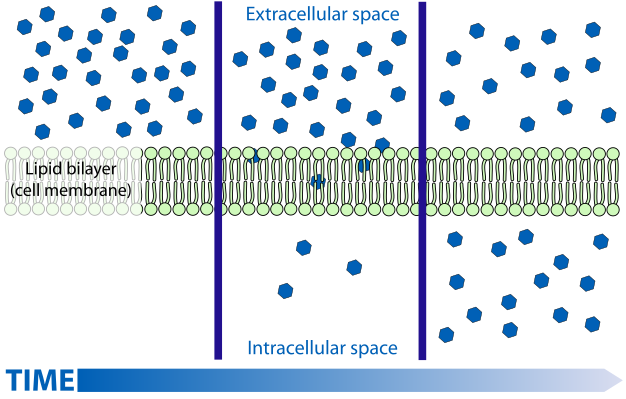
This diagram shows a cell membrane and three different states of a cell. At first, there are more molecules in the extracellular space (outside the cell). There are none in the intracellular space (inside the cell). In the second panel, there are some molecules inside the cell. In the third panel, there is an equal number of molecules inside and outside the cell.

This picture illustrates diffusion, which is an excellent example of maintaining balance. The cell can function at its best when the concentration of some substances is the same inside the cell as outside of the cell.

Image source: By LadyofHats [Public domain], via Wikimedia Commons

The cell membrane plays a large part in keeping this balance by controlling the passage of water and ions.

For example, the engine in your car is in balance when every part of it is working perfectly and in prime condition. It has all the fuel and fluids it needs. Similarly, a cell is in homeostasis when it has all of the ions, macromolecules, and liquids it needs to be healthy.

In order to ensure that it will keep on living, a cell does things to keep itself at a homeostatic set point. This could be pumping out water, releasing antibodies, regulating pH, controlling carbon dioxide levels in the blood, or hundreds of other actions that maintain the stability of a cell.

Vocabulary Review:\color{#8925AE}{\text{Vocabulary Review:}}

Homeostasis\color{#8925AE}{\text{Homeostasis}} : The ability of living things to keep a balance between things entering and leaving the cell. In other words, the organism controls its internal environment

Thermoregulation\color{#8925AE}{\text{Thermoregulation}} : The process that allows organisms to maintain their internal temperature

Ion Regulation\color{#8925AE}{\text{Ion Regulation}} : The process of balancing the ion content inside the body. It is how organisms control the pH outside their cells

Osmoregulation\color{#8925AE}{\text{Osmoregulation}} : The process of balancing the water content inside the body

Equilibrium\color{#8925AE}{\text{Equilibrium}} : All things in a system are perfectly balanced

Set Point\color{#8925AE}{\text{Set Point}} : The stable point of some physiological state. For example, the human set point for body temperature is 98.6°F

Read · 2 min

Why Do We Need Homeostasis?

Homeostasis is basically a fancy term for the functions performed by an organism to maintain its survival. When a cell or organism can no longer perform these functions, this organism's internal environments will no longer be stable and the organism will end up dying.

The internal environment can be thrown off balance in multiple ways. This can include but isn't limited to: the cellular environment becoming too acidic or too basic, the temperature becoming too hot or too cold, the cellular environment becoming too concentrated in salt, and so on. To reach a balance between two extreme conditions, the organism must use up energy.

What Are Some Examples?

We can see this process in humans when we regulate body temperature. When we are too cold, our bodies react to warm us up. One example is that we shiver when we're cold. By using up energy, the body is able to create heat to keep us warm. On the other hand, when humans are too hot, we sweat. Sweat is very useful because when it evaporates, it cools the body. This process is called evaporative cooling.

What Happens If You Don't Maintain a Stable Internal Environment?

The reason why organisms want to maintain proper conditions is that bad things begin to occur when the balance is thrown off. Proteins are macromolecules found all over the body and throughout cells. The shape of a protein is very important to its function. This shape, however, can be changed depending on the environment the cell resides in. The process of a protein changing shape and no longer working is called denaturing. Proteins like to function in a specific range of temperature, pH, and salinity. When the balance is thrown off, proteins can denature and are no longer able to function. When proteins are no longer able to work, a lot of cellular functions are brought to a stop. If things can't get back in balance, the organism will end up dying.

An important thing to note is that this balance of temperature, pH, and salinity varies between organisms and even individual cells within multicellular organisms. The balance needed to maintain survival for plankton that live on the ocean floor is different than the balance needed to maintain the survival of your dog.

Illustrated · 1 min

What Is Homeostasis?

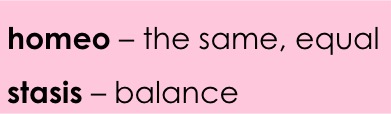
To figure out what this word means, let's break it down:

Homeo means the same or equal.
Stasis means balance.

Image source: By Hannah Bonville

To put the word back together, homeostasis is the maintenance of constant balance.

In other words, it's the ability to maintain internal conditions (keep them stable) even when the external environment changes. All living things do this; it's what keeps them alive.

Homeostasis is maintaining a balance.

Think of it as the body's way of balancing things out and maintaining stability.

Image source: By Clker-Free-Vector-Images CC0, via pixabay.com

Let's look at an example.

Body Temperature

Think about the last time you were outside in the cold. I bet your whole body—even your toes—felt cold, right?

Well, your body likes to keep its internal temperature constant. Normal human body temperature is around 98.6°F (read "98.6 degrees Fahrenheit"). Being outside in freezing temperatures poses a challenge to that.

In order to prevent your internal temperature from dropping as the outside temperature drops, your body automatically responds with things to keep it warm. For example, your body might start shivering, reducing blood circulation to the skin, and increasing blood pressure.

Type a concept, like “slope” or “photosynthesis”.

↑ ↓ to choose · Enter to openSearch explanations and problems