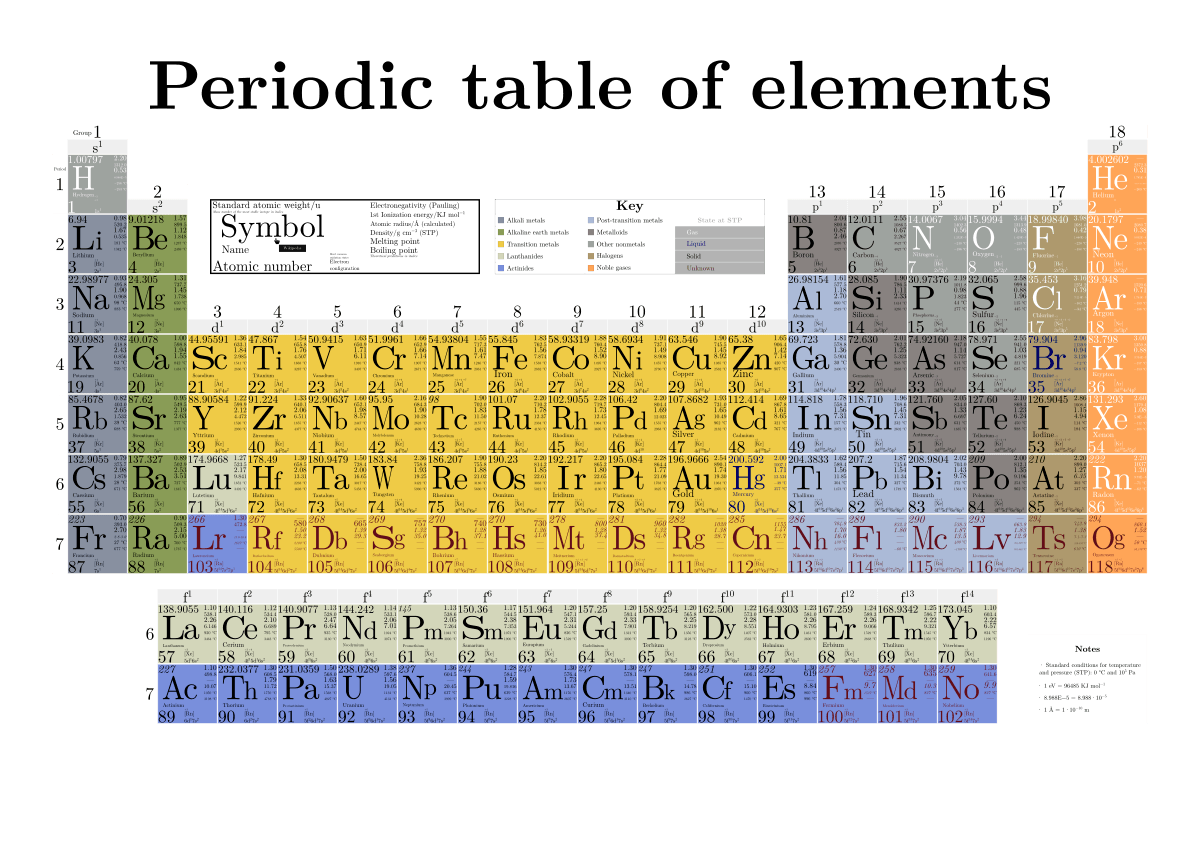
What Does the Periodic Table Tell Us?
The periodic table contains an immense amount of information, but if read correctly it can be a powerful tool for chemistry.
There are primarily three ways that people navigate the periodic table: group, period, and atomic number.
Groups
The columns of the periodic table are called groups. It may seem strange to call columns groups, but this is done because elements of the same group have similar properties. In fact, the periodic table organizes elements into groups based on their properties. This is one reason for the strange shape of the table. The group number is listed on top of each column. The table shown above shows 18 groups. Some tables only show eight groups, while others show up to 32 groups. 18 groups is the most common, but the number of groups does not have a significant impact on the information the table provides.
Periods
The rows of the periodic table are called periods. This may seem silly, but let's think about why they are named periods for a bit. When we think about waves, orbits, circular motion, or really anything that repeats, the time that it takes to do one cycle is called a period. Examine the sine wave depicted below.
At every interval of 1 (0−1, 1−2, 2−3, etc), the graph of the sine wave exactly repeats itself. The sine wave is said to be periodic with an interval of 1. Well, the periodic table is periodic through the properties of the elements. If we go across a period of the table from the left to the right, the properties of the elements change drastically until we get to the end of the row. The next element is directly below the element we started at. This means they are in the same group. Think back to what we learned about groups: elements in the same group have similar properties. This means these two elements have similar properties. As we can see, the cycle of properties repeats itself with every period.
The periods are numbered on the left side of each row. There are seven periods overall. The two rows on the bottom actually belong in periods 6 and 7. They are typically taken out like this in order to improve the readability of the table.
Atomic number
The atomic number is the number of protons an element has. The atomic number increases by one as we move one element to the right. That is to say, if an element has an atomic number of 25, the element directly on its right will have the atomic number 26. When we reach the end of a period, the next element is the leftmost element of the next period.
Information on Elements
Each box on the periodic table represents an element. The table shown above gives more information than many tables, but reading it can be difficult. Below is a cropping of the key provided on the table.
We are mostly concerned with the atomic number, chemical symbol, atomic mass, and name. In this example, the atomic number is 26, the chemical symbol is Fe, the atomic mass is 55.845 (this mass is always given in daltons, or its equivalent, grams per mole), and the name is iron. These four pieces of information will be used significantly more than the rest, and you should feel comfortable with what they mean and how to read them.
Other Information
The other information provided on this table is first ionization energy, electronegativity, electron configuration, and oxidation states.
First ionization energy is how much energy must be put into a gaseous atom in order to knock off the outermost electron. It is typically expressed in kilojoules per mole.
Electronegativity is how strongly an atom attracts electrons. It is rated on a scale of 0 to 4, and it increases as you proceed up and to the right on the table. Fluorine is the most electronegative element, and francium is the least.
The electron configuration is how the electrons are organized into sub-shells. A more in-depth explanation is beyond the scope of this page, but the electron configuration is strongly linked to the properties of the element.
Oxidation states are the ionic states where the atom is stable. Using iron as an example, iron will commonly lose either two or three electrons, but it is stable losing up to six electrons, or gaining up to two electrons.
Vocabulary Review:
Group: The columns of the periodic table
Period: The rows of the periodic table
Atomic number: The number of protons of an element