Hund's Rule (The Easy Version)
We've learned about atomic orbitals. Each can hold two electrons. As we move to higher sublevels, there are more orbitals. So, there is one s-orbital, three p-orbitals, five d-orbitals, and seven f-orbitals. We want to determine how electrons get placed into each subshell.
We know that atoms and molecules will create the lowest energy state. So, let's consider how we can assemble the lowest energy. First, we need to obey the rules of quantum mechanics. So let's recall the Pauli exclusion principle. It says that electrons cannot share the same quantum numbers. So practically, electrons within the same orbital cannot have the same spin. That's why electrons pair as spin-up and spin-down.
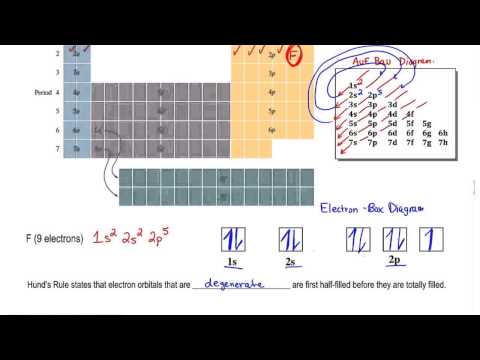
But let's also consider electron pairing. Electrons have a negative charge. So, if they are within the same space, they'll repel. The electrostatic repulsion increases the energy. So, the electrons will spread out as much as possible. The easiest way to do this is to fill an unoccupied orbital. But, the orbitals need to have equal energies. For example, the 2px, 2py, and 2pz orbitals are all equal. They only have different orientations. How do we fill the 2p energy level? We place one electron into each 2p-orbital before pairing. The custom is to place spin-up electrons first. Then, we pair them with spin-down electrons.
This background leads us to Hund's Rule. It states, "for orbital subshells with equal energies, a single electron gets placed into each subshell before pairing." Sometimes, you'll see the phrase "degenerate orbitals." That's a fancy way of saying the orbitals have equal energies. At this point, this is all you need to know for general chemistry.
Practical Uses for Hund's Rule
At this point, are you wondering how to use Hund's rule? Like most parts of quantum mechanics, it seems theoretical. But we've actually already seen it in action. First, think back to our lessons on electron configuration. Remember, we started by finding the electron configuration of pure elements. Then we studied the electron configuration of ions. For both elements and ions, we needed to know how the orbitals got filled. From the electron configuration, we learned how to find valence electrons. They reside in the outermost shell. The valence electrons define how an element forms covalent or ionic bonds. But were the electrons paired? Already paired electrons don't take part in bonding. You can only know if they get paired with Hund's rule. In a future lesson, we'll explore Lewis Dot Structures. It's part of the valence bond theory of chemical bonding. You'll use Hund's rule to determine the valence electrons. From there, you can write the structural formula of molecules!
Hund's Rules (The Advanced Version)
Hund's rule is one of those subjects that gets super simplified in general chemistry. For example, there are actually three rules. The one we described above is a simplification of Hund's first rule. If you want to learn more about the advanced details, keep reading. If not, feel free to stop here.
Hund's first rule is the rule of maximum multiplicity. The rule explains the behavior of atomic spectra. It states, "the lowest energy electron configuration has the greatest spin multiplicity." What does that mean? The electron configuration will maximize spin. Remember, spin-up electrons have a value of +21. Spin-down electrons are −21. We find the multiplicity by using the formula 2S+1. S is the total spin angular momentum. For each spin-up electron, we add one-half. For each spin-down electron, we subtract one-half. We can also say that it equals the number of unpaired electrons plus one. The multiplicity has applications within spectroscopy.
The second rule states that electrons will maximize orbital angular momentum. Sometimes, the spin multiplicity is the same for various states. For example, this begins to occur for transition metals. Why? The 3d subshell and the 4s subshell have very similar energies. So, it's possible to fill either. In that case, the state with the most prominent L value has the lowest energy. Remember, L is the angular momentum quantum number. It explains how the electrons circle the nucleus. If they orbit in the same direction, they encounter each other less often. So, they reduce repulsion.
Hund's third rule occurs because of relativity. An electron's energy gets influenced by its spin and motion. That's Hund's first and second rule. But, in some cases, the spin and motion influence each other. We see this in atomic spectra. At high resolutions, spectral lines will split into multiple lines. The line splitting is how we knew the Schrodinger equation was only an approximation. Remember, the Schrodinger equation did not include relativistic effects. It was Paul Dirac who modified the equation to incorporate relativity. So, it's all really advanced chemistry. We call the interaction between spin and angular momentum spin-orbit coupling. When the orbitals are less than half-full, we minimize the coupling. If they are more than half-full, we maximize it.
Again, Hund's three rules are very advanced. You do not need to know these for general chemistry!