Video

(Video) Hybrid Orbitals Explained - Valence Bond Theory | Crash Chemistry Academy
by Crash Chemistry Academy

This video gives a great explanation as to how hybrid orbitals form and shows what these models look like.

Before this, knowMolecular Orbital TheoryValence Bond Theory — Overview & Importance
Video
by Crash Chemistry Academy
This video gives a great explanation as to how hybrid orbitals form and shows what these models look like.
Read · 4 min
In the 1920's Erwin Schrodinger solved the wave functions for the hydrogen atom. We had a new understanding of atomic orbitals. Chemists quickly turned their attention towards applying Schrodinger's quantum mechanical model to bonding. We have two modern theories that use quantum mechanics. The first theory created was valence bond theory. In valence bond theory, bonds form when two atomic orbitals overlap. Valence bond theory was a powerful tool for describing simple molecules. For example, dihydrogen comes from the overlap of the 1s orbitals from each hydrogen atom. The overlap of both 1s orbitals is the covalent bond. The overlap is where both atoms share electrons.
Valence bond theory could not explain every molecule. Methane, , is an example of its limitations. In VSEPR, methane has a tetrahedral molecular geometry. The bond lengths and angles are equal. But, carbon's electron configuration has valence electrons in the 2s and 2p orbitals. The p-orbitals have higher energy. So, why do the carbon-hydrogen bonds end up being the same? To answer this question, physical chemists developed hybridization.
Sometimes, when atoms bond, they combine two different types of orbitals. In the case of methane, it uses its 2s and 2p orbitals for each bond. Each bond in methane exhibits some 2s character and some 2p character. We call orbitals with dual characters hybrids. The hybrid orbital model works very well for elements in periods one through three of the periodic table. The transition metals d-orbitals can also hybridize. But, d-orbital hybridization becomes complicated. We'll only look at s and p orbital hybrids.
The number of hybrid orbitals depends on the number of atomic orbitals used. In methane, the carbon uses its s-orbital and all three p-orbitals. So, carbon has four hybrid orbitals. Each hybrid orbital has less energy than the p-orbital. But, it has higher energy than the s-orbital. When we draw the orbital diagrams, the hybrid orbitals are between the s and p. Also, every hybrid has one electron. The electron is the one it shares during bonding. A hybrid orbital only forms a single bond. Before hybridization, the atom had paired s-orbital electrons. During hybridization, the electrons become unpaired. They are obeying Hund's rule. The paired electrons had the same spin because of the Pauli exclusion principle. When they become unpaired, we have the convention of writing all of them as spin up.
Next, we will look at the different types of hybrid orbitals. There are three different types. Each type depends on the number of atomic orbitals used.
The hybridization uses all the s and p orbitals to make four hybrid orbitals. Each hybrid will form a single bond. In valence bond theory, single bonds are called sigma bonds. You write them as -bonds. An example of is the carbon in methane.
The hybridization uses the s-orbital and two of the p-orbitals to form three single bonds. The extra p-orbital will overlap with another p-orbital. P-orbital overlap forms a double bond. An example of hybridization is ethene . Each carbon forms three single bonds. One carbon-carbon single bond. And two carbon-hydrogen single bonds. Each carbon's remaining p-orbitals overlap to form a carbon-carbon double bond. We call overlapping p-orbitals pi bonds. You write them as -bonds.
The final type of hybrid orbital is hybridization. The hybridization uses one s-orbital and one p-orbital to make two hybrid orbitals. The two remaining p-orbitals can overlap to create two -bonds. A -bond and two -bonds is a triple bond. An example of hybridization is ethyne, . Ethyne has a carbon-carbon triple bond and two carbon-hydrogen single bonds.
The hybridization model has limitations. In reality, hybrid orbitals do not exist. They are a mathematical approximation from valence bond theory. In advanced chemistry, you learn about the percentage of orbital character. For example, a bond could have a thirty percent s-orbital character. The remaining seventy percent could be p orbital character. Earlier, we saw that methane has equal bond lengths and bond angles. That is true. However, the orbitals energies of the four bonds are different. Bond lengths and angles are not quantum mechanical properties. Some of methane's bonds show carbon s-orbital overlap. Methane's other bonds show p-orbital overlap.
Another limitation is that hybridization assumes localized bonding. Quantum mechanics teaches us that a molecule has delocalized electrons. The electrons do not stay between the atoms. If you hold too tightly to the localized electron picture, you'll get confused. Quantum mechanics will be especially confusing.
The hybrid orbital does have benefits. When atoms bond, the formation of the bond does lower the orbital energy. When we hybridized, the hybrid orbital's energy was between the atomic orbitals. The hybrid orbital also explains why double and triple bonded molecules are rigid. When atoms single bond, they rotate. With multiple bonds, they cannot rotate because of the overlapping p-orbitals.
Almost every concept in chemistry is a model. A model is a tool that helps us to explain what is happening. The model always has true aspects. However, some parts are approximations. The reason a model includes approximations is that the system is too complex. For example, consider atomic orbitals. Schrodinger only solved his equations for the hydrogen atom. Handling the electron repulsion in larger atoms was too complicated. Do we think that electron repulsion would not change the orbitals? Of course, it would. But, the model Schrodinger developed provided us with a lot of useful information. Schrodinger's model was a tool that transformed the next century of chemistry research!
Illustrated · 1 min
Hybrid Orbitals: Visualization of Hybrid Orbitals Using Carbon
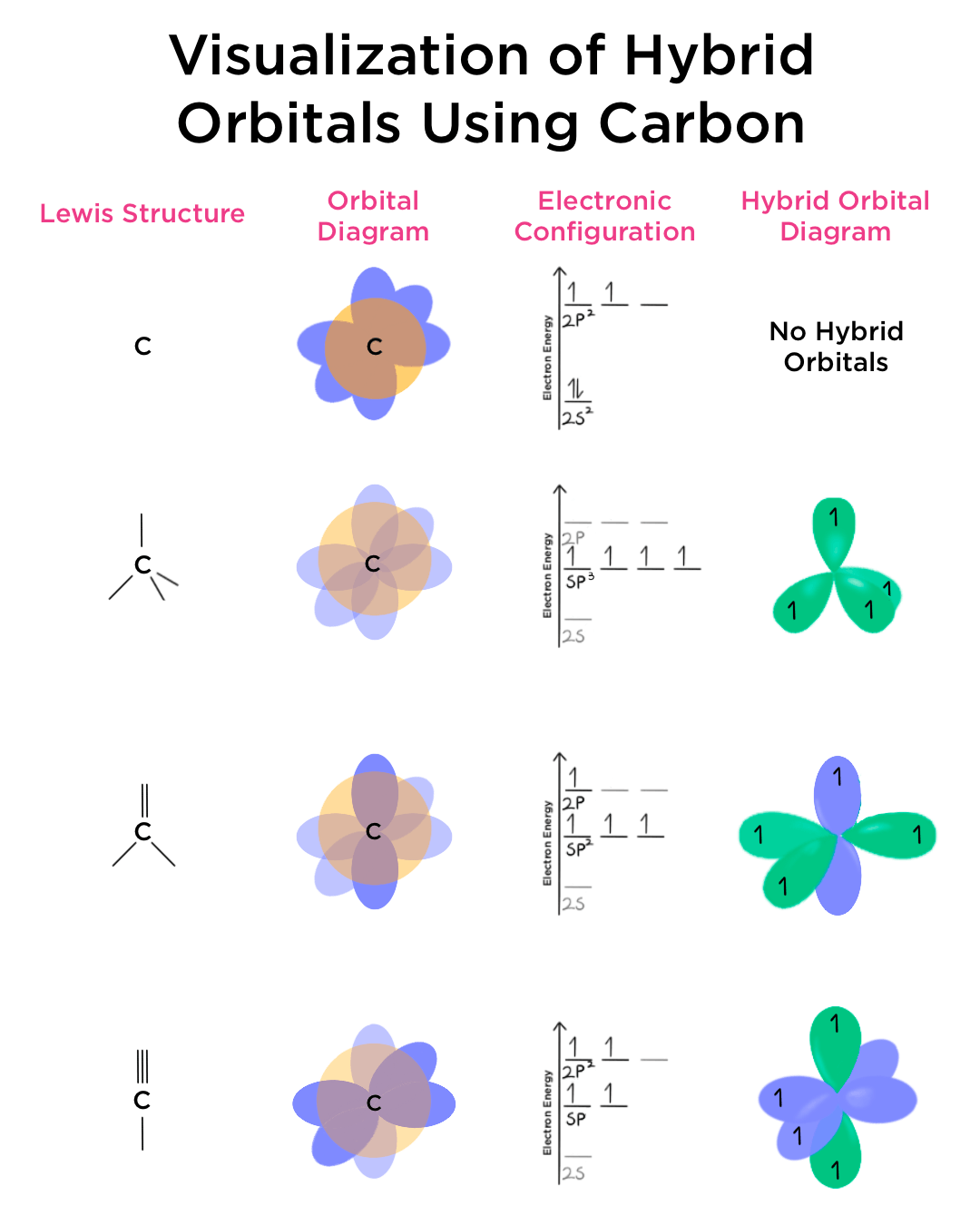
Image Source: Leo Dong