Interactive · 2 questions

+3 contributors


What Are Hydrogen Bonds?
They are a form of dipole-dipole interaction between polar molecules that contain hydrogen atoms. The hydrogen atoms must be bonded to either nitrogen, oxygen, or flourine. The bond itself happens when these molecules are attracted to these same atoms in other molecules.
Polar molecules get their partial charges, or dipoles, from the uneven sharing of the electrons in the bonds between atoms. These electrons stick closer to atoms that have higher electronegativity, or need for electrons. Therefore, how polar or ionic a bond is depends on the difference between the electronegativities of the two elements involved.

The periodic table with each element's electronegativity labeled.
Image source: By Adblocker CC BY-SA 3.0, via Wikimedia Commons
The highest electronegativities on the periodic table are found in the top right (red), with an electronegativity of 3.98 for fluorine (), 3.44 for Oxygen (), and 3.04 for nitrogen (). These atoms are more electronegative than hydrogen (). This means the electrons will move to the stronger elements like fluorine, oxygen, and nitrogen, creating a partial negative charge. The hydrogen side will have a partial positive charge.
When multiple molecules containing hydrogen bound to , , or are near each other, the more positive will stick to the more negative atom of another molecule. This interaction is called a hydrogen bond or H-bonding. It is important to note that the bond directly between , , or and hydrogen () in the same molecule is not a hydrogen bond. H-bonding is not a true bond between atoms but a strong interaction between atoms on other molecules.
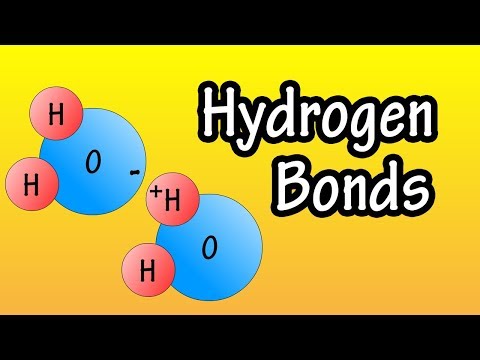
The most classic example of hydrogen bonds is in water, . H-bonding occurs in three places on one molecule, which connects it to three other water molecules. This leads to a lot of interactions between water molecules and is referred to as cohesion.

The crystal structure of ice.
Image source: By NIMSoffice [Public domain], via Wikimedia Commons
In this picture of the crystal structure of ice, H-bonding is shown with gray dotted lines. The of each molecule forms the negative dipole of the molecule, while the s are the positive dipoles.
Hydrogen bonds are what holds the separate molecules in ice packed in a solid structure. They also keep the molecules in liquid water close together. In steam, the water molecules are too far apart to do H-bonding.
They are much stronger than the other types of intermolecular bonds. This results in unique properties of water necessary for biology.
Which depicts H-bonding?
Which side of is negatively charged?