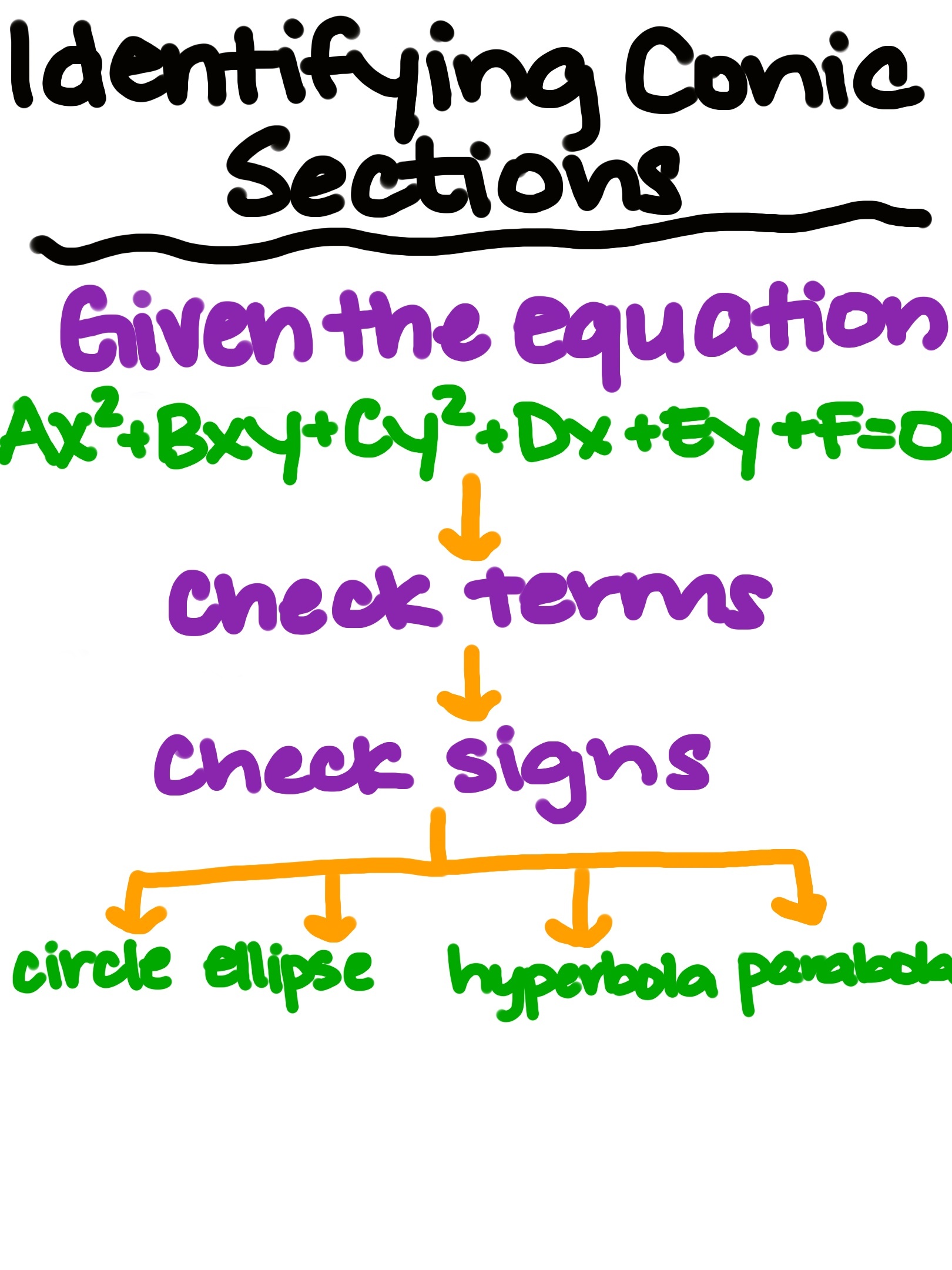
Identifying Conic Sections from the General Form Equation

Read · 1 min

Conic Sections are a special group of function that share similar characteristics.

Similar to how we can write the equation of a linear line in different forms, such as slope-intercept form (i.e. y=mx+by = mx + b) and point-slope form (i.e. y1−y0=m(x1−x0)y_{1} - y_{0} = m(x_{1} - x_{0})), we also have different forms in which we can write the equation of the four conic sections. Here, we will explain just the general forms for them.

General Form of a Circle‾\underline{\textbf{General Form of a Circle}}

  • General Form: (x−h)2+(y−k)2=r2(x - h)^{2} + (y - k)^{2} = r^{2}

where rr is the radius and (h,k)(h, k) is the coordinate of the center/focus

General Form of a Ellipse‾\underline{\textbf{General Form of a Ellipse}}

  • General Form: (x−h)2a2+(y−k)2b2=1\dfrac{(x - h)^{2}}{a^{2}} + \dfrac{(y - k)^{2}}{b^{2}} = 1

where if a>ba > b the ellipse is a horizontal ellipse and if b>ab > a the ellipse is a vertical ellipse

General Form of a Parabola‾\underline{\textbf{General Form of a Parabola}}

  • General Form: y=ax2+bx+cy = ax^{2} + bx + c

General Form of a Hyperbola‾\underline{\textbf{General Form of a Hyperbola}}

  • General Form: (x−h)2a2−(y−k)2b2=1\dfrac{(x - h)^{2}}{a^{2}} - \dfrac{(y - k)^{2}}{b^{2}} = 1

where if a>ba > b the hyperbola is a horizontal hyperbola and if b>ab > a the hyperbola is a vertical hyperbola

also note: this equation is very similar to that of the Ellipse, be careful not to confuse them!

Video

(Video) Equations for Conic Sections

by Brian McLogan

In this video by Brian McLogan, you will learn to determine if an equation is a parabola, circle, ellipse or hyperbola.

Summary

Most conic sections are given by a quadratic equation in xx and yy:

Ax2+Bxy+Cy2+Dx+Ey+F=0Ax^2 + Bxy + Cy^2 + Dx + Ey + F =0

We need to classify the x2x^2, xyxy, and y2y^2.

Use the Discriminant

Remember the discriminant:

D=B2−4ACD = B^2 - 4AC
  • If D<0D<0: the equation represents an ellipse (or a circle when A=CA=C)
  • If D=0D=0: it's a parabola
  • If D>0D>0: it's a hyperbola

Coefficient Patterns

When B=0B=0, you can often spot the conic more directly:

  • Circle: both x2x^2 and y2y^2 are present, with equal coefficients and the same sign
  • Ellipse: both squared terms are present, with the same sign, but different coefficients
  • Parabola: only one squared term appears and the other is missing
  • Hyperbola: both squared terms appear, but with opposite signs

Illustrated · 1 min

Conic Sections

When a plane cuts through a cone, we get conic sections: like a circle, ellipse, parabola, or hyperbola. These shapes have special equations (in the general form):

Ax2+Bxy+Cy2+Dx+Ey+F=0Ax^2+Bxy+Cy^2+Dx+Ey+F=0
Identifying Conic Sections

Image source: by Anusha Rahman

The capital letters are constants. The figure out what shape the equation makes, look at the coefficients, A,B and CA, B \text{ and } C.

  • If AA and CC are equal and B=0B=0: the conic is a circle
  • If AA and CC are different but have the same sign and B=0B=0: the conic is an ellipse
  • If there is only one squared term present, it's a parabola
  • If AA and CC have opposite signs, the conic is hyperbola
  • If B≠0B \neq 0, the axes are rotated (so that means you have a rotated ellipse or hyperbola)

To identify the conic quickly:

  1. Check the squared terms: are both present or just one?

  2. Check the signs: are they equal?

In the next lesson, we will learn about the characteristics of conics.

Type a concept, like “slope” or “photosynthesis”.

↑ ↓ to choose · Enter to openSearch explanations and problems