
Illustrated · 1 min
+1 contributors

Features of a Redox Reaction
When determining if the reaction is a redox reaction it is important to identify:
-
reduced species (gains electrons)
-
oxidized species (loses electrons)
A redox reaction will always have something reduced and something oxidized. Usually redox reactions contain one or more of the following:
-
Neutral diatomic molecules (, , , )
-
Transition metals ()
Look Out for Oxidation State Changes
The change in oxidation states, or oxidation numbers, from reactants to products will help distinguish the reduced and oxidized species.
Neutral diatomic molecules when borken, often experience a gain or loss of electrons. For example, is neutral, but has a oxidation state.
Transition metals have various oxidation states which make them great for redox reactions. For example iron, , can access oxidation states between to . The most common oxidation states of iron is and . To determine the oxidation state look at the atoms bound to in compounds. For example in , has a oxidation state and there are 3 s giving a negative charge overall. To make a neutral compound Fe must be , . Another example is , where we have and .
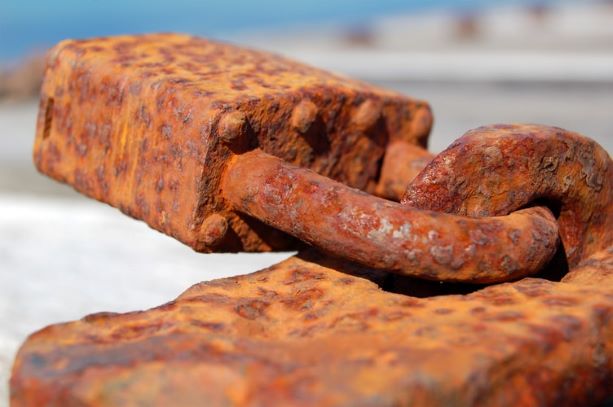
This lock was made with iron and overtime the iron was oxidized to form rust or ferric oxide.
Checking Changes in Oxidation States
Iron has been used for thousands of years as a metal for things such as screws, bolts, tools, cookware, and more. These iron items can rust in the presence of oxygen in the air. Rust is the brown-orange layer that can form on the silvery iron. The balanced chemical reaction for this process is: The next steps is to check the oxidation states for each atom in the reactants and products: Both and start at a zero oxidation state in the reactants, but change in the products. loses electrons and becomes more positive while gains electrons and becomes more negative. is oxidized and is reduced.
