Inscribed Angle Theorem: Chord Case

Illustrated · 1 min

Inscribed angles appear frequently in circle geometry:

(Here ∠ABC\angle{ABC}, with vertex BB, is an inscribed angle of the green circle.)

Let's think about a natural question:

What's the angle measure of ∠ABC\angle{ABC}?

Of course, it will depend on the relative locations of A,B,CA,B,C on the green circle. A more precise question might be the following:

How, if at all, does the angle measure of ∠ABC\angle{ABC} relate to other quantities in our diagram above?

If you're up for it, take a moment to think about this. The following "more complete diagram" might help. (Side note: to get to the heart of the matter (pun not intended), it's usually a good idea to draw the center of a circle---here, the point OO. The basic reason is that central angles (like ∠AOB\angle{AOB}, with vertex at the center OO) are the only angles we really know anything about yet---after all, we defined their angle size as arc length! If we then draw the radii OAOA, OBOB, OCOC, we get lots of symmetry and isosceles triangles. :)

Try playing around with this interactive Geogebra applet, too!

It turns out that if we fix points AA and CC, the answer doesn't depend on BB (as long as BB stays on the same side of line ACAC---we'll look at what happens when BB "switches sides" soon)! In fact, ∠ABC=12∠AOB=12AC^\angle{ABC} = \frac12 \angle{AOB} = \frac12 \widehat{AC}. (Here arc AC^\widehat{AC} is interpreted as the arc from AA to CC that doesn't contain BB. It's sometimes known as the arc intercepted by angle ABCABC.)

This is a very special property of the circle---for a "random curve/shape", we might expect the answer to depend on BB (i.e. change as BB moves around).

There are many nice ways to prove this result. If you're feeling adventurous, then in the spirit of Lockhart's Lament (p. 20-22), see if you can find a proof yourself! Otherwise see the follow-up post here.

Preparing for a math contest?

Working through past problems on one idea at a time is one of the most effective ways to prepare. These are real problems from the AMC 8, AMC 12 and AIME, the national math competitions for middle and high school students, each with a worked solution on LIVE by Po-Shen Loh.

Illustrated · 3 min

Let's work through a couple proofs (hidden below the fold) of the result developed in the post here.

We start with the diagram from before. We wish to show ∠ABC\angle{ABC} has half the measure/length of its intercepted arc ACAC (the one not containing BB), or 12∠AOC\frac12 \angle{AOC} (where we recall by definition that ∠AOC=AC^\angle{AOC} = \widehat{AC}).

(We've marked the radii OAOA, OBOB, OCOC as segments of the same length. This gives us isoceles triangles AOBAOB, BOCBOC, COACOA with vertices at OO, so by the isosceles triangle theorem, we get 33 pairs of equal angles, marked in red, yellow, and cyan. Recall that the reason we drew in the center and radii was to "get lots of symmetry and isosceles triangles".)

If you'd like a nice "angle chasing" exercise, try to show that ∠AOC=2∠ABC\angle{AOC} = 2\angle{ABC} yourself, before looking below.

Proof 1: direct but less enlightening

We know ∠ABC=blue=yellow+red\angle{ABC} = \text{blue} = \text{yellow} + \text{red}. (@)

On the other hand, we can get a handle on ∠AOC\angle{AOC} using the fact that the interior angles in a triangle sum to π\pi (or 180∘180^\circ if you prefer). In triangle AOCAOC this gives π=∠AOC+2cyan\pi = \angle{AOC} + 2\text{cyan}. So ∠AOC=π−2cyan\angle{AOC} = \pi - 2\text{cyan}. (#)

To relate the previous two equations, we use the same fact in triangle ABCABC to get π=2yellow+2red+2cyan\pi = 2\text{yellow} + 2\text{red} + 2\text{cyan}. (*)

To finish, we combine these three equations together. Plugging (*) in (#) gives ∠AOC=π−2cyan=2yellow+2red\angle{AOC} = \pi - 2\text{cyan} = 2\text{yellow}+2\text{red}. But by (@), this latter expression is just twice yellow+red=∠ABC\text{yellow}+\text{red} = \angle{ABC}. In other words, ∠AOC=2∠ABC,\angle{AOC} = 2\angle{ABC}, which is what we wanted to prove.

Caveat to Proof 1

Here B,OB,O are on the same side of line ACAC. Does the proof above still work if B,OB,O are on opposite sides? If not, how does it need to be modified?

Proof 2: harder to come up with, but more enlightening

Here's a proof following the strategy that the most "fundamental" angles (or the "ones we know best") are the central angles: those with vertex at the center OO of the green circle.

The diagram looks complicated, but if we focus on the blue lines and angles, the proof almost goes without words. The idea is by shrinking everything by a factor of 22 about XX (the reflection of BB over OO, which also lies on the green circle), we've constructed a (blue) basically central angle ∠POR\angle{POR} visibly equal to the original ∠ABC\angle{ABC} (since dilations preserve angles).

Now everything is centered at OO, and we just need to show ∠AOC\angle{AOC} is twice ∠POR\angle{POR}. But ray OP→\overrightarrow{OP} cuts arc XA^\widehat{XA} in half (look at the red angles: we're using the congruent angles given by parallel lines OPOP and BABA). Similarly, ray OR→\overrightarrow{OR} cuts arc XC^\widehat{XC} in half (look at the yellow angles).

Thus gluing these two "half-arcs" together at XX, we see that rays OP→\overrightarrow{OP} and OR→\overrightarrow{OR} together "halve" arc AC^\widehat{AC}, so ∠POR\angle{POR} is half of 12∠AOC\frac12 \angle{AOC} (as usual, converting between arc length and central angle measure), so we're done.

The goal of the second proof was to explain the factor of 22: why ∠ABC\angle{ABC} is precisely half of ∠AOC\angle{AOC} (or arc AC^\widehat{AC}).

Caveat to Proof 2

Here A,CA,C are on opposite sides of line BOBO. Does the proof above still work if A,CA,C are on the same side? If not, how does it need to be modified?

(Hint: Proof 2 is basically the same as the proof on Wikipedia, just phrased differently. The Wikipedia article addresses both cases in full detail. How can we do the same here?)

Interactive · 7 questions

There are some useful formulas to calculate angles in circles, formed by radii, chords, secants, and tangents.

  1. Central Angle ========

A central angle is formed by two intersecting radii in a circle. Its vertex must be at the center of the circle.

Central Angle

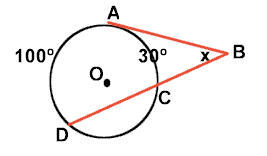
In this diagram, x is the central angle. In a circle, or congruent circles, congruent central angles have congruent arcs.

Central Angle = Intercepted Arc

Thus,

Angle Measure of Arc AB = Central Angle x (Angle AOB)

What is the measure of angle x?

Choose one answer

Illustrated · 1 min

Angle - Arc - Relationship

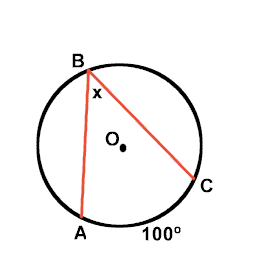
Chords ADAD and AEAE intersect at point AA on the circle's circumference, forming ∠EAD\angle{EAD}. The #degrees in arc DEDE is twice as much as the #degrees in ∠EAD\angle{EAD}.

Read · 1 min

Now you have learned about all parts of the circle except for tangents, so you can do this worksheet! (Yes, there are tangent questions, but if you know what you are doing, you can use process of elimination for them, and maybe even figure out what they are without reading the explanation!)

http://www.mathworksheets4kids.com/circles/parts-medium-large.png

Type a concept, like “slope” or “photosynthesis”.

↑ ↓ to choose · Enter to openSearch explanations and problems