Inscribed Angle Theorem: Tangent Case

Before this, knowInscribed Angle Theorem: Chord Case

Illustrated · 1 min

Intuitive limiting argument

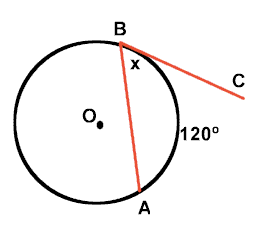
Sometimes we have a sort of "degenerate/tangent" inscribed angle, like ∠ABX\angle{ABX} below. It's a "degenerate tangent case" in the sense that the inscribed angle is formed by the secant ABAB and the tangent BXBX to the magenta circle (when the circle in question is clear, it can be helpful, at least intuitively, to call the tangent line "BBBB", and the inscribed angle "∠ABB\angle{ABB}").

Do you have a guess for what ∠ABX\angle{ABX} might equal, in view of the blue, green, yellow, and orange lines (and the previous topic on "normal" inscribed-angle/intercepted-arc relationships)?

In the diagram, it looks like the sequence of inscribed angles ∠ABP,∠ABQ,∠ABR,∠ABS\angle{ABP}, \angle{ABQ}, \angle{ABR}, \angle{ABS} "approaches the limiting degenerate/tangent inscribed angle ∠ABB=∠ABX\angle{ABB} = \angle{ABX}".

Similarly, it looks like the sequence of arcs AP^,AQ^,AR^,AS^\widehat{AP}, \widehat{AQ}, \widehat{AR}, \widehat{AS} "approaches the arc AB^\widehat{AB}" (although this time we don't have any "degeneracy" or anything like that).

Based on the previously encountered "normal case", we have ∠ABP=12AP^,∠ABQ=12AQ^,∠ABR=12AR^, ∠ABS=12AS^\begin{align*} \angle{ABP} &= \frac12 \widehat{AP}, \\ \angle{ABQ} &= \frac12 \widehat{AQ}, \\ \angle{ABR} &= \frac12 \widehat{AR}, \\\ \angle{ABS} &= \frac12 \widehat{AS} \end{align*} so might expect that ∠ABX=∠ABB\angle{ABX} = \angle{ABB} is simply equal to 12AB^\frac12 \widehat{AB}.

This is indeed true, but in order to "formalize" the argument above, we need to use a basic tool/notion from calculus---that of limits and continuity. But don't worry about this---if you can understand the intuition, that's great.

Caveat with "lazy ∠ABB\angle{ABB}" notation

If we "approach BB from the other direction", then we need to be careful talking about "∠ABB\angle{ABB}". In this new context we would mean ∠ABB=∠ABY\angle{ABB} = \angle{ABY}, which is supplementary, so generally unequal, to ∠ABX\angle{ABX}.

Math as a puzzle

Many contest problems feel more like puzzles than homework. They are a good way to find out how much fun math can be. These are real problems from the AMC 8 and AMC 12, the national math competitions for middle and high school students, each with a worked solution on LIVE by Po-Shen Loh.

Interactive · 7 questions

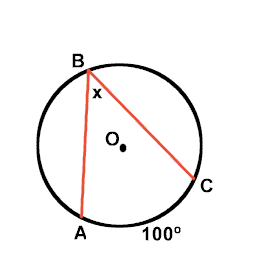
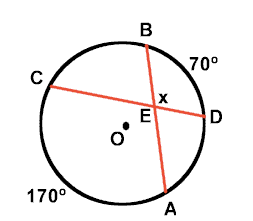
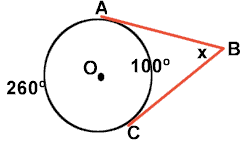
There are some useful formulas to calculate angles in circles, formed by radii, chords, secants, and tangents.

  1. Central Angle ========

A central angle is formed by two intersecting radii in a circle. Its vertex must be at the center of the circle.

Central Angle

In this diagram, x is the central angle. In a circle, or congruent circles, congruent central angles have congruent arcs.

Central Angle = Intercepted Arc

Thus,

Angle Measure of Arc AB = Central Angle x (Angle AOB)

What is the measure of angle x?

Choose one answer

Read · 1 min

Use the "tangent case formula" to derive the "normal case formula".

(This is not circular, because it's possible to prove the tangent case formula without using the normal case formula---in fact, it's easier that way.)

Read · 1 min

Here is a worksheet for identifying tangents: http://cdn.kutasoftware.com/Worksheets/Geo/11-Tangents to Circles.pdf

Problems 1-6 pertain specifically to this topic, but the others are fun as well

The Pythagorean Theorem, c2=a2+b2c^2 = a^2 + b^2, is useful for these exercises.

Type a concept, like “slope” or “photosynthesis”.

↑ ↓ to choose · Enter to openSearch explanations and problems