Integration by Parts

Interactive · 3 questions

So far, we've learned about a couple of basic methods of integration: for instance, we know that integrals add: ∫[f(x)−g(x)] dx=∫f(x) dx−∫g(x) dx.\int [f(x)-g(x)]\, dx=\int f(x)\, dx-\int g(x)\, dx.

We also get the following integrals:

Integrals of polynomials: ∫xn dx=1n+1xn+1+C.\int x^n\, dx=\frac{1}{n+1}x^{n+1}+C.

Integrals of sin⁡x\sin{x} and cos⁡x\cos{x}: ∫sin⁡x dx=−cos⁡x+C.\int \sin{x}\, dx=-\cos{x}+C. ∫cos⁡x dx=sin⁡x+C.\int \cos{x}\, dx=\sin{x}+C.

Integrals of exponential functions: ∫ex dx=ex+C.\int e^x\, dx=e^x+C.

So, we can find integrals of functions such as ∫[x+ex] dx.\int \left[x+e^x\right]\, dx.

But can we integrate ∫x⋅ex dx\int x\cdot e^x\, dx using the techniques that we have so far?

Choose one answer

Read · 1 min

Integration by parts is a powerful tool that results from reversing the Product Rule. Of course, while

∫f′(x)g(x)+f(x)g′(x)dx=f(x)g(x)\int{f'(x)g(x) + f(x)g'(x)dx} = f(x)g(x)

That said, integration by parts results from the formula derived as follows:

∫f′(x)g(x)dx+∫f(x)g′(x)dx=f(x)g(x)\int{f'(x)g(x)dx} + \int{f(x)g'(x)dx} = f(x)g(x)

Now subtract the second integral from both sides of the equation:

∫f′(x)g(x)dx=f(x)g(x)−∫f(x)g′(x)dx\int{f'(x)g(x)dx} = f(x)g(x) - \int{f(x)g'(x)dx}

Therefore, at least one of the two functions must have an antiderivative for this to work.

Here is a simple example: integrate ∫x2dx\int{x^2dx} using integration by parts.

Obviously ∫x2dx=13x3+C\int{x^2dx} = \frac{1}{3}x^3 + C as you're integrating a polynomial, but this example is good for showing how integration by parts works. In this case, f′(x)=xf'(x) = x and g(x)=xg(x) = x. We must find f(x)f(x) and g′(x)g'(x) at the beginning to ensure integration by parts is usable:

f(x)=12x2f(x) = \frac{1}{2}x^2

g′(x)=1g'(x) = 1

*leave off the +C+C until the end. It's not necessary to have multiple constants.

Now plug the two functions and their derivatives into the formula:

∫f′(x)g(x)dx=f(x)g(x)−∫f(x)g′(x)dx⇒\int{f'(x)g(x)dx} = f(x)g(x) - \int{f(x)g'(x)dx} \Rightarrow

∫x⋅xdx=12x2⋅x−∫12x2⋅1dx⇒\int{x \cdot xdx} = \frac{1}{2}x^2 \cdot x - \int{\frac{1}{2}x^2 \cdot 1dx} \Rightarrow

∫x2dx=12x3−∫12x2dx⇒\int{x^2dx} = \frac{1}{2}x^3 - \int{\frac{1}{2}x^2dx} \Rightarrow

∫x2dx=12x3−12∫x2dx\int{x^2dx} = \frac{1}{2}x^3 - \frac{1}{2}\int{x^2dx}

Now we can solve for ∫x2dx\int{x^2dx} in this equation:

32∫x2dx=12x3⇒\frac{3}{2}\int{x^2dx} = \frac{1}{2}x^3 \Rightarrow

∫x2dx=13x3\int{x^2dx} = \frac{1}{3}x^3

Then, once everything else is done, you add on the arbitrary constant:

∫x2dx=13x3+C\int{x^2dx} = \frac{1}{3}x^3 + C

Although usable for monomials, integration by parts is more commonly used for functions involving exponential, logarithmic, and/or trigonometric functions as factors or terms. Knowledge of some basic antiderivatives is important.

Read · 1 min

How do we do an integration that is the product of 2 functions? For example... how do we integrate xsin⁡3xx \sin3x dx?

If xx or sin⁡3x\sin3x were by themselves we could easily do the integral. But, they are multiplied together and not by themselves, and we don't have a substitution that we can use for this integral. However, we would be able to do this integration by using Integration By Parts.

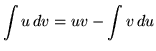
The formula for Integration By Parts is: ∫u dv=uv−∫v du.\int u\, dv=uv-\int v\, du.

Supposing u(x)u(x) and v(x)v(x) are continuously differentiable functions, this formula turns a complicated integral into a much more simpler one. However, it is important to choose u and dv carefully in order to make the integration simple.

So, to integrate xsin⁡3xx\sin3x, we must choose a uu and a dvdv. uu is usually chosen so that the derivative of uu (dudx\frac{du}{dx}) turns out to be simpler than uu.

Let u=xu=x and dv=sin⁡3xdv=\sin3x

Then du=dxdu=dx and v=−cos⁡3x3v=\frac{-\cos3x}{3}

Now, we just substitute these 4 expressions into the integration by parts formula to get... ∫u dv=uv−∫v du.\int u\, dv=uv-\int v\, du. ∫x sin⁡3x=x−cos⁡3x3−∫−cos⁡3x3dx.\int x\, \sin3x= x\frac{-\cos3x}{3}-\int\frac{-\cos3x}{3}dx.

and simplify to get = −xcos⁡3x3+sin⁡3x9+C\frac{-x\cos3x}{3} + \frac{\sin3x}{9} + C

Interactive · 2 questions

First we will talk about how we derive the formula for integration by parts from the product rule of derivation. The product rule states that d/dx[f(x)g(x)]=f′(x)g(x)+f(x)g′(x)d/dx[f(x)g(x)]=f'(x)g(x)+f(x)g'(x).

So we must first integrate both sides

f(x)g(x)=∫f′(x)g(x) dx+∫f(x)g′(x) dxf(x)g(x)=\int f'(x)g(x)\,dx+\int f(x)g'(x)\,dx

Then rearrange

∫f(x)g′(x) dx=f(x)g(x)−∫f′(x)g(x) dx\int f(x)g'(x)\,dx=f(x)g(x)-\int f'(x)g(x)\,dx

Now lets try to solve ∫xsinx dx\int xsinx\,dx.

In order to use the formula above we must designate values for the terms f(x),f′(x),g(x)f(x), f'(x), g(x) and g′(x)g'(x).

We will start with f(x)f(x) and g′(x)g'(x). What our goal should be is the designate the value of f(x)f(x) so that f′(x)f'(x) is simpler than f(x)f(x) and designate g′(x)g'(x) so that its derivative does not become any more complicated.

The value of f(x)f(x) should be

Choose one answer

Interactive · 1 question

A very common mistake people make with integration is seen below:

if one were to plug in f(x)=xf(x)=x and g(x)=1g(x)=1 you will instantly realize that the idea above that one was going is wrong.

You would get ∫1x dx=∫x dx∗∫1 dx\int 1x\,dx = \int x\,dx * \int1\,dx

This further simplifies to .5x2+c=(.5x2+c)∗(x+c).5x^2 + c = (.5x^2 + c) * (x+c) So one can clearly see the addition of a component that makes it so that the two sides cannot be equal thus rendering the above formula wrong.

A better formula to use is "integration by parts" which utilizes substitution and an inverse of the product rule to get the answer for integrals with two separate functions contained within them.

Here we have the formula:

u being f(x) and v being g(x)

Now lets try using integration by parts to solve the prior integral.

So we have: ∫1x dx\int 1x\,dx

lets let u = x and dv = 1 so du = 1 and v = x

now lets plug them into the equation

We have: ∫1x dx=x2−∫x dx\int 1x\,dx = x^2 - \int x\,dx

Which simplifies to ∫1x dx=x2−(.5x2)+c\int 1x\,dx = x^2 - (.5x^2 )+c

So we know that ∫1x dx\int 1x\,dx is really just ∫x dx\int x\,dx and the one is just a place holder for a tougher function for (g(x)). Knowing this, we know that ∫x dx=.5x2+c\int x\,dx = .5x^2 + c so going back to the simplification we see that there is a subtraction between x2−.5x2x^2 - .5x^2 and one realizes that this subtracts to .5x2.5x^2

So the final equation becomes:

.5x2+c=.5x2+c.5x^2 + c = .5x^2 + c which proves that "integration by parts" is valid and works.

Lets look at a problem now. Be careful that you properly choose which function is U and which is dv because you may end up making things harder if you choose the wrong function for each.

∫xcos⁡x dx\int x \cos x\,dx now which is u and which is dv

Choose one answer

Interactive · 2 questions

In Calculus 1 we learned about the product rule for differentiation

ddxuv=duv+udv\frac{d}{dx} uv = duv+udv

Integration by parts is the method for reversing the product rule. Reorganizing this formula we get the form

udv=ddxuv−duvudv = \frac{d}{dx} uv - duv

If we see an indefinite or definite integral in the form ∫(udv)\int(udv), the form of a function with an antiderivative that used the chain rule, we can use integration by parts.

The formula for integration by parts (IBP) is

∫(udv)=uv−∫(vdu)\int(udv) = uv - \int(vdu)

What this method allows us to do is replace an integral that might be really difficult to take with its derivative.

For example, let's integrate the function xexxe^x; ∫(xex)dx\int(xe^x)dx

First we have to make the function look like the IBP form.

Choose which values each variable should stand for and remember that you want to set uu equal to whichever value is more difficult to integrate.

Choose which value we should set dvdv equal to

Choose one answer

Video · + 2 min read

(Video) Integration by Parts Made Easy

by PatrickJMT

Introduction

In this video by PatrickJMT, he goes over how to use integration by parts. Integration by parts is, in a way, a more advanced uu-substitution.

  1. You start by selecting one expression to be equal to uu, and the other expression to be equal to dvdv.
  2. You take the derivative of uu to get dudu and take the integral of dvdv to get vv.
  3. You substitute these into the expression: uv−∫v duuv-\int v\,du.
  4. Solve.

One important part is selecting which expression will be uu and which will be dvdv. There is a trick to use. Warning: Teachers will advise you against using this technique, saying that it doesn't always work. While this might be true, I've never encountered a problem where it doesn't work.

We use the term LIATE to determine which expression will be the uu.

  • **L\color{red}{L}**ogarithms
  • **I\color{red}{I}**nverse Trig
  • **A\color{red}{A}**lgebra
  • **T\color{red}{T}**rig
  • **E\color{red}{E}**xponents

Example 1

It's probably easier to understand all this once we work through a problem. The first problem that Patrick looks at is: ∫xe−x dx\int xe^{-x}\,dx

Step 1 is to select which expression we want to be uu and which to be dvdv. In this problem we have two choices: xx and e−xe^{-x}. We can use LIATE to help us pick uu. Algebra, which is xx, comes before Exponentials, which is e−xe^{-x}. So we let u=xu=x and dv=e−x dxdv=e^{-x}\,dx. Let:u=xdv=e−x dx\begin{array}{rl|l} \text{Let:}&u=x&dv=e^{-x}\,dx \end{array}

Step 2 is to take the derivative of uu and the integral of dvdv. Let:u=xdv=e−x dxThen:du=dxv=−e−x\begin{array}{rl|l} \color{red}{\text{Let:}}&\color{red}{u=x}&\color{red}{dv=e^{-x}\,dx}\\ \text{Then:}&du=dx&v=-e^{-x} \end{array}

Step 3 is to plug these into the formula: uv−∫v duuv-\int v\,du uv−∫v du=x(−e−x)−∫(−e−x) dx=−xe−x+∫e−x dx\begin{align} uv-\int v\,du&=x(-e^{-x})-\int(-e^{-x})\,dx\\ &=-xe^{-x}+\int e^{-x}\,dx \end{align}

Step 4 is to solve. The remaining integral is much easier for us. In fact we literally just took it to get from dvdv to vv. So: −xe−x+∫e−x dx=−xe−x+(−e−x)+C=−xe−x−e−x+C=−e−x(x+1)+C\begin{align} -xe^{-x}+\int e^{-x}\,dx&=-xe^{-x}+(-e^{-x})+C\\ &=-xe^{-x}-e^{-x}+C\\ &=-e^{-x}(x+1)+C \end{align}

Example 2

We can use integration by parts to find the integral of ln⁡x\ln x. ∫ln⁡x dx\int\ln x\,dx

So let's start by choosing uu. LIATE tells us that uu should just be ln⁡x\ln x. So what's dvdv? That can just be dxdx! u=ln⁡xv=x↓↑du=1x dxdv=dx\begin{array}{c|c} \color{red}{u=\ln x}&v=x\\ \downarrow&\uparrow\\ du=\frac1x\,dx&\color{red}{dv=dx} \end{array}

Now plug these into the formula: uv−∫v duuv-\int v\,du and solve. uv−∫v du=(ln⁡x)(x)−∫(x)(1x) dx=xln⁡x−∫dx=xln⁡x−x+C\begin{align} uv-\int v\,du&=(\ln x)(x)-\int (x)\left(\frac1x\right)\,dx\\ &=x\ln x-\int dx\\ &=x\ln x-x+C \end{align}

Example 3

Let's try one more. ∫x5x dx\int x5^x\,dx

LIATE tells us algebra is before exponents, so let's let u=xu=x. u=xv=5xln⁡5↓↑du=dxdv=5x dx\begin{array}{c|c} \color{red}{u=x}&v=\frac{5^x}{\ln 5}\\ \downarrow&\uparrow\\ du=dx&\color{red}{dv=5^x\,dx} \end{array}

Now let's integrate. uv−∫v du=x5xln⁡5−∫5xln⁡5 dx=x5xln⁡5−1ln⁡5∫5x dx=x5xln⁡5−1ln⁡5(5xln⁡5)+C=x5xln⁡5−5x(ln⁡5)2+C=5xln⁡5(x−1ln⁡5)+C\begin{align} uv-\int v\,du&=\frac{x5^x}{\ln 5}-\int\frac{5^x}{\ln 5}\,dx\\ &=\frac{x5^x}{\ln 5}-\frac{1}{\ln5}\int5^x\,dx\\ &=\frac{x5^x}{\ln 5}-\frac{1}{\ln5}\left(\frac{5^x}{\ln 5}\right)+C\\ &=\frac{x5^x}{\ln 5}-\frac{5^x}{(\ln5)^2}+C\\ &=\frac{5^x}{\ln5}\left(x-\frac{1}{\ln5}\right)+C \end{align}

Video

(Video) Integration by Parts with Definite Integrals

by PatrickJMT

Introduction

Here's a video by PatrickJMT in which he shows you how to integrate my parts when the integral has limits of integration. This isn't any more complicated than before, but you just have to be careful. ∫abu dv=uv∣ab−∫abv du\int_a^bu\,dv=uv|_a^b-\int_a^b v\,du

It's important to apply the limits of integration to the uvuv section.

**Example **

The example that Patrick goes over is: ∫12ln⁡xx2 dx\int_1^2\frac{\ln x}{x^2}\,dx

We start, as always, by picking our uu term. LIATE tells us that Logarithm is before Algebra, so u=ln⁡xu=\ln x. u=ln⁡xv=−1x↓↑du=1x dxdv=1x2 dx\begin{array}{c|c} \color{red}{u=\ln x}&v=-\frac1x\\ \downarrow&\uparrow\\ du=\frac1x\,dx&\color{red}{dv=\frac{1}{x^2}\,dx} \end{array} uv∣ab−∫abv du=−ln⁡xx∣12−∫12−1x2 dx=−ln⁡xx∣12+∫121x2 dx=−ln⁡xx∣12+−1x∣12=−ln⁡xx∣12−1x∣12=[ln⁡22−ln⁡11]−[12−11]=ln⁡22+12=12(ln⁡2+1)\begin{align} uv|_a^b-\int_a^b v\,du&=-\frac{\ln x}{x}\bigg|_1^2-\int_1^2-\frac1{x^2}\,dx\\ &=-\frac{\ln x}{x}\bigg|_1^2+\int_1^2\frac1{x^2}\,dx\\ &=-\frac{\ln x}{x}\bigg|_1^2+-\frac1x\bigg|_1^2\\ &=-\frac{\ln x}{x}\bigg|_1^2-\frac1x\bigg|_1^2\\ &=\left[\frac{\ln2}{2}-\frac{\ln1}{1}\right]-\left[\frac12-\frac11\right]\\ &=\frac{\ln2}{2}+\frac12\\ &=\frac12(\ln2+1) \end{align}

Type a concept, like “slope” or “photosynthesis”.

↑ ↓ to choose · Enter to openSearch explanations and problems