Interactive · 3 questions
+4 contributors

So far, we've learned about a couple of basic methods of integration: for instance, we know that integrals add:
We also get the following integrals:
Integrals of polynomials:
Integrals of and :
Integrals of exponential functions:
So, we can find integrals of functions such as
But can we integrate using the techniques that we have so far?
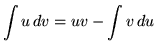
As of right now, we don't know enough to figure this out. But that's why we have integration by parts! Specifically, it states the following:
Integration by parts: Suppose and are continuously differentiable functions. Then
We can also write this as
Do you see how this technique is the counterpart of the product rule for derivatives? First, think about it!
To see why, let's rewrite the equation as Aha! This resembles the product rule for derivatives: Let's see what happens when we integrate both sides: By the Fundamental Theorem of Calculus, the left hand side is equal to . So, we get which is precisely the formula given above.
Now that we know where this technique comes from, let's try and use this technique for the previous problem! To do so, we let and . Then and (Here, we can ignore the term.) So, plugging it into the formula for integration by parts
In general, the trick is to make the function that can ``disappear'' when you differentiate it. (For example, in the previous example we set because .
Now you try!
Evaluate
Let's try this together: As before, we want to make the function whose derivative disappears quickly. So, we set and . Then and So, plugging these values into the formula for integration by parts, we have and we're done.
Let's look at one more problem together:
Integrate
As you've probably noticed, the integrand appears to have only one function! Well, not quite. We can see that the integral is actually So, one trick would be to let and . So, and So, using integration by parts we get So, integration by parts helped again (this time, a bit sneakily)!
Like in the previous problems, his technique becomes very useful as we approach more complicated integrals. Find out how else this can be used on the next section!