Read · 9 min
We are beginning to study thermodynamics. Thermodynamics studies changes in energy. To start, I'm going to write a lot about energy. There is a lot of confusion about it. I know I was confused for a long time. Even in college, my professors didn't explain it well. At times, it seemed almost magical. One moment it's one thing. The next moment it's something different. So, let's be sure we understand energy. After we've built our foundation, we'll look at internal energy. Internal energy is the starting point of thermodynamics.
How Does Energy Work?
There are four things we must understand.
-
Energy is a possession.
-
Energy is stored.
-
Energy is transferred. The transfer causes some change.
-
Energy always retains its identity.
What's a helpful metaphor for understanding energy? Money! For example, I possess some amount of it in my bank account. Other people have more or less. If I want to, I can store it in my bank account. Or I could keep it in a Folger's coffee can under my bed. When I buy something, it transfers to someone else. I have less money, and they have more. Obviously, the amount they gained equals what I lost. Now, they have the option of putting it in the bank or a Folger's can. Either way, it's still money.
But, what about chemistry? Every chemical system possesses energy. They have two ways to store it: kinetic and potential energy. Kinetic energy is stored as movement. In chemistry, potential energy is stored in electrostatic interactions. Both kinetic and potential can be transferred. The transfer can be between the same forms. Just like, I can transfer money from one bank account to another. But, it can also be between different forms. This would be like moving my money from my bank account to my coffee can. Either way, the total energy stays the same.
You'll notice that I say forms of energy. I hesitate to use "types of energy." That's because energy is energy. The difference between kinetic and potential energy is in how it's stored. When I first learned about energy, "types of energy" was confusing. It made me think that kinetic and potential energy are different. But, the difference is the storage method. That's why our last rule is, "energy retains its identity."
What is Energy
First, we need to understand what energy is. Money is an excellent analogy because energy is like currency. The more money I have, the more I can buy. One hundred dollars doesn't purchase a mansion. One hundred million dollars does. The more energy I have, the more I can cause change.
In chemistry, we focus on chemical change. For example, does our system have enough energy to start a chemical reaction? That's the activation energy. Sometimes, we care about physical changes. For example, a pressure change might move a piston.
But, what does change mean? In science, a change means we applied a force. Energy's units are Joules (). The Joule is a Newton-meter. That's a force multiplied by a length. So, one Joule is the energy transferred to an object when one Newton of force is applied for one meter. In chemistry, the distances are tiny. But, the forces can be enormous.
How is Energy Stored?
Let's consider kinetic energy. The faster something moves, the more kinetic energy it has. But remember, there are different motions. Translational is moving from point A to point B. Rotational is the spinning of atoms or molecules. Finally, vibrational is the bending and stretching of bonds. Kinetic energy is stored in the molecule's movements.
What about potential energy? It can be confusing. But, you need to remember two things. All energy comes from forces and distances. If you change either, the potential energy changes.
How do we describe forces? With fields. For example, you may have heard of gravitational or electric fields. What do fields look like? You'd see arrows pointing in all directions. They represent the force's strength and direction. If the force pushes, it points outward. If the force pulls, it points inward. The longest ones are closest to the object. The closer you get, the greater the force. As you move away, the arrows shrink and eventually disappear.
Potential energy changes as objects move closer or further. That's because the field's strength changes. If we move a little closer, the force is strong. A little further, it's weaker. Anytime the forces change, our energy changes.
Let's think about an example. The sun is so large, its gravitational field pulls the earth. Why does our planet not crash into the sun? Its kinetic energy! The energy of the earth's orbit exactly balances the sun's gravitational pull. The kinetic energy equals the gravitational potential energy. Our planet is exactly the correct distance from the sun. What if we were a meter closer? Remember, moving within a field changes the potential energy. The gravitational potential energy would be greater. So, the earth would be pulled into the sun. That's a bad day for mankind.
But, what about chemistry? Atoms and molecules are tiny. So, they don't exert gravitational pulls. Instead, they have electric charges. Electric charges produce electric fields.
Consider two cations. The closer they are, the more they repel. But, a cation and anion will attract. When an anion and cation bond, their electric fields cancel. In chemistry, you'd have an ionic bond. They achieve a low energy state. So, they're stable. It takes a lot of energy to separate the two charges! That's the bond energy.
What about covalent bonds? In covalent bonds, the electric fields don't entirely cancel. Instead, by sharing electrons, the atoms minimize their electric fields. That's why covalent bonds are weaker than ionic bonds. The atoms' nuclei are attracted to the electrons. But, what if we were to push the nuclei together? It wouldn't take much for the protons to repel. A covalent bond delicately balances the nucleis' repulsions and attractions.
How is Energy Transferred?
How is kinetic energy transferred? Through collisions! Let's say a fast molecule slams into a slow one. After they hit, the slow one will be moving faster. The faster one will be moving slower. If we calculated the total energies before and after, they'd be equal. Sometimes, the collisions are so strong, they break bonds. When bonds are broken and formed, potential energy changes. So, we can see the transfer between kinetic and potential energies.
How is potential energy transferred? Anything that alters the electric field changes the potential energy. Are bonds broken? If so, the electrons moved. The electric field changed. So, the potential energy changed. Were new bonds formed? Same thing.
How can potential energy be transferred to kinetic energy? It's mostly from repulsion. Imagine we could hold two cations right next to each other. Their electric fields would point in opposite directions. They want to get away, and their potential energy would be immense. What if we suddenly let go of the charges? They would zip away. The potential energy was transferred to kinetic energy.
Thermodynamic's Foundation: The First Law of Thermodynamics
Now that we understand energy, we can start thermodynamics. You've heard the first law of thermodynamic. It's, "energy is never created or destroyed, only transformed." So, energy is conserved. That's why we can say, "energy always retains its identity." No matter how it is transferred, we end with the same amount as we began.
Personally, I dislike the word transformed. It sounds like it becomes something else. I prefer the word transferred. Then we can think about the mechanism. For example, let's consider phase changes. Recall a phase change diagram. The graph has flat lines that happen at melting and vaporization. Many people would say that heat or thermal energy became potential energy. But, what's really happening? The heat is causing the molecules to move more. We are increasing their kinetic energy. Eventually, they have enough kinetic energy to overcome the intermolecular forces.
Furthermore, what is heat? Let's say we have a beaker of liquid water on a hot plate. The hot plate's molecules collide with the beaker's. The hot plate's molecules have more kinetic energy. So during the collision, the beaker molecules gain kinetic energy. Next, the beaker's molecules collide with water. Some of the kinetic energy is transferred to the water. Eventually, some water molecules have enough kinetic energy to overcome the hydrogen bonds. So, they enter the gas phase. Heat is really just transferred kinetic energy. The transfer happens because of the temperature differance.
The Equation for The First Law of Thermodynamics
We can express the conservation of energy mathematically.
-
is the internal energy. It's the basis of thermodynamics so, we'll look at it in more detail below.
-
is the heat. Heat is the transfer of energy caused by temperature differences.
- Heat causes a change in the molecules' movements.
- Positive means our system gained heat.
- Negative means our system lost heat.
- is work. Work is the amount of transferred energy from exerting a force. For example, consider an ideal gas. Let's increase its temperature. From the Ideal gas law, we know our system's pressure increased. Let's say the pressure increase moved a piston. The work done is the energy required to move the piston.
- Work causes a change in the system or surroundings.
- If work is positive, the surroundings act on the system.
- If it's negative, the system acts on the surrounding. In our example, work is negative because the gas moved the piston.
- Be aware, in physics, the convention is flipped.
- Our next lesson is on work.
What Exactly is Internal Energy?
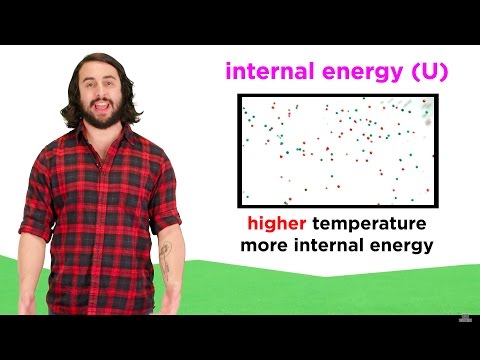
So, what exactly is internal energy? It's the energy a system. It is the sum of all the potential and kinetic energies. For example, let's say we have a glass of water sitting on a table. The water's internal energy is all the molecules' kinetic and potential energies. What if I picked up the glass and threw it? I didn't change the internal energy. The whole system now has kinetic energy because it's flying through the air. But, the energy of the water molecules is the same.
Internal energy is an extensive property. It changes with the amount. For example, 50.0 grams of water has less internal energy than 100.0 grams of water.
Internal energy is also a state function. A state function does not depend on the path. For example, let's say I heated 100 milliliters of water from 25.0 celsius to 30.0 celsius. Let's say I took another 100 milliliters of water from 25.0 celsius to 35.0 celsius. Next, I cooled it from 35.0 celsius to 30.0 celsius. Now both sets of water have the same temperature. They also have the same internal energy. It did not matter that I cooled the second one.
Thermodynamics is all about how internal energies change. As you study, you will learn how to calculate heat and work. Sometimes, it will look different for various systems. But, your goal is always to understand the change in internal energy.