Intersection of Sets - Definition & Examples

Before this, knowSet-Builder Notation - Definition & ExamplesSubsets and Complements - Definition & Examples

Interactive · 5 questions

Intersection of Sets

The intersection of two (or three, or four, or more) sets contains the elements common to all of the sets. The intersection of sets is a set, itself!

The intersection of sets AA and BB (denoted as A∩BA \cap B) is the set containing the elements that are in both AA and B!B!

Here is a graphic that visually represents the intersection of sets using Venn diagrams:
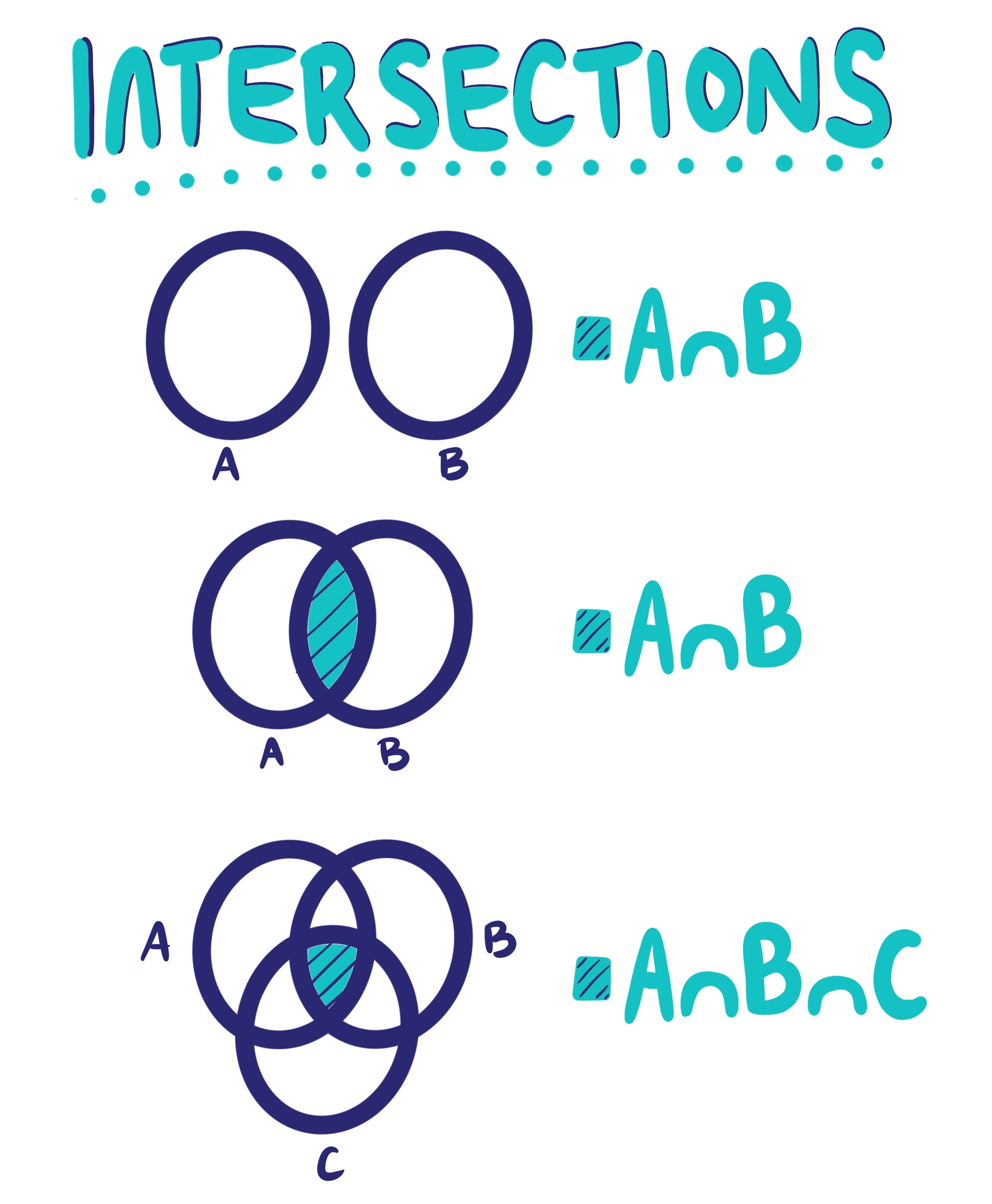
Visual representation of the intersection of sets using Venn diagrams. On the first line, sets A and B do not intersect, on the second line sets A and B intersect, and on the third line sets A, B, and C intersect. The regions of intersection are denoted in turquoise.

Image source: by Caroline Kulczycky

Example

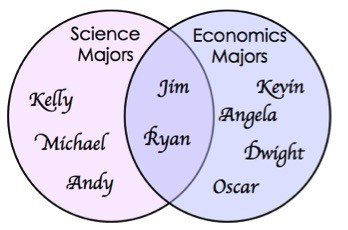
Let's start off with an easy example, using just two sets. Consider the following sets: A={a,b,c,d}A = \{a, b, c, d\} and B={c,d,e}.B = \{c, d, e\}.

A = {a, b, c, d} and B = {c, d, e}

Image source: by Caroline

What is A∩B?A \cap B? (Hint: make a Venn diagram with sets AA and B!B!)

Choose one answer

Video · + 1 min read

(Video) Sets: Union and Intersection

by patrickJMT

This video by PatrickJMT explains unions and intersections of sets.

Summary\large{\text{Summary}}

The union of two sets is the set containing all the elements that appear in either of the sets. We use the symbol ∪\cup. The union of set AA and set BB is the set of all the elements that are in either set AA or\textbf{or} set B.B.

An intersection of two sets is the elements that appear in both of the sets. We use the symbol ∩\cap. The intersection of set AA and set BB is the set of all the elements that are in set AA and\textbf{and} set B.B.


Suppose we had the following sets: A={a,b,c,e}B={b,f,g}A=\{a,b,c,e\}\quad B=\{b,f,g\} Let's say we want to find the intersection of these sets. This intersection is represented as A∩BA\cap B.

Since the intersection contains all of the elements that appear in both sets, we just look at each set and list the elements that appear in both. In this case, the only element that both sets share is bb. So, A∩B={b}A\cap B=\{b\}

Let's look at another example. Suppose we have the following sets: A={1,3,5,7,9,⋯ }B={2,4,6,8,10,⋯ }A=\{1,3,5,7,9,\cdots\}\quad B=\{2,4,6,8,10,\cdots\} What is A∩BA\cap B?

Since AA is the set of all positive odd numbers and BB is the set of all positive even numbers, there will be no elements that appear in both. An odd number cannot ever be even, and an even number cannot be odd. Therefore, the intersection is the empty set, the set with no elements in it. A∩B={}=∅A\cap B=\{ \} = \emptyset

Interactive · 4 questions

Intersection of Sets

Let's say we have two sets, AA and BB. The intersection of sets AA and BB includes all of the values that are shared between them.

Think of it like a Venn diagram:

A: 1, 3, 6, 8, 9, 5, 7
B: 2, 4, 5, 7
A and B: 5, 7

Image source: by Hannah Bonville

In the case of the Venn diagram above, set AA is in purple and set BB is in pink. The intersection of set AA and set BB is the part where these two sets overlap.

How could we write set AA using roster form?

Choose one answer

Interactive · 1 question

Sometimes, you might get a problem like this:

‘‘x``x and yy are real numbers such that {2x+3}∩{4x−1}={y}\{2x + 3\} \cap \{4x -1\} = \{y\}. Find y."y."

How do we solve this?

Since there is one value for x,x, the evaluation of 2x+32x + 3 will either be exactly the same or completely different than the evaluation of 4x−1.4x -1. In other words, after we plug xx into both expressions, the resulting numbers will either be the same or different.

Option A: They Evaluate to Different Numbers

Let's say that 2x+32x+3 evaluates to aa and 4x−14x-1 evaluates to bb where a≠b.a \neq b. Then: {2x+3}∩{4x−1}={y}{a}∩{b}={y}, after we evaluate at x∅={y},(a≠b so {a} and {b} have no common elements)\begin{align} \{2x + 3\} \cap \{4x -1\} &= \{y\}\\ \{a\} \cap \{b\} &= \{y\}, \small{\text{ after we evaluate at $x$}}\\ \emptyset &= \{y\}, \small{(a \neq b \text{ so }\{a\} \text{ and } \{b\} \text{ have no common elements})} \end{align}

But remember, the empty set has no elements in it! So, if {y}=∅={ },\{y\}= \emptyset = \{ \: \}, it must not exist! However, remember that the problem says that yy is a real number. Thus, yy cannot equal ∅,\emptyset, and Option A is not possible.

Option B: They Evaluate to the Same Number

Let's say that 2x+32x + 3 and 4x−14x-1 both evaluate to a,a, which will be a real number. Then: {2x+3}∩{4x−1}={y}{a}∩{a}={y}, after we evaluate at x{a}={y}a=y\begin{align} \{2x + 3\} \cap \{4x -1\} &= \{y\}\\ \{a\} \cap \{a\} &= \{y\}, \small{\text{ after we evaluate at $x$}}\\ \{a\} &= \{y\}\\ a&= y \end{align} Here, y=a,y=a, a real number! Option B works!

Solving the Problem

Now we know that we need 2x+32x + 3 and 4x−14x-1 to evaluate to the same number. In other words, to solve the problem, we need to set 2x+32x + 3 and 4x−14x-1 equal to each other. Then, we'll solve for xx, and finally we'll use our knowledge of intersection of sets to solve for y.y. Here's how it works:

Step 1: Solve for xx

2x+3=4x−12x − 4x+3=4x − 4x−1−2x+3=−1−2x+3 − 3=−1 − 3−2x=−4−2x−2=−4−2x=2\begin{align} 2x+3 &= 4x-1\\ 2x\,{\color{#8925AE}{-\,4x}}+3&=4x\,{\color{#8925AE}{-\,4x}}-1\\ -2x+3&=-1\\ -2x+3\,\color{#8925AE}{-\,3}&=-1\,\color{#8925AE}{-\,3}\\ -2x&=-4\\ \frac{-2x}{\color{#8925AE}{-2}}&=\frac{-4}{\color{#8925AE}{-2}}\\ x&=2 \end{align}

Step 2: Plug in x=2x=2 to solve for y:y:

{2x+3}∩{4x−1}={y}{2(2)+3}∩{4(2)−1}={y}{4+3}∩{8−1}={y}{7}∩{7}={y}{7}={y}7=y\begin{align} \{2x + 3\} \cap \{4x -1\} &= \{y\}\\ \{2({\color{#8925AE}{2}}) + 3\} \cap \{4({\color{#8925AE}{2}}) -1\} &= \{y\}\\ \{4 + 3\} \cap \{8 -1\} &= \{y\}\\ \{7\} \cap \{7\} &= \{y\}\\ \{7\} &= \{y\}\\ 7&=y \end{align}

So, y=7.y=7. Let's try another one to practice!

xx and yy are real numbers such that {5x+15}∩{7x+7}={y}\{5x+15\} \cap \{7x+7\} = \{y\}. Find y.y.

Choose one answer

Interactive · 2 questions

The intersection of sets is the elements that they share

A∩BA \cap B is read as "AA intersection BB". The intersection of sets AA and BB contains all the elements that are in both AA and BB. In other words, all the elements in the intersection A∩BA \cap B will also be elements of both of AA and BB.

In set builder notation, we can say that: A∩B={x∣x∈AA \cap B = \{x \mid x \in A and x∈B}x \in B\}.

Examples:

{1,2,3}∩{3,4}={3}\{1, 2, 3\} \cap \{3, 4\} = \{3\}

33 is in both the set before the ∩\cap and the set after it, so it's in the intersection. Since no other elements overlap, 33 is the only thing in the intersection. {3,7,9}∩{{2,3},4}=∅\{3, 7, 9\} \cap \{\{2, 3\}, 4\} = \emptyset The two sets have no elements in common, so their intersection is the empty set, ∅,\emptyset, or the set with no elements in it. The empty set can also be represented like this: { }.\{\: \}. {1,2,3}∩{1,2,3}={1,2,3}\{1, 2, 3\} \cap \{1, 2, 3\} = \{1, 2, 3\} This is a universal set because it contains all of the elements.

Test Yourself

What is the intersection of {5,6,2,{1,2}}\{5, 6, 2, \{1, 2\}\} and {5,6,2,{1,2}}\{5, 6, 2,\{1, 2\}\}?

Choose one answer

Type a concept, like “slope” or “photosynthesis”.

↑ ↓ to choose · Enter to openSearch explanations and problems