Interval and Set-Builder Notation - Compound Inequalities

Interactive · 3 questions

Interval Notation and Set-Builder Notation for Intervals

Earlier, we learning about writing inequalities. We saw how to graph linear inequalities. Now, we'll look at intervals, specifically interval notation and set-builder notation.

An interval is one of the simplest infinite sets of reals. It's just the continuous block of real numbers between two endpoints.

There are several types of intervals, among them closed intervals and open intervals. The two types differ in whether they contain their endpoints.

A closed interval is denoted [a,b][a, b]. It is the set of real numbers between aa and bb, including both aa and bb.

Which of the following sets is correct set-builder notation for [a,b][a, b]?

Choose one answer

Video · + 1 min read

(Video) Linear Inequality Interval Notation

by mathman1024

This video by mathman1024 goes over interval notation.

Summary

You find the bounds of the solution and put them in between parentheses (   )(\ \ \ ) if the number is not included or brackets [0][\phantom{0} ] if the number is included. For example if you wanted to use interval notation to express the solutions to the inequality x>5x>5 you would write:

(5,∞)(5,\infty)

This says that any number between 55 and infinity (not including 55) is a solution to the inequality. We always use a parentheses with infinity. This is because infinity is not a real number, and therefore can't be included in an interval.

Let's look at some of the examples he goes over on a number line!

Example 1

The interval on the real line of all numbers greater than or equal to $7$.

Image source: by Alex Federspiel

First, look at the circle. Since it's closed we know that we use a bracket. Next, we find the bounds. This one starts at 77 and goes on to infinity. So we would write: [7,∞)[7,\infty)

Let's look at another.

Example 2

The interval of real numbers greater than $-12$ and less than or equal to $3$.

Image source: by Alex Federspiel

In this one we see the first number has an open circle which indicates that we should use an open parenthesis, i.e. ((. The second circle is closed so we use a closed bracket, i.e. ]]. Next, we find the bounds. This one starts at −12-12 (not including it) and ends at 33. So we would write: (−12,3](-12,3]

He does a few more examples but the final one is also very important.

Example 3

The real numbers less than $\frac{1}{2}$ or greater than or equal to $5$.

Image source: by Alex Federspiel

This example has two different sets of intervals. The first is from negative infinity to 12\frac12 (so, including all negative numbers) and the second is from 55 to infinity (i.e., greater than or equal to 55). When there are multiple intervals you string them together with the union symbol, ∪,\cup, which we also use when we are finding the union of sets. Our solution is: (−∞,12)∪[5,∞)\bigg(-\infty,\frac12\bigg)\cup[5,\infty)

Illustrated · 1 min

Interval Notation for Compound Inequality

We can use interval notation to represent the solutions of a compound inequality. Before we see how, let's review interval notation.

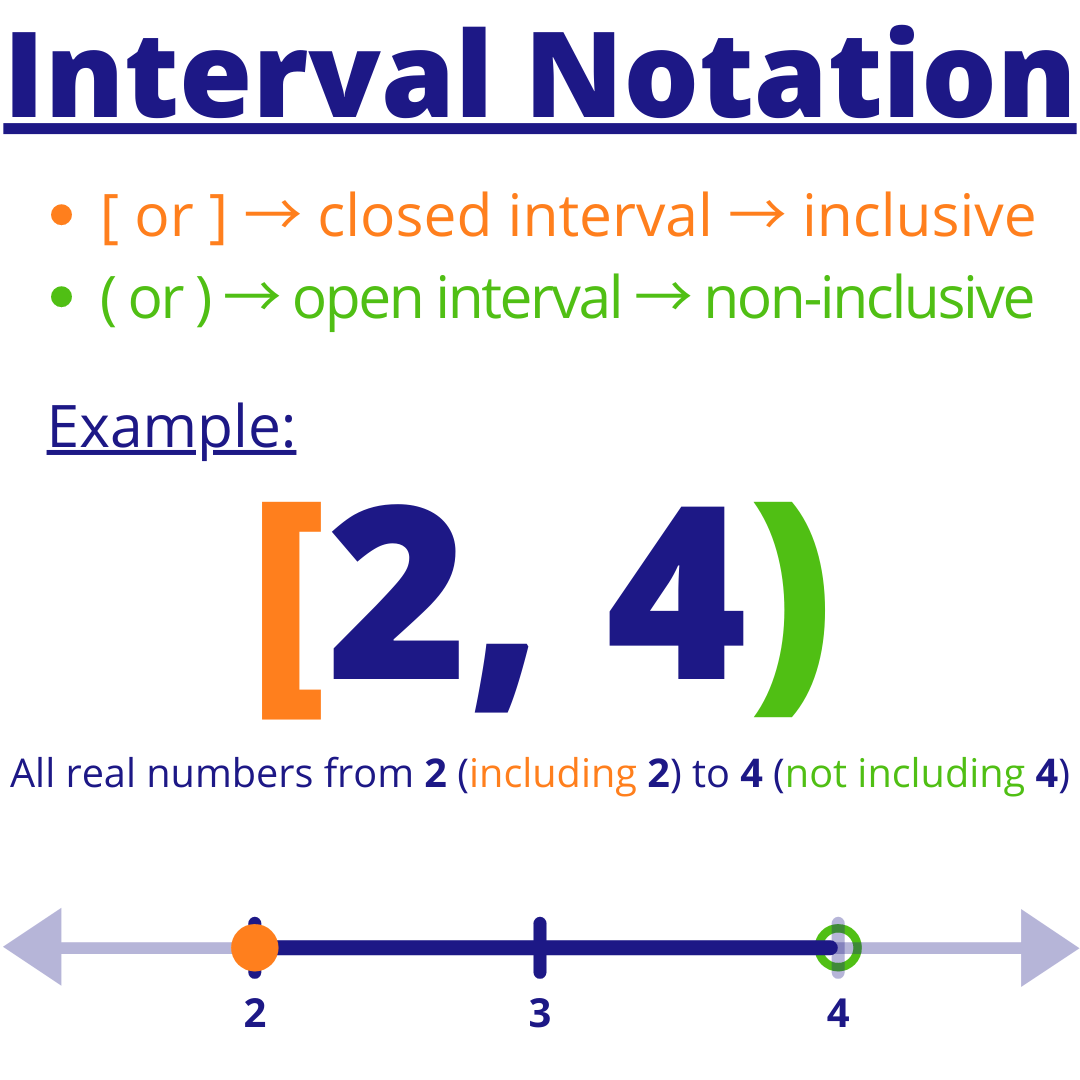
Interval Notation. [ or ] means closed interval or inclusive. ( or ) means open interval and non-inclusive. Example: [2, 4) means all real numbers from 2 (including 2) to 4 (not including 4). On a number line, it is the area between 2 and 4 (with a solid dot on the 2 denoting that we are including 2 and an open circle around the 4 denoting that we are not including 4).

Image source: By Caroline Kulczycky

AND Example

We can represent AND compound inequalities with one pair of numbers in interval notation: x>1 AND x≤5⇒(1,5] in interval notationx>1 \text{ AND } x \le 5 \Rightarrow (1, 5] \text{ in interval notation}

OR Example

For OR compound inequalities, we need a union of our interval notation sets.
x<1 OR x≥5⇒(−∞,1)∪[5,∞) in interval notationx<1 \text{ OR } x \ge 5 \Rightarrow (-\infty, 1) \cup [5, \infty) \text{ in interval notation}

Type a concept, like “slope” or “photosynthesis”.

↑ ↓ to choose · Enter to openSearch explanations and problems