Interactive · 3 questions
+4 contributors



Interval Notation and Set-Builder Notation for Intervals
Earlier, we learning about writing inequalities. We saw how to graph linear inequalities. Now, we'll look at intervals, specifically interval notation and set-builder notation.
An interval is one of the simplest infinite sets of reals. It's just the continuous block of real numbers between two endpoints.
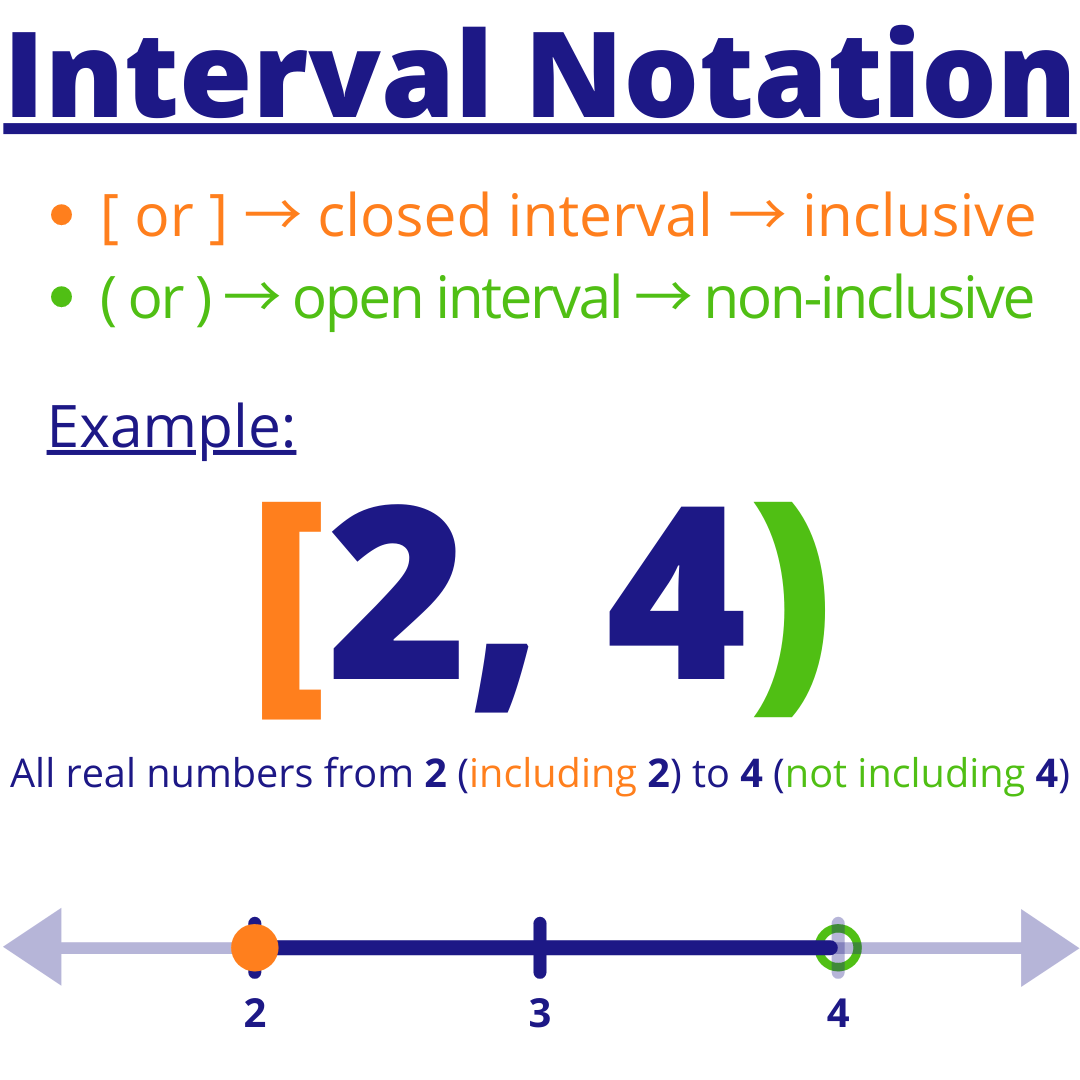
There are several types of intervals, among them closed intervals and open intervals. The two types differ in whether they contain their endpoints.
A closed interval is denoted . It is the set of real numbers between and , including both and .
Which of the following sets is correct set-builder notation for ?
An open interval is denoted . It is the set of real numbers between and , but not including or .
Which of the following sets is correct set-builder notation for ?
Sometimes, you will see half-open intervals or . These include one of their endpoints. The endpoint with the square bracket is included, the endpoint with a parentheses is not.
Which of these intervals contain ?
Interval Notation and Infinity
Some intervals include all real numbers. This means the endpoints are and . These intervals cannot include infinity, because infinity is not a real number. The correct interval notation for the set of all real numbers is .