
Illustrated · 2 min
Distance
When it comes to the universe, everything is quite large. When we look at the scale of the universe, things are measured not in kilometers, but in light years. Light, at the speed of meters per second, travels trillion kilometers in a single year. You would have to go around the earth million times to cover that distance. The numbers are astounding. Our nearest neighbor, Alpha Centauri is light years away. These huge distances mean that whenever we look up to the sky, we look into the past. But, wouldn't it be great to know how far away those stars actually are, to know how long that light has taken to reach us. Well, Trigonometry has offered a nifty way to do this for stars closer to home.
Measuring Distances with Parallax
Parallax is the displacement of an object that is caused by a change in the point of view of an observer. An easy way to observe this effect is to look at an object first with only your left eye, and then with your right. It will seem that the object has moved.
Usign this effect, the distance to a star can be measured. As Earth orbits our sun, a star that is close enough will seem to move against a background of far away stars, similar to how the object you looked at seemed to move when you switched eyes. So, Astronomers can measure a stars position once, and then six months later measure its position again and calculate its change in position. The apparent motion of the star is called stellar paralax.
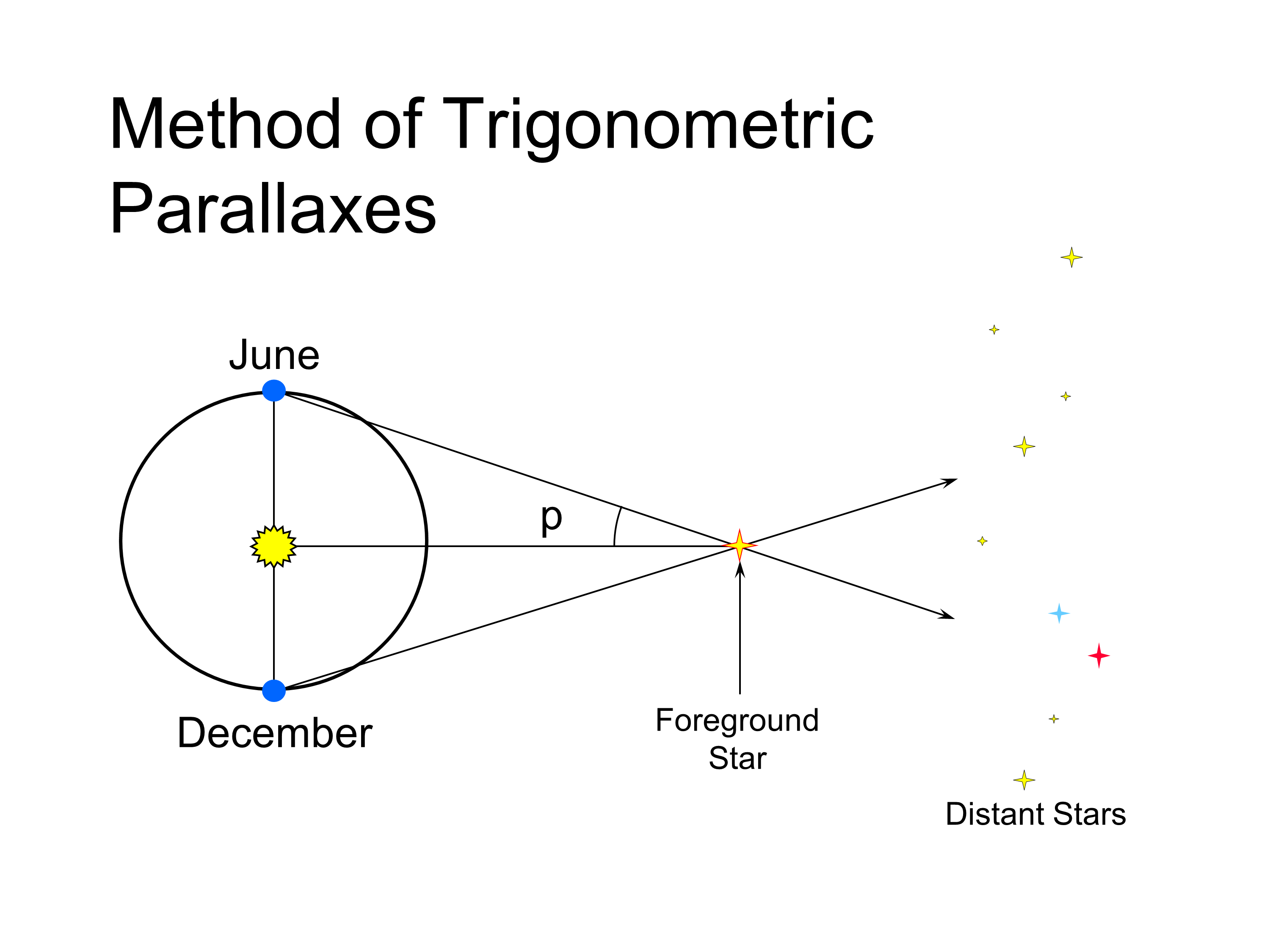
When it comes to calculating distances with parallax, though, its is much easier to stick the AU unit, as it describes the distance between the Earth and the Sun. This AU is equivalent to light years.
Given the paralax angle and the distance between the Earth and the sun, calculating the distance is as simple as using right triangle trigonometry by dividing 1 AU by the tangent of the parallax angle :
And to put this back to light years simply multiply by .