Read · 1 min

So what are Electromagnetic Waves?

Well to start off, electromagnetic waves do NOT require matter to travel. Electromagnetic waves can travel through space (which is a vacuum), so we can identify many bodies in space because of that.

There are several types of electromagnetic waves:

Radio Wave: The longest electromagnetic waves, with a wavelength of about 1 to 300,000,000 meters (in a vacuum), are often used for cell phones, televisions, and radios.

Microwave: With a wavelength of 1 millimeter to 1 meter, microwaves are often used to send information.

Infrared: Infrared light is often used to detect heat; it has a wavelength of 700 nanometers to 1 millimeter.

Visible Light: Visible light is the only wavelength visible to the naked eye, hence the name "visible light", and is (obviously) used by humans to see, or detect objects that interact with this wave. Its wavelength of 390 to 700 nanometers is smaller than the average bacteria.

Ultraviolet: Often known for creating stunning pictures of the universe and causing sunburns, Ultraviolet light has a wavelength of 10 to 390 nanometers. Some people can see ultraviolet light of a certain wavelength. It also creates pyrimidine dimers in DNA which is the primary cause of skin cancer.

X-Ray: Often used in, you guessed it, an X-Ray machine, with a wavelength of 0.01 to 10 nanometers (about the size of an atom), are also used to detect black holes and neutron stars.

Gamma Wave: The smallest electromagnetic wave, with a wavelength about the size of a nucleus, can kill cells, and can be used as a cure for cancer.
Read · 2 min

Electromagnetic waves do not require a medium to transfer energy, or for the waves to travel. A medium is matter that helps tranfer energy. Instead they can move through empty space. This helps scientists and astronomers analyze celestial bodies in space. There are 7 types of electromagnetic waves, but their wavelengths classify them as to what wave they are. All of the types have different wavelength but they all travel at the same speed- about the speed of light.

Radio Waves: These waves have the longest wavelength of anywhere from 1 millimeter to 42 kilometers. These waves are given off by all celestial bodies and they can be artificially created for television signals, cellular mobiles and radios.

Microwaves: These have smaller wavelengths than the radio waves. These can be used in weather forecasts and for sending information from one place to another because it can penetrate almost any type of weather. There is also Cosmic Microwave Background Radiation. This is a single low frequency sound throughout the entire Universwe from all directions. This is beleived to be a clue to the Big Bang- the creation of the Universe.

Infrared Waves: These waves are even smaller than microwaves and these are used in detecting temperature. Warmer objects emit more infrared waves and colder objects emit less waves. On the infrared scale, red is hot and blue is cold. It is used to detect heat.

Visible Light: These are the only waves a human can see. Each color has a certain wavelength and there is a single range of wavelength that we can see. When these colors are seen together, it is white light. When this white light is seen through a prism or water vapor, it is seen as the colors of the rainbow. Visible light can help astronomers enhance the regions of planets.

Ultraviolet Rays: These waves are emitted by all stars, including our sun. These rays are harmful to our skin. These rays allow astronomers to look at galaxies and look at the structure of the galaxies.

X-Ray: This wave has the second smallest wavelength of the electromagnetic waves. These waves can penetrate through skin, but not through bones, where they rebound back. This is how we get out images when we injure ourselves.

Gamma Rays: These are the waves with the smallest wavelength. These gamma rays are emitted in the hottest regions of space. They can also be created in labs. They are very dangerous for humans. They can be used to cure cancer and sterilize medical equiptment.

Illustrated · 2 min

Electromagnetic waves are the synchronized oscillations of electric fields and magnetic fields. The acceleration of any charged particle can create the electromagnetic waves.

If you want to know about different kinds of electromagnetic wave, you can visit this following link - https://www.expii.com/t/introduction-to-electromagnetic-waves-1783?type=explanation&id=1761

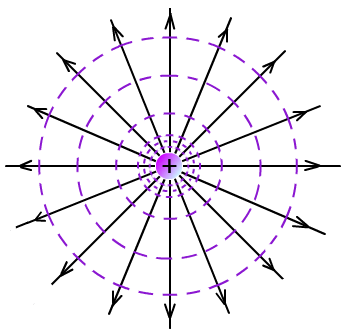
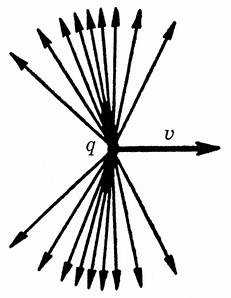
In brief, if we want to understand how electromagnetic waves form, we have to look at the change of electric field due to the motion of charged particles. If a charged particle is in motion it will make e different electric filed in vacuum than the electric field which is created due to a stationary charged particle. The electric field due to a stationary charged particle is uniform at a distance r. But the value of electric field due to a charged particle which is in motion is not uniform in all orientations. You will find some denser electric intensity perpendicular to the motion of the particle than the points which stay along with the direction of motion.

Electric field of a stationary charge particle

Electric field due to the motion of a charged particle

The electric intensity due to a stationary charged particle is completely different than that of the moving particle. Now if you think to move a stationary charged particle with a velocity v, a distant observer, who measures the intensity of the electric filed of the charged particle won’t suddenly feel the change of the electric intensity due to the motion of the particle. If he is 3⋅1083\cdot10^83⋅108 m away from the particle, he will feel the change of field after 1 second.Wow!! This is the speed of light. So we can claim that the change of electric field due to the acceleration of any charged particle travels with the speed of light. This information not only travels at the speed of light but also this information is light itself.

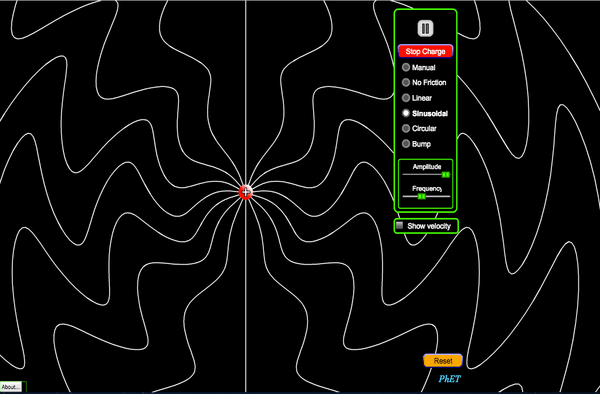
Now if you decide to stop the particle and again move it and continue do this process, you will get something like the following picture-

It looks like a wave!!

This oscillation is nothing but the electromagnetic wave where the visible light is one of the sub-sets of the electromagnetic waves.

Type a concept, like “slope” or “photosynthesis”.

↑ ↓ to choose · Enter to openSearch explanations and problems