Illustrated · 1 min

Introduction to Magnetism

  1. Causes of a magnetic field (B⃗\vec{B}): A moving charge, unpaired electrons and preferential orientation of electrons. (The arrows represent the orientation of the electrons)
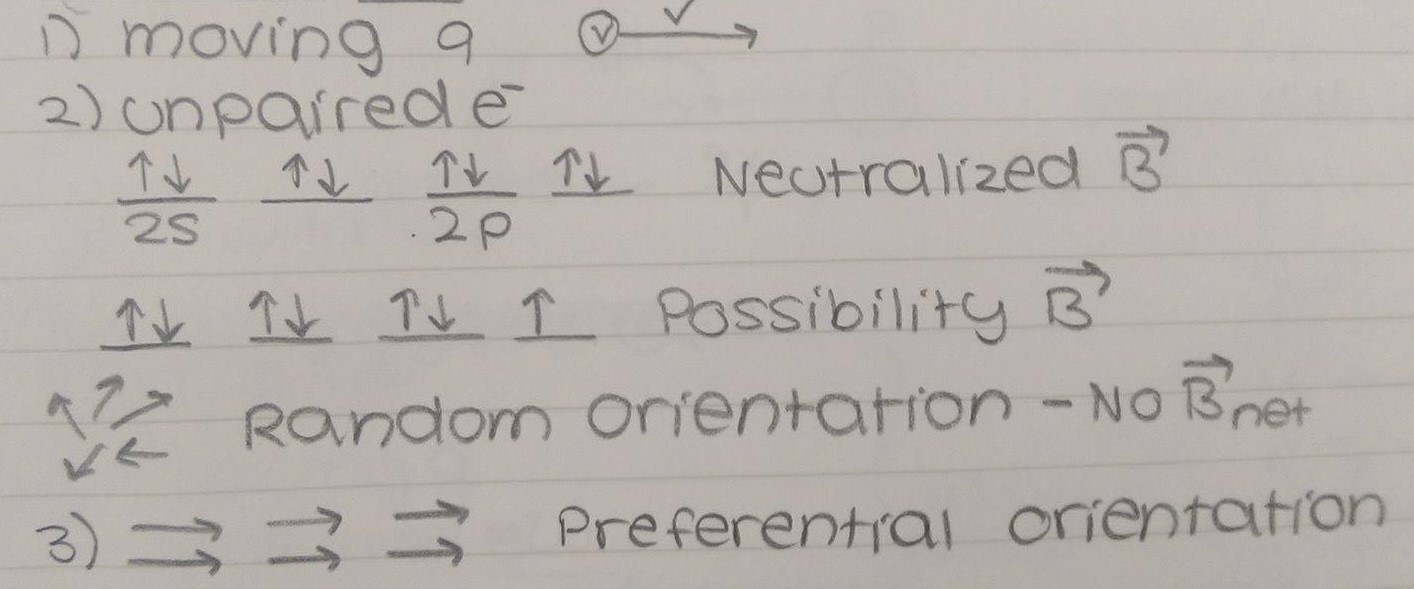
Handwritten notes on what causes a magnetic field: a moving charge with velocity v; unpaired electrons, where paired spins cancel B but one unpaired spin leaves a possible B; and random versus preferential spin orientation.
  1. Important formulas:

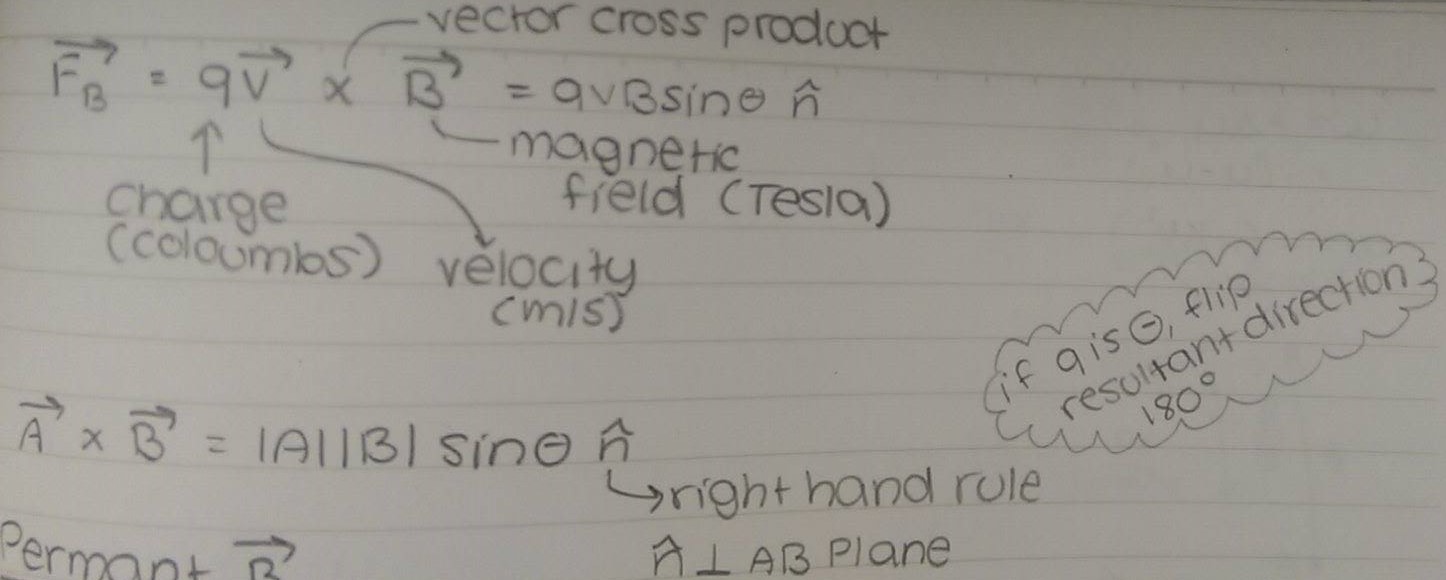
FB⃗=qV⃗\vec{F_B} = q\vec{V} x B⃗=qVBsin⁡θ\vec{B} = qVB\sin\theta

Handwritten notes: F_B = q v x B = qvB sin(theta), with q in coulombs, v in m/s and B in tesla; the force direction flips 180 degrees if q is negative. The cross product of A and B is |A||B| sin(theta), with direction by the right-hand rule.

FB⃗=Il⃗\vec{F_B} = I\vec{l} x B⃗=IlBsin⁡θ\vec{B} = IlB\sin\theta

  1. FB⊥V⊥BF_B\perp{V}\perp{B}

  2. Like poles repel and unlike poles attract

  3. B⃗\vec{B} lines are closed loops with no beginning or end
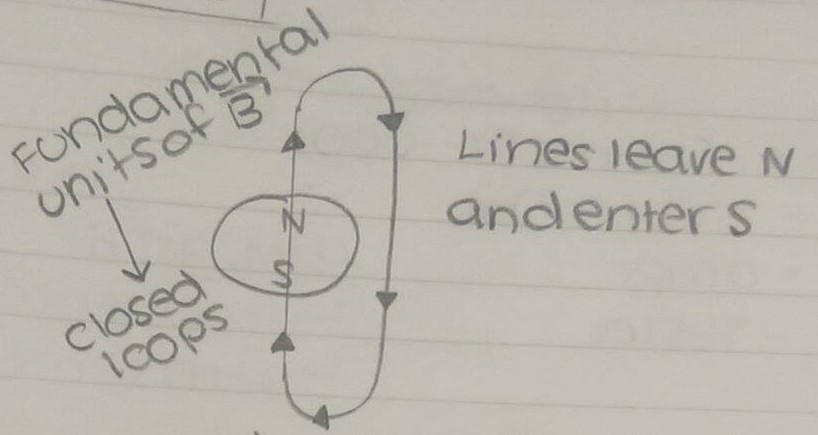
Field lines around a small oval marked N above and S below: a large closed loop leaves N, curves around and re-enters S, with arrows showing direction.
  1. Magnetic monopoles cannot exist because the north and south pole cannot exist without each other

Type a concept, like “slope” or “photosynthesis”.

↑ ↓ to choose · Enter to openSearch explanations and problems