Intro to Multiplying Rational Expressions

Before this, knowIntro to Rational Expressions, and Simplifying

Video · + 1 min read

(Video) Multiplying and Dividing Rational Expressions

by PatrickJMT

Here's another video by PatrickJMT where he works through a problem.

Summary\large{\text{Summary}}

Multiplying rational expressions is usually easier than adding or subtracting them.

When multiplying, the denominators do not need to match. Instead, you simply multiply the numerators together and then multiply the denominators together.

The result is a new fraction with the product on top and the product on the bottom. The main strategy is to factor and cancel. Let's see how this works with an example.

3x2+7x+2x2−2x−8⋅x2−3x−4x2+3x+2\frac{3x^2+7x+2}{x^2-2x-8}\cdot\frac{x^2-3x-4}{x^2+3x+2}

To multiply this as is would be tedious. Luckily, we can factor each of the quadratics to help make it easier.

The first polynomial can be factored into (3x+1)(x+2)(3x+1)(x+2). (3x+1)(x+2)x2−2x−8⋅x2−3x−4x2+3x+2\frac{(3x+1)(x+2)}{x^2-2x-8}\cdot\frac{x^2-3x-4}{x^2+3x+2}

The next can be factored into (x−4)(x+2)(x-4)(x+2). (3x+1)(x+2)(x−4)(x+2)⋅x2−3x−4x2+3x+2\frac{(3x+1)(x+2)}{(x-4)(x+2)}\cdot\frac{x^2-3x-4}{x^2+3x+2}

The third can be factored into (x−4)(x+1)(x-4)(x+1). (3x+1)(x+2)(x−4)(x+2)⋅(x−4)(x+1)x2+3x+2\frac{(3x+1)(x+2)}{(x-4)(x+2)}\cdot\frac{(x-4)(x+1)}{x^2+3x+2}

The final polynomial can be written as (x+1)(x+2)(x+1)(x+2). (3x+1)(x+2)(x−4)(x+2)⋅(x−4)(x+1)(x+1)(x+2)\frac{(3x+1)(x+2)}{(x-4)(x+2)}\cdot\frac{(x-4)(x+1)}{(x+1)(x+2)}

Now that we factored the polynomials, we can see that the first fraction has a common factor of (x+2)(x+2) and the second has a common factor of (x+1)(x+1).

(3x+1)(x+2)(x−4)(x+2)⋅(x−4)(x+1)(x+1)(x+2)\frac{(3x+1)\color{#8925AE}{(x+2)}}{(x-4)\color{#8925AE}{(x+2)}}\cdot\frac{(x-4)\color{Blue}{(x+1)}}{\color{Blue}{(x+1)}(x+2)}

Therefore, we can just cancel these out. (3x+1)(x+2)(x−4)(x+2)⋅(x−4)(x+1)(x+1)(x+2)=3x+1x−4⋅x−4x+2\frac{(3x+1)\cancel{\color{#8925AE}{(x+2)}}}{(x-4)\cancel{\color{#8925AE}{(x+2)}}}\cdot\frac{(x-4)\cancel{\color{Blue}{(x+1)}}}{\cancel{\color{Blue}{(x+1)}}(x+2)}=\frac{3x+1}{x-4}\cdot\frac{x-4}{x+2}

If we multiply these together, we see there's another common factor of (x−4)(x-4). (3x+1)(x−4)(x−4)(x+2)=3x+1x+2\frac{(3x+1)\cancel{\color{green}{(x-4)}}}{\cancel{\color{green}{(x-4)}}(x+2)}=\boxed{\frac{3x+1}{x+2}}

We've really simplified the denominator of the product!

Test Yourself: x−3x+4⋅x−2x−4\dfrac{x-3}{x+4}\cdot \dfrac{x-2}{x-4}

Choose one answer

Illustrated · 1 min

Multiply Rational Expressions

Our next lesson in simplifying rational expressions is to learn tricks of multiplying.

The trick is to simplify terms as much as possible before multiplying.

Example:

2425⋅5536\frac{24}{25}\cdot\frac{55}{36}. 2425⋅5536=24⋅5525⋅36\begin{align} \frac{24}{25}\cdot\frac{55}{36}&=\frac{24\cdot55}{25\cdot36} \end{align}

You can reduce the numbers now but it can be easier to follow if you put the numbers that can reduce on top of each other like so, 2425⋅5536=24⋅5525⋅36=24⋅5536⋅25\begin{align} \frac{24}{25}\cdot\frac{55}{36}&=\frac{24\cdot55}{25\cdot36}\\ &=\frac{24\cdot55}{36\cdot25} \end{align}

Now we can reduce these before multiplying. 2425⋅5536=24⋅5525⋅36=24⋅5536⋅25=(12⋅2)⋅(11⋅5)(12⋅3)⋅(5⋅5)=2⋅113⋅5=2215\begin{align} \frac{24}{25}\cdot\frac{55}{36}&=\frac{24\cdot55}{25\cdot36}\\ &=\frac{24\cdot55}{36\cdot25}\\ &=\frac{(\color{#8925AE}{12}\cdot2)\cdot(11\cdot\color{#8925AE}{5})}{(\color{#8925AE}{12}\cdot3)\cdot(5\cdot\color{#8925AE}{5})}\\ &=\frac{2\cdot11}{3\cdot5}\\ &=\frac{22}{15} \end{align}

So while we could have multiplied then reduced, it's easier and faster to reduce and then multiply.


Example:

x2+7x+12x2−9⋅x2−8x+15x2−12x+35\dfrac{x^2+7x+12}{x^2-9}\cdot\dfrac{x^2-8x+15}{x^2-12x+35}

First, we have to factor.

Factoring x^2+7x+12 and x^2-8x+15

Image source: by Alex Federspiel

factoring x^2-9 and x^2-12x+35

Image source: by Alex Federspiel

x2+7x+12x2−9⋅x2−8x+15x2−12x+35=(x+4)(x+3)(x+3)(x−3)⋅(x−3)(x−5)(x−5)(x−7)=x+4x−7\begin{align} &\dfrac{x^2+7x+12}{x^2-9}\cdot\dfrac{x^2-8x+15}{x^2-12x+35}\\ &=\frac{(x+4)\color{#8925AE}{(x+3)}}{\color{#8925AE}{(x+3)}\color{green}{(x-3)}}\cdot\frac{\color{green}{(x-3)}\color{blue}{(x-5)}}{\color{blue}{(x-5)}(x-7)}\\ &=\frac{x+4}{x-7} \end{align}

Interactive · 1 question

Multiplying rational expressions

Recall how we multiply fractions (without variables): 18⋅25=1⋅28⋅5=240=120\frac{1}{8}\cdot \frac{2}{5}=\frac{1\cdot 2}{8\cdot 5}=\frac{2}{40}=\frac{1}{20}

We multiply the numerators and multiply the denominators. We can simplify in the end, or before we multiply:

Multiplying rational expressions is exactly the same!

However, we usually simplify as much as we can before multiplying—this could make the multiplication easier!

Take a look at the example below. 2x2x3⋅x(x+1)2\frac{2x^2}{x^3}\cdot \frac{x(x+1)}{2}

Start by simplifying, then multiply.

Try the problem below!

Simplify and multiply: 3x(x+1)x⋅(x−1)2\frac{3x(x+1)}{x}\cdot\frac{(x-1)}{2}

Choose one answer

Illustrated · 1 min

Multiplying Rational Expressions

In this lesson, we will learn how to multiply rational expressions.

A rational expression is a fraction that has variables in it, like x2\frac{x}{2} or 3x4y\frac{3x}{4y}.

When we multiply regular fractions, we multiply the numerators (top numbers) together. Then we multiply the denominators (bottom numbers) together.

We follow the same steps when multiplying rational expressions.

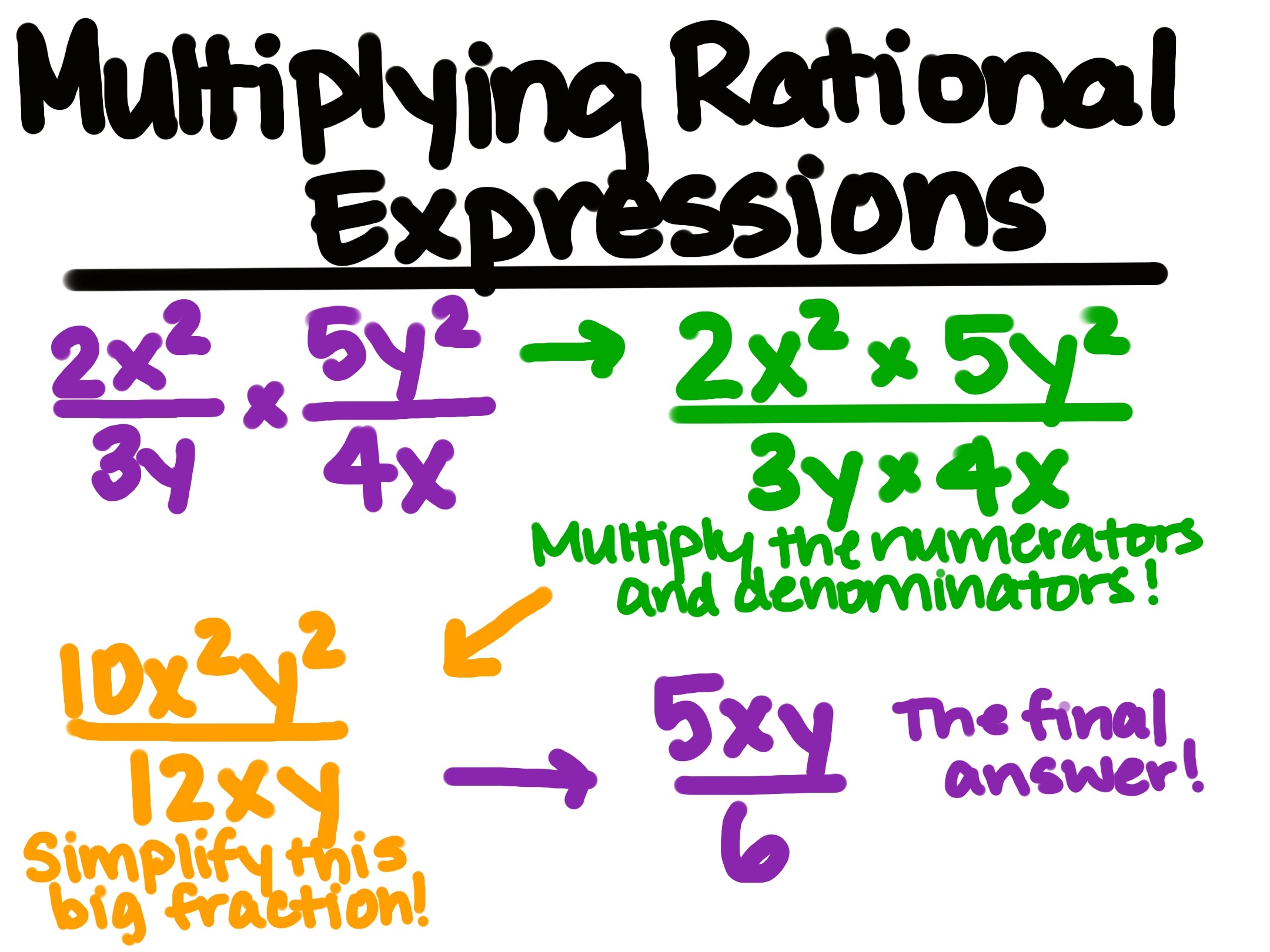
Multiplying Rational Expressions
1) Multiply the numerators and denominators
2) Simplify the big fraction
3) The final answer

Image source: by Anusha Rahman

Rational expressions can sometimes look messy.

Because of this, it is often easier to multiply first and simplify second. Multiplying first helps reduce the number of terms you have to work with.

This also lowers the chance of making mistakes.

A good rule to remember is: multiply, then simplify.

####Example

Let's walk through this example.

2x23y⋅5y24x\frac{2x^2}{3y} \cdot \frac{5y^2}{4x}

Our first step is the multiply the numerators:

2x2⋅5y2=10x2y22x^2 \cdot 5y^2 = 10x^2y^2

Next, we will multiply the denominators:

3y⋅4x=12xy3y \cdot 4x = 12xy

Finally, we will simplify the big fraction. We can see a common factor of 22, in both 1010 and 1212. We can also see common factors of xx and yy.

So, the final answer will be:

5xy6\frac{5xy}{6}

Always remember to look for common factors on the top and bottom. If the same factor appears in both places, you can cancel it out.

If the expression looks messy, try factoring first. Factoring makes it easier to see what can cancel.

Multiplying rational expressions is like solving a puzzle. You fit the pieces together first, and then clean everything up at the end.

Looking Further

Let's continue to build on this idea. In these lessons, you will learn how to:

Type a concept, like “slope” or “photosynthesis”.

↑ ↓ to choose · Enter to openSearch explanations and problems