Natural Logarithms
Next in the series on logarithms and exponential functions, we will tackle natural logs. This is a common logarithm that you will see frequently. The mathematical constant e arises naturally in continuously compounded interest.
We previously learned about Euler's number, e, and about logarithms. We can combine the two concepts to learn about natural logarithms.
We can represent the natural logarithm with "ln". "Log base e of x" can be written as:
loge(x)=ln(x)
The natural logarithm answers the question: "To what power must e be raised to in order to get a given number?"
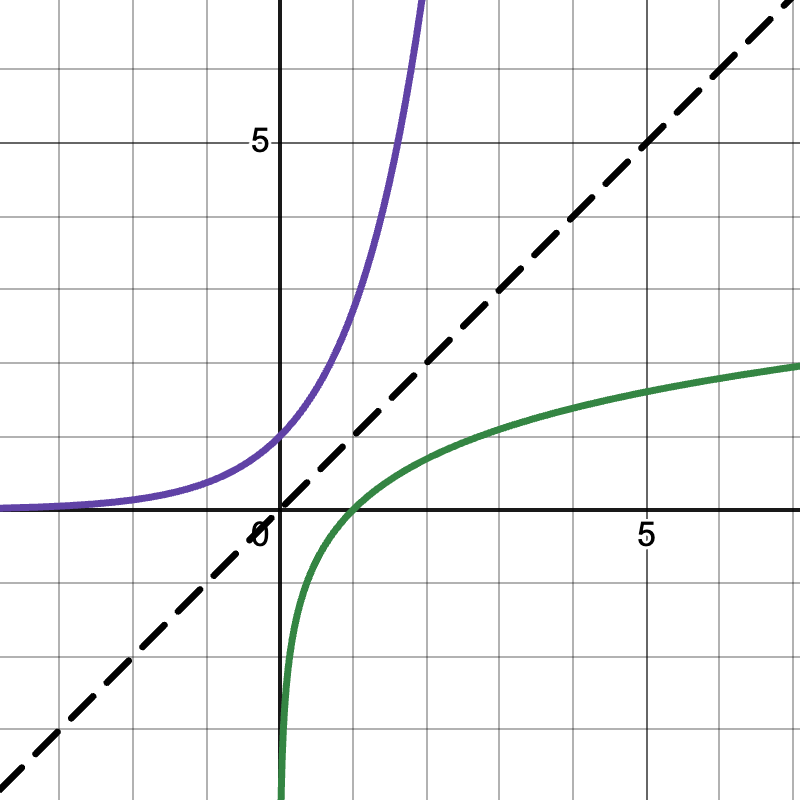
The natural logarithm is the inverse of the exponential function y=ex. Let's look at what this inverse relationship looks like on a graph!
Just as subtraction undoes addition, the natural logarithm undoes exponentiation with base e. They are inverse functions!
ln(ex)=x is the inverse of eln(x)=x
There are some important restrictions on the domain and range of a natural log function. For the domain, the input must be positive (x>0). That means that you cannot take the natural log of zero or a negative number.
For the range, the output can be any real number. That means that the range is (−∞,∞).
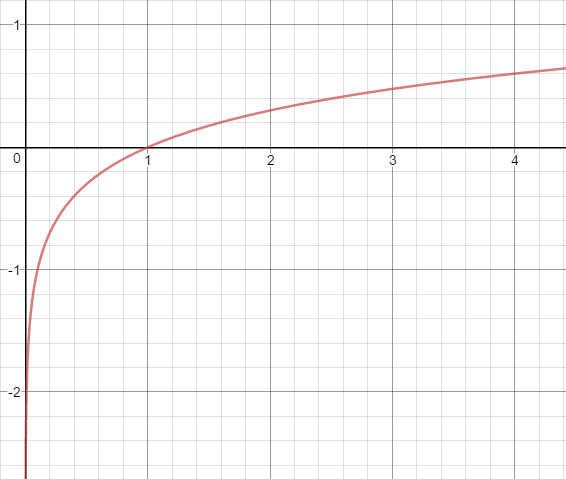
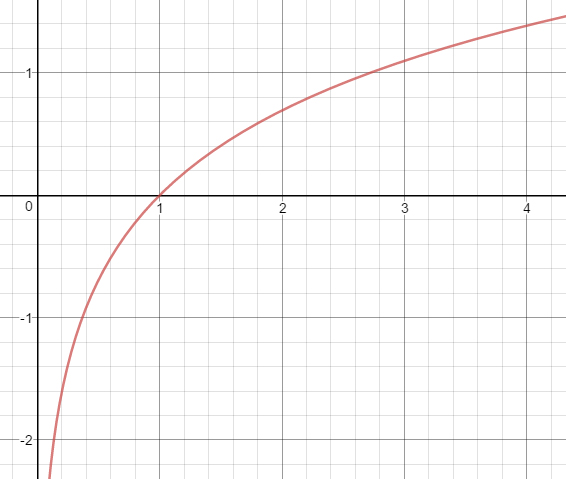
The graph of the natural logarithm has the following properties:
- Passes through the point (1,0)
- Increases slowly as x increases
- Has a vertical asymptote at x=0