Sums
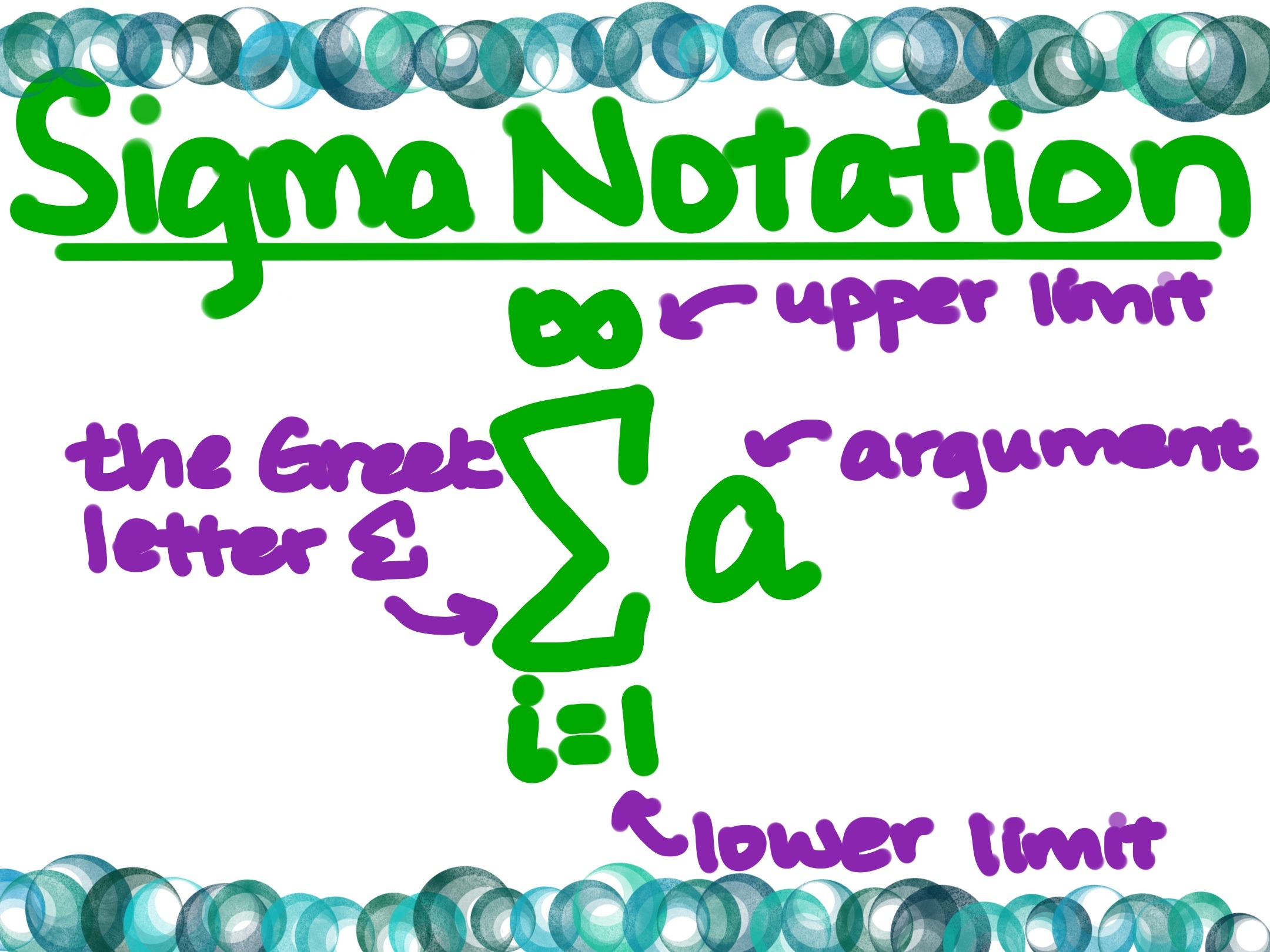
A summation is simply a shorthand for summing terms given by a formula together. These "sums" are things like 2+4+6+8 or 1+21+41+⋯ and can be expressed with a shorthand known as sigma notation:
i=1∑42i=2+4+6+8
i=0∑∞2i1=1+21+41+⋯
This may appear confusing at first, but it's actually not that bad. Essentially, given a function f(x), we can express the sum:
f(j)+f(j+1)+⋯+f(k)
As:
i=j∑kf(i)
(Note that j and k must be integers such that k≥j, otherwise the sum is just 0)
You might still be confused about the "i=" at the bottom. The purpose of i is just to be a "dummy variable" used in the expression; we could've just replaced i with x or z or anything. However, i,j,k are the standard dummy variables that are used.
You might still be confused about the "i=" at the bottom. The purpose of i is just to be a "dummy variable" used in the expression; we could've just replaced i with x or z or anything. However, i,j,k are the standard dummy variables that are used.
Summation Identities
These identities can be proven with basic arithmetic; they involve "taking out" or "splitting up" terms of the summation.
i=j∑kcf(i)=ci=j∑kf(i)
i=j∑kf(i)+g(i)=i=j∑kf(i)+i=j∑kg(i)
And for j≤a<k:
i=j∑kf(i)=i=j∑af(i)+i=a+1∑kf(i)
Ready for products? They're not as bad as they look as well!
Products
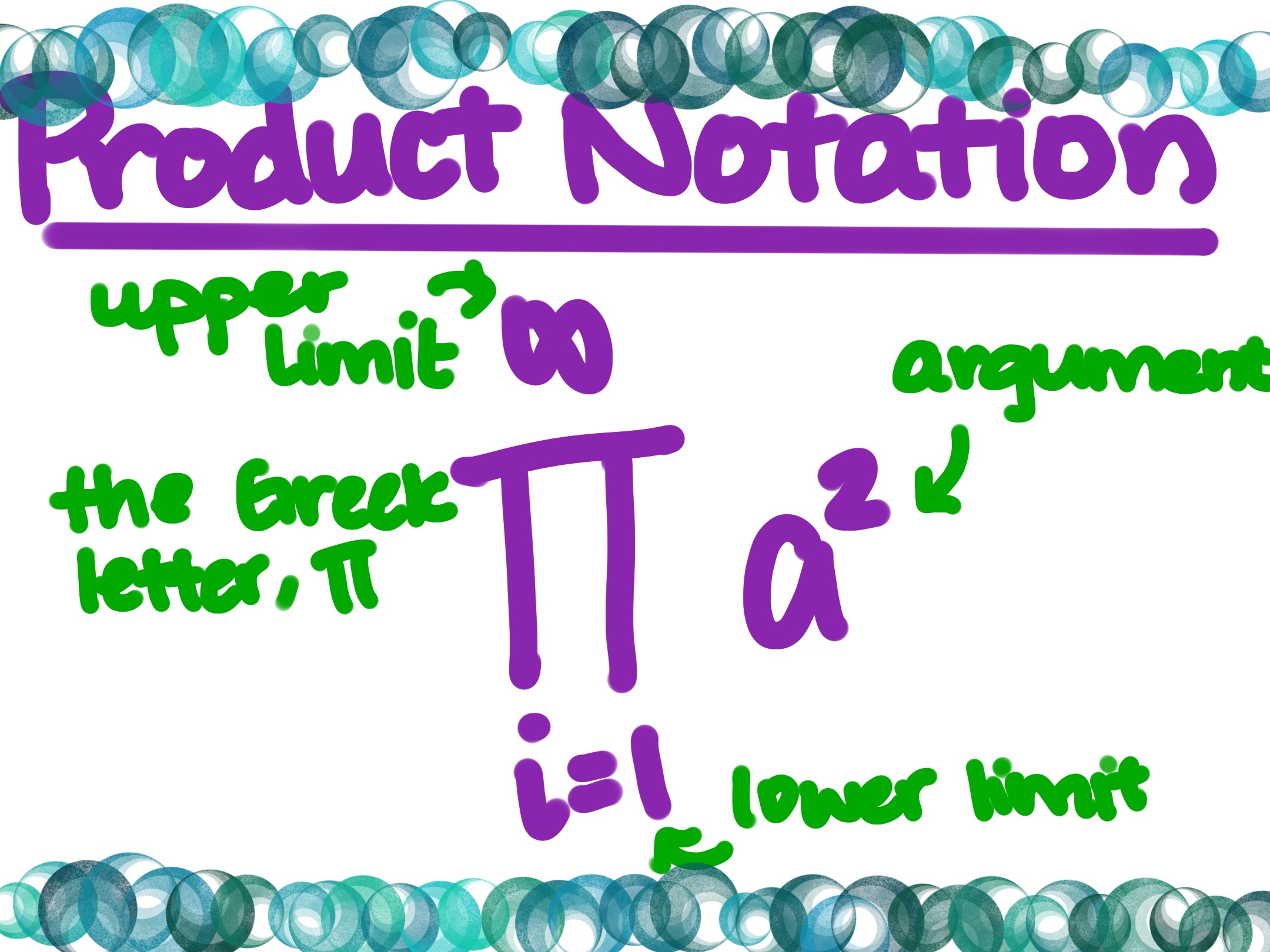
Products are just like sums, except they multiply the terms instead of adding them together. Products are expressed with big pi notation. As an example, the product 1⋅3⋅5⋅7 can be expressed as:
i=1∏4(2i−1)
Product Identities
Like the summation identities discussed earlier, product identities behave the same way. Here they are:
i=j∏kf(i)c=(i=j∏kf(i))c
i=j∏k(f(i)⋅g(i))=i=j∏kf(i)⋅i=j∏kg(i)
And for j≤a<k:
i=j∏kf(i)=i=j∏af(i)⋅i=a+1∏kf(i)
That's it; I hope you enjoy your newfound knowledge of summations and products!