Interactive · 1 question
+2 contributors

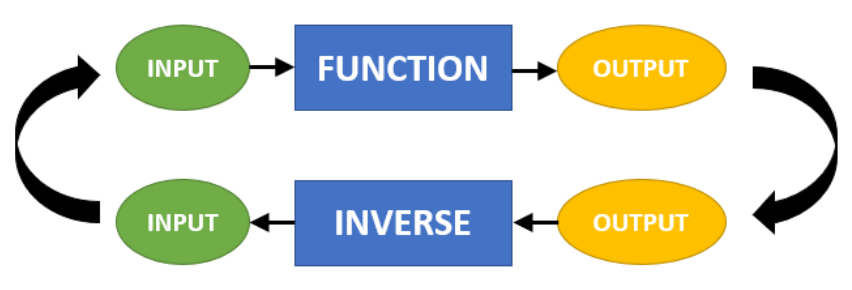
Inverses are very interesting creations. You can think of them as things that you use to "undo" what you just did. Say, let's take the variable and apply function to to get the result . Now, to get back to or "undo" are application of function , we can take the inverse of , which is written as to the (don't confuse this as reciprocal). The inverse of would undo leaving . Yay, that was a wordy introduction. Here's a fun picture to understand this better.

We put apples into function f to get lemons. When we put the lemons into the inverse function f^{-1} we get our original apples!
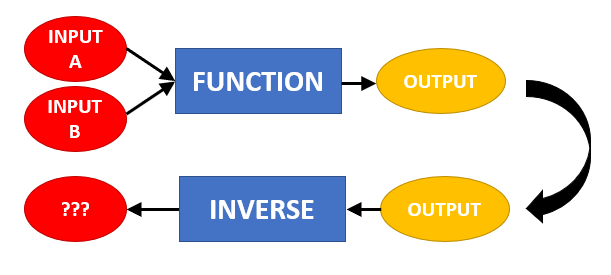
Which of the following are true?
Let's move onto some review of linear functions and how to find their inverses!
Linear functions are in the form or more simply as . So how do we find the inverses of these functions? Recall that for a function , (the inverse function applied to the function gives the input ). Using this, we will be able to find the inverse of a linear function. Let's try an example out.
Example Find the inverse of .
Another way to write is the . Let us call the inverse of . We know that , meaning must also be a linear function or else we will get powers of greater than . Thus, we can assume , where we have to find and . Plugging into our , we get This means that .
The linear terms on both sides of the equation must be the same, as do the constant terms on both sides of the equation. Namely, the coefficients must be the same. Therefore, , so
and we know that , so , the inverse of , or solely must be Checking our work, , so we found the correct inverse! Continue for a better technique :D
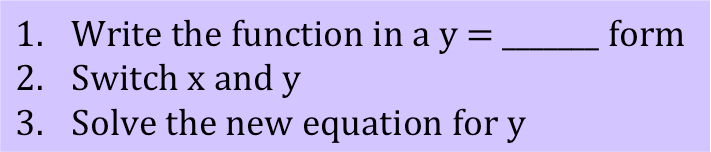
Since we know that for every input passed into function , we get output and for every output passed into , the inverse of , we will get back the input . This means that what an inverse does, is switch the and of a function. Using our previous example, we can go ahead switch our and to get . Now solving for , we get the same answer, !
From this trick of being able to switch and to find the inverse, we can see how the graphs of inverse functions behave.
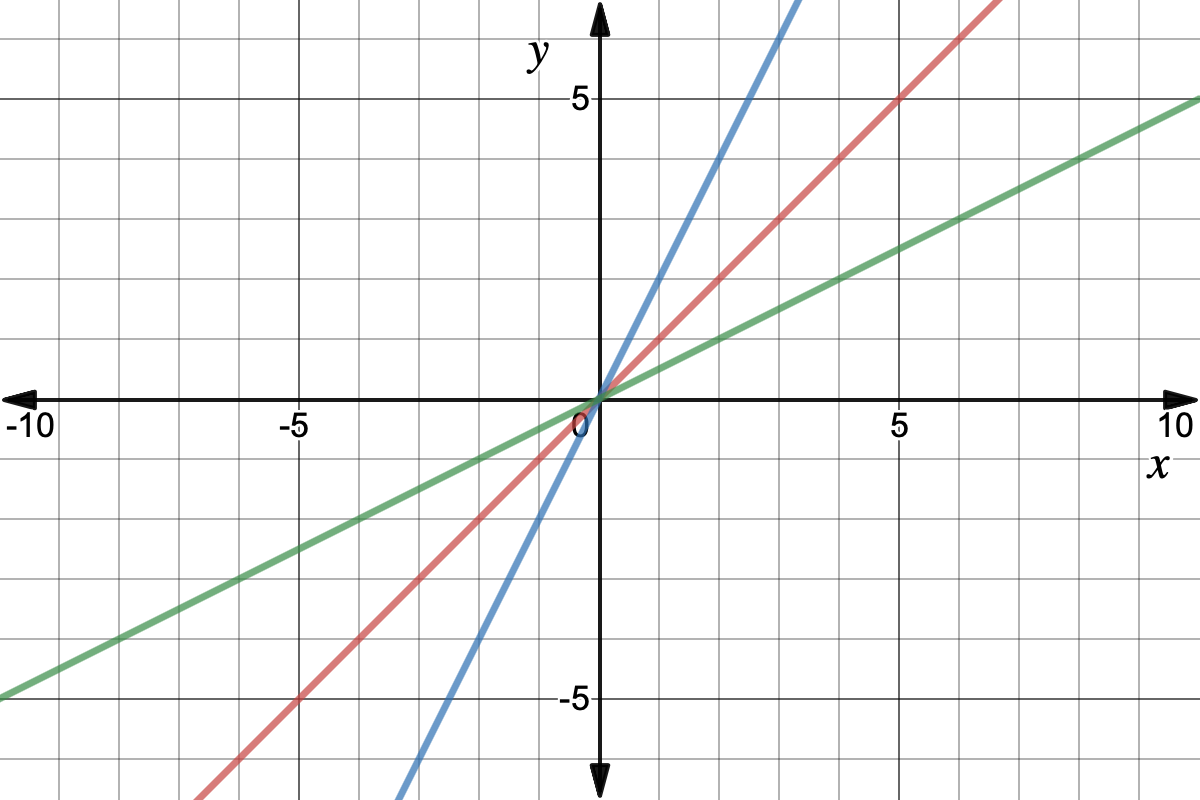
Graph courtesy of Desmos
We have that and when we calculate , we find that . And the graphs of and its inverse are reflections of each other over the line .