
Inverse Powers and Radical Functions

Before this, knowPower Functions with Any Exponent

Read · 1 min

Powers and Radicals

We're going to think about the relationship between power functions and radical functions/radical expressions. The key point in this relationship is that they are inverses of each other. This can be shown with a general form, but we're going to dig into some examples to make things easier to understand.

Note: inverse powers is different from negative numbers!

Let's start with y=x2y=x^2. We're going to find the inverse of this function. y=x2x=y2x=y\begin{align}y&=x^2\\ x&=y^2\\ \sqrt{x}&=y\end{align} This remains true for any power function. The inverse of y=xny=x^n is y=xny=\sqrt[n]{x}. f(x)=xnf−1(x)=xnf(x)=x3f−1(x)=x3f(x)=x32f−1(x)=x23f−1(x)=x23\begin{align}f(x)&=x^n\\ f^{-1}(x)&=\sqrt[n]{x}\\ \\ f(x)&=x^3\\ f^{-1}(x)&=\sqrt[3]{x}\\ \\ f(x)&=x^{\frac32}\\ f^{-1}(x)&=x^{\frac23}\\ f^{-1}(x)&=\sqrt[3]{x^2} \end{align}

This can be made a little bit more clear if we think of radicals as taking something to a power of a fraction. x\sqrt{x} can be rewritten as x12x^\frac12. We can think of radical functions as power functions because of this, which can help us when we need to switch between the two.

In the Future

While there are mathematical ways of finding the domain and range of power functions, the easiest method is generally to use a graph. In future lessons, you will learn about the range and domain of the function. You will also dive deeper into the square root graph and the cube root graph.

Video

(Video) Finding the Inverse Function (Exponent and Radical)

by MATHStorya

In this video by MATHStorya, you will learn how to find the inverse of a function, with both radicals and exponents.

Summary

To find the inverse of f(x)=9x2−3f(x)=9x^2-3, there are four steps we will follow.

First, we will replace the f(x)f(x) with yy.

y=9x2−3y=9x^2-3

Our next step is to flip the xx and yy terms.

x=9y2−3x=9y^2-3

We now need to solve for yy.

x=9y2−3x+3=9y2x+39=y2x+39=yx+33=y\begin{align} x &= 9y^2-3 \\ x+3 &= 9y^2 \\ \frac{x+3}{9} &= y^2 \\ \sqrt{\frac{x+3}{9}} &= y \\ \frac{\sqrt{x+3}}{3} &= y \\ \end{align}

Our last step is to replace the yy with f−1(x)f^-1(x). So, our final answer is:

f−1(x)=x+33f^-1(x) = \frac{\sqrt{x+3}}{3}

The next example looks at finding the inverse when dealing with an exponent. You will follow the same four steps, though, so try it on your own before watching the video!

Example: Find the inverse of f(x)=x3+5f(x)=x^3+5

Illustrated · 1 min

Inverse Powers and Radical Functions

In this lesson, we are going to explore inverse powers and radical functions. These are different ways to write and work with powers and roots in math.

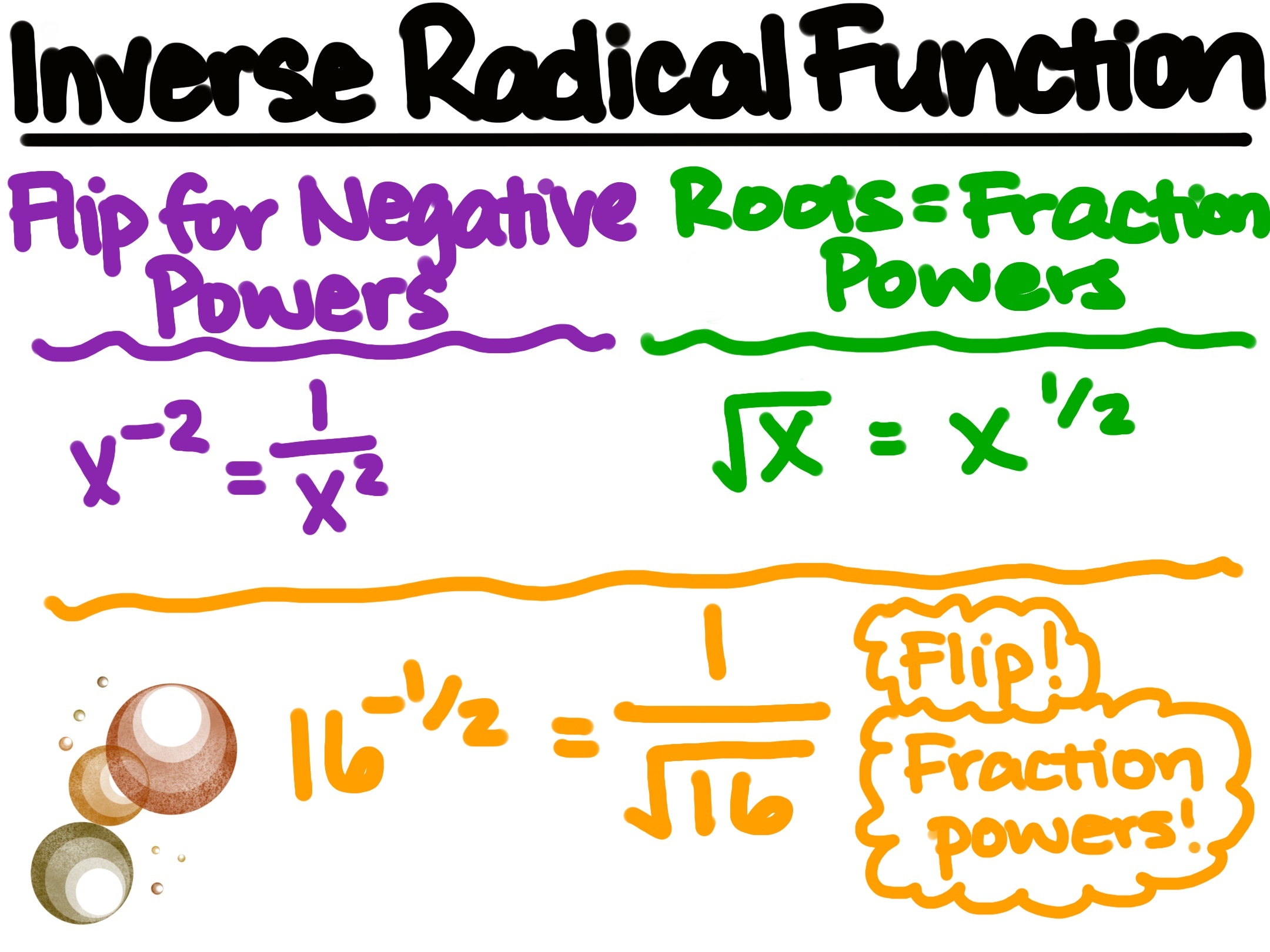
Inverse Radical Function
Flip for negative powers
Roots = fraction powers

Image source: by Anusha Rahman

An inverse power uses a negative exponent, like x−2x^{-2}. This means we flip the number and make the exponent positive. For example:

x−2=1x2x^{-2} = \frac{1}{x^2}

Radical functions involve roots, like square roots and cube roots. We've spent a lot of time with radical functions! Radicals can be written as fractional exponents. A square root is the same thing as raising a number to the power of 12\frac12. A cube root is x13x^{\frac13}, and a fourth root would be x14x^{\frac14}.

Let's look at an example to tie it all together.

Example

Let's think about 16−1216^{-\frac12}.

We immediately see the negative sign, which tells us to flip the number. We also know that the 12\frac12 means square root. So, if we put it all together:

16−12=116=1416^{-\frac12} = \frac{1}{\sqrt{16}} = \frac14

Inverse powers and radicals might look different, but they are two ways to say the same thing!

Type a concept, like “slope” or “photosynthesis”.

↑ ↓ to choose · Enter to openSearch explanations and problems
