Read · 1 min
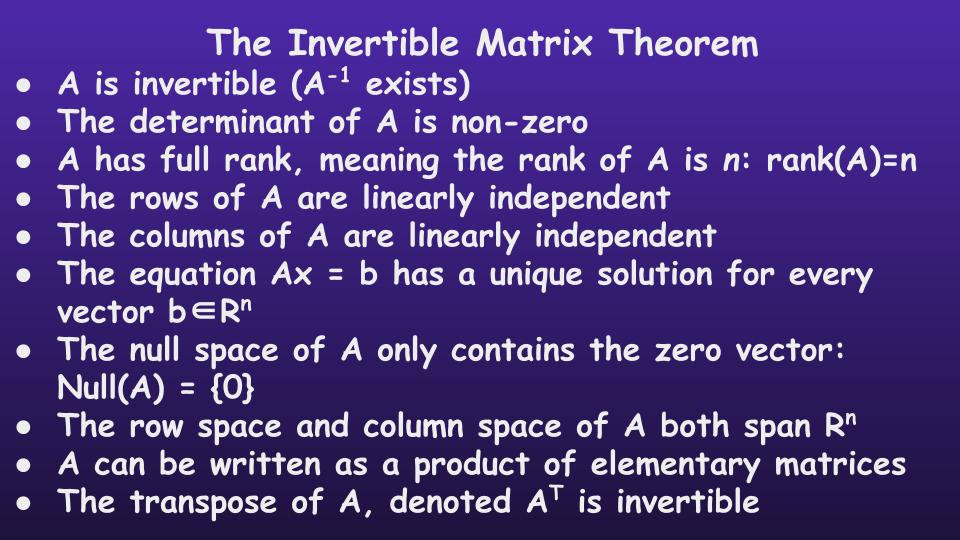
The invertible matrix theorem is a theorem in linear algebra which offers a list of equivalent conditions for an n×n square matrix A to have an inverse.
Matrix A is invertible if and only if any (and hence, all) of the following hold:
-
A is row-equivalent to the n×n identity matrix I_n.
-
A has n pivot positions.
-
The equation Ax=0 has only the trivial solution x=0.
-
The columns of A form a linearly independent set.
-
The linear transformation x|->Ax is one-to-one.
-
For each column vector b in R^n, the equation Ax=b has a unique solution.
-
The columns of A span R^n.
-
The linear transformation x|->Ax is a surjection.
-
There is an n×n matrix C such that CA=I_n.
-
There is an n×n matrix D such that AD=I_n.
-
The transpose matrix A^(T) is invertible.
-
The columns of A form a basis for R^n.
-
The column space of A is equal to R^n.
-
The dimension of the column space of A is n.
-
The rank of A is n.
-
The null space of A is {0}.
-
The dimension of the null space of A is 0.
-
0 fails to be an eigenvalue of A.
-
The determinant of A is not zero.
-
The orthogonal complement of the column space of A is {0}.
-
The orthogonal complement of the null space of A is R^n.
-
The row space of A is R^n.
-
The matrix A has n non-zero singular values.