Read · 4 min
We are learning about intermolecular forces. Van der Waal's forces are interactions between molecules caused by electrostatic interactions. In dispersion forces, the movement of electrons creates a temporary dipole. Temporary dipoles create momentary electrostatic charges. A dipole can also be the result of electronegativity differences between atoms. For example, the interactions in hydrogen bonding and dipole-dipole interactions. Electrostatic interactions are also the cause of ionic bonding. In ionic bonding, electron transfer creates cations and anions. The cation and anion have opposite charges. The opposite charges result in an attractive force between the ions.
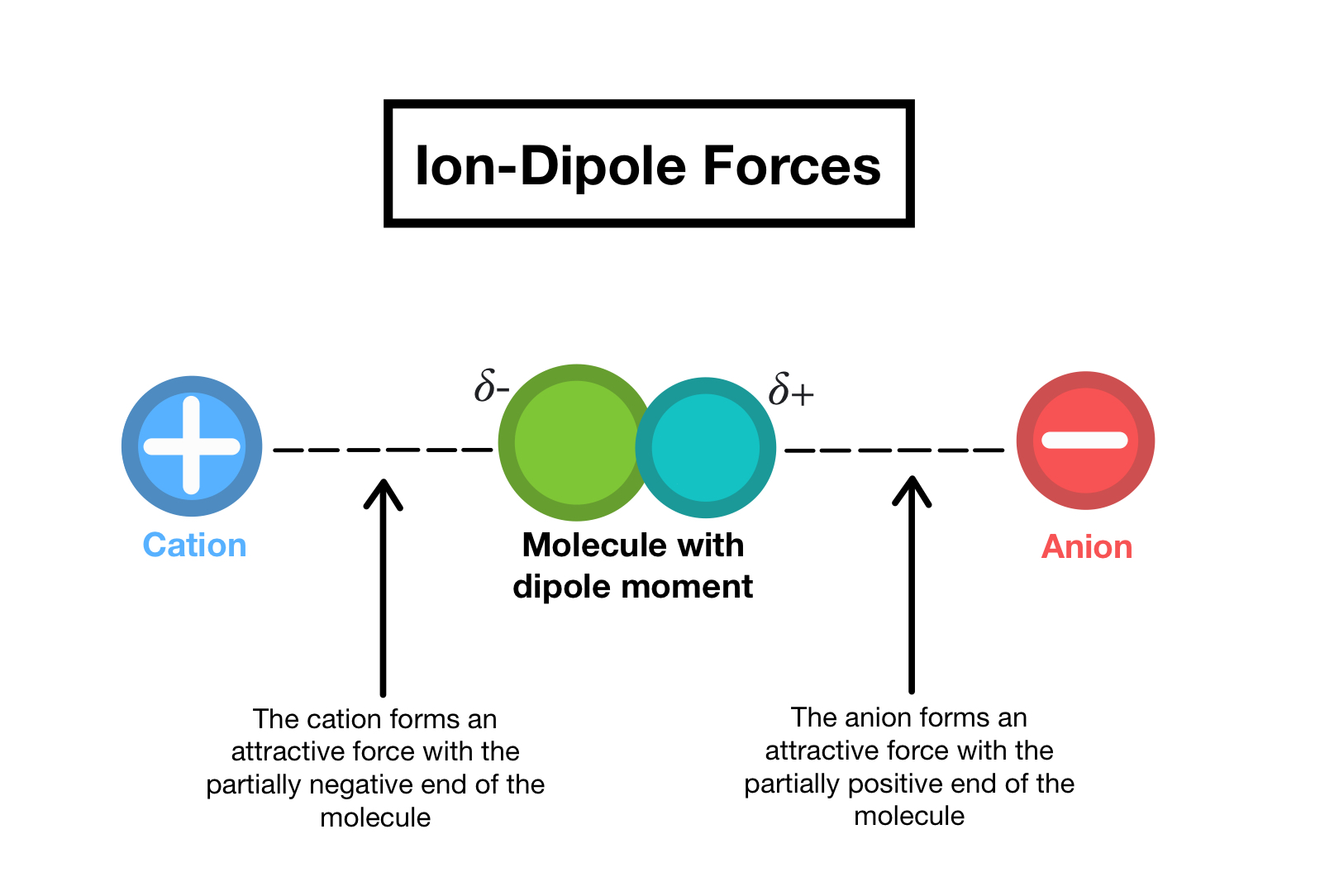
Have you ever wondered about interactions in solutions? For example, what happens when we dissolve a salt in water? To better understand solutions, you need to know about ion-dipole forces! Ion-dipole forces are the electrostatic interaction between an ion and a polar molecule.
A Quick Refresher on Solutions
There are two components to every solution. The solute is dissolved. The solvent is doing the dissolving. A solute is soluble if the intermolecular interactions are favorable. Insolubility is the result of unfavorable intermolecular interactions.
What causes favorable or unfavorable intermolecular interactions? The solvent's ability to handle the charge of the solute. Let's say we add a polar solute to a non-polar solvent. The solute will attract itself. The solvent cannot balance the polarity of the solute. Because the solute is polar it has a positive and negative side. The positive and negative sides will interact to balance the partial charges. For example, the difference in polarity is why water and oil separate. Water is a polar molecule. Oil is non-polar. Water can hydrogen bond to itself to balance its polarity. The oil is neutral and does not help reduce the charge of the water. It is more stable for water to interact with itself.
Ion-Dipole Interactions
When we add an ionic compound to a polar solvent it dissociates. Water is the most common polar solvent because of its hydrogen bonds. The solvent needs to balance the charge of both the cation and anion. But, the charge of the ion is greater than the partial charges of the solvent. Remember, the charges on ions are always whole numbers. Dipole charges are much smaller fractions. It will take a lot of solvent molecules to balance one solute molecule. This is why solutions reach saturation. Beyond saturation, there is too much solute for the solvent to balance the solute's charge.
To balance the charge of the ion, the solvent will form a shell around the ion. By forming a shell the solvent molecules disperse the ion's charge. For the cation, the solvent uses the negative side of its dipole. For the anion, it uses the positive side of its dipole.
Let's imagine dissolving sodium chloride () in water. Sodium chloride is a strong electrolyte. The sodium-chlorine bond will completely dissociate. The positive charge on the sodium ion needs to be balanced by the water. Let's assume that it takes six water molecules to balance sodium's charge. You can imagine the sodium ion is at the center. Evenly spaced around it will be the six water molecules. Each water molecule has its partially negative oxygen atom pointing toward the sodium. The electrostatic interactions between the sodium and the six water molecules are balanced.
The Strength of Ion-Dipole Interactions
The strength of ion-dipole interactions is dependent on the charge and the distance. The charge of the ion is much larger than the charge of the dipole. So, the ionic charge is the determining factor. It increases as we move across a period on the periodic table. For example, magnesium has a larger ion-dipole interaction than sodium. The distance between the ion and the dipole is dependent on the size of the molecule. A polar molecule that is only a couple of atoms will easily approach the ion. A polar molecule with hundreds of atoms will have a more difficult time coming close to the ion.
The Reasoning Behind Qualitative Solubility Rules
You may have learned some qualitative solubility rules. The rules tell us that some compounds have high solubility. Others have low solubility. Some compounds are always insoluble. What determines if a compound is soluble or insoluble? It depends on the strength of the ion-dipole interactions. If the ion-dipole interactions are very strong, it is favorable for the compound to dissociate. In contrast, sometimes the ion-dipole interactions are weak. So, it is more stable for the compound to stay bonded. For compounds containing alkali metals or halogens, the ion-dipole interactions are very strong. For example, sodium chloride spontaneously dissociates in water. However, for many compounds, it is more stable to stay bonded. An example is silver hydroxide (AgOH). The silver-hydroxide bond is far stronger than the ion-dipole interactions. So, silver hydroxide does not dissociate. Silver hydroxide will precipitate out of solution.