Ionic Bonding (Biology) — Definition & Role

Interactive · 2 questions

Ionic Bond: Taken, Not Shared

Elements are electrically neutral because they have the same number of electrons and protons.

Well, if an atom gives an electron away, suddenly it has more protons than electrons. This gives the atom a positive charge. Similarly, if an atom accepts an electron from another atom, then it has more electrons than protons. This gives it a negative charge.

If you remember, charged atoms are called ions. Conveniently enough, bonds between ions are called ionic bonds.

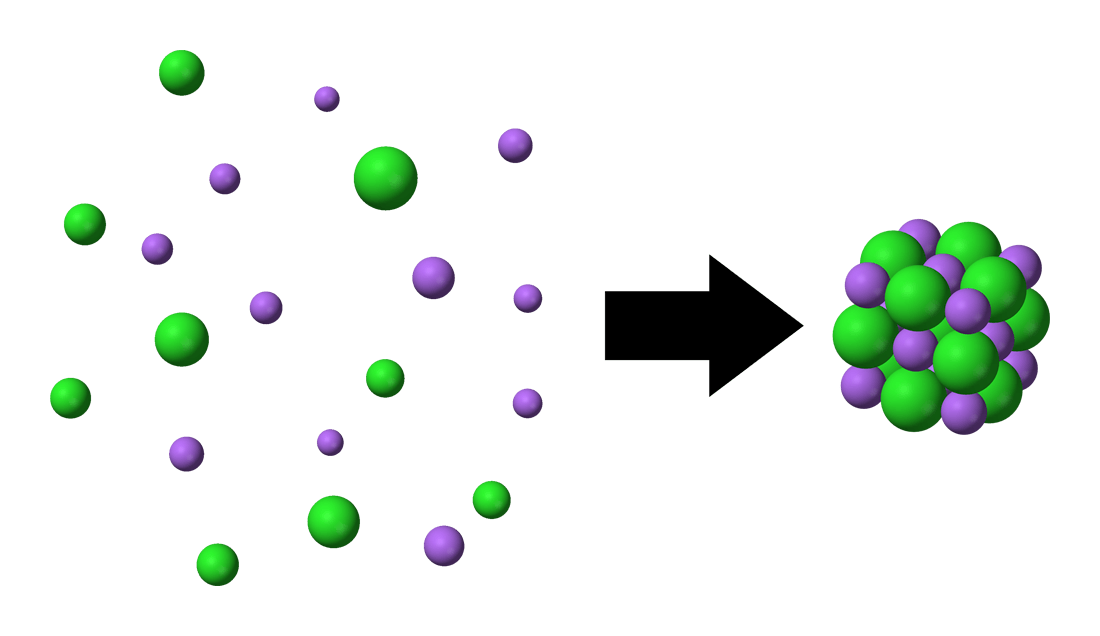
Ionic bond formation between sodium and fluorine

Image source: By Wdcf CC BY-SA 3.0, via Wikimedia Commons

These bonds are formed when an electron of one atom is either donated or taken by another atom. When an atom donates an electron, it gains a positive charge. The atom accepting the electron gains a negative charge. Much like magnets, the opposite charges attract and an ionic bond is formed. An electrostatic attraction holds the atoms together.

What happens to the atoms that form an ionic bond?

Choose one answer

Illustrated · 1 min

Chemical Compounds and Their Bonds

Covalent bonds can be either polar or nonpolar. Molecules share electrons. Meanwhile, ionic compounds do not share electrons. Instead, the more strongly electronegative ion steals the electrons.
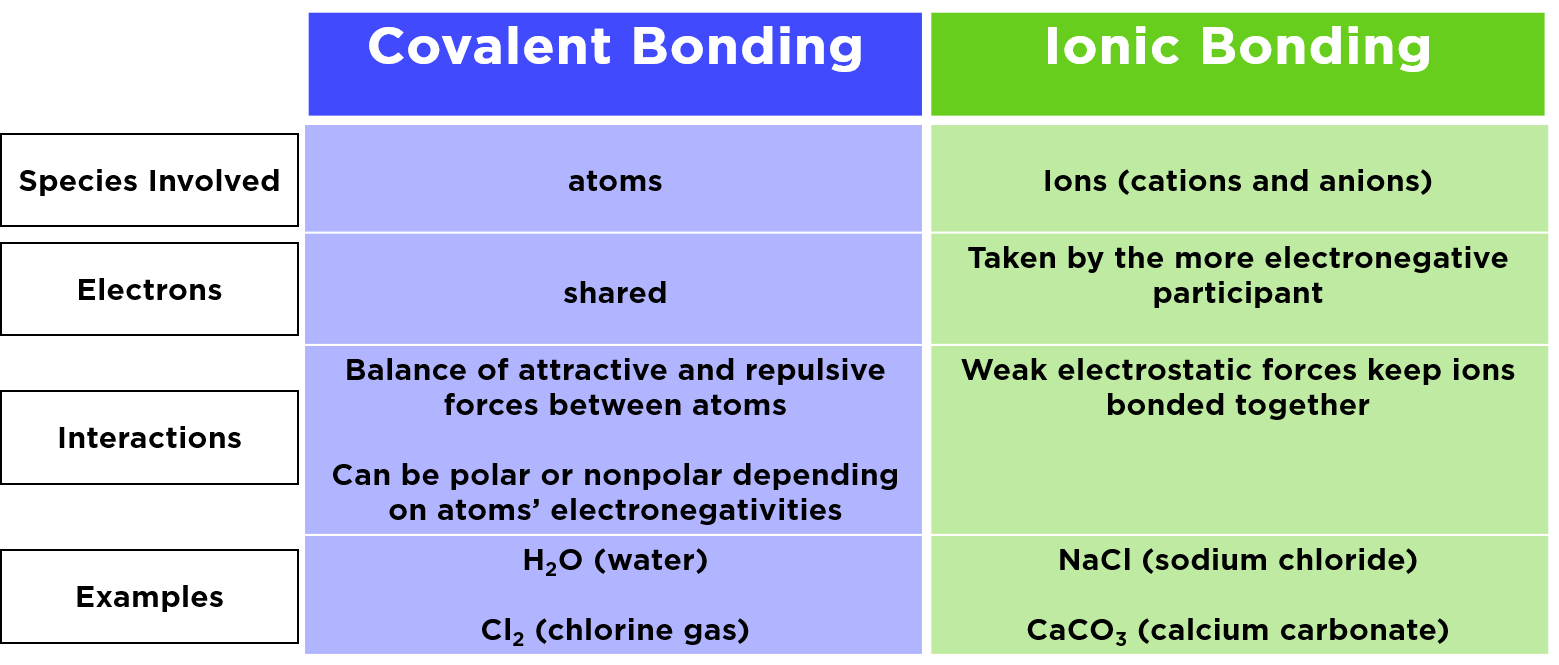
This table shows the differences between covalent bonding and ionic bonding. In covalent bonds, atoms are involved. Electrons are shared between them. It is a balance of attractive and repulsive forces between atoms. The bond can be polar or nonpolar depending on the atoms' electronegativities. Examples include H2O (water) and Cl2 (chlorine gas).

In ionic bonds, ions (cations and anions) are involved. Electrons are taken by the more electronegative participant. Weak electrostatic forces keep the ions bonded together. Examples include NaCl (sodium chloride) and CaCO3 (calcium carbonate).

Image source: By Valeri Natole

Interactive · 2 questions

Electronegativity and Ionic Bonding

Electronegativity is a metric of how strongly an atom pulls on electrons. As you move diagonally up the periodic table (ignoring noble gases), this value increases.

The periodic table of elements with an arrow pointing from francium to fluorine

Arrow indicating the direction of increasing electronegativity

Image source: By Armtuk (modified by Jasper Brown) CC BY-SA 3.0, via Wikimedia Commons

Francium has the lowest electronegativity with a value of 0.70.7 and fluorine has the highest with a value of 44.

If two atoms have a large enough difference in electronegativity (ΔE−≥2\Delta E_{-} \geq 2), then the atom with a higher electronegativity will steal an electron (or more than one) from the other. The two atoms become oppositely charged ions and then form a bond. An ionic bond is merely the attractive force between these oppositely charged ions.

How Many Electrons Are Transferred?

The type of atom determines the number of electrons that are transferred. Each atom is trying to obtain a full valence shell, which in most cases is eight electrons. The number of valence electrons an atom has is the same as its group number. You can find that out by looking at the periodic table shown above. In order to form this full valence shell, the atom can either lose all of its current valence electrons or gain electrons until it has eight.

Let's look at an example. Oxygen is in group 6, so it has six electrons in its outer shell. This means it either needs to gain two electrons or lose six to have a full valence shell. It is a lot easier to gain two, so oxygen usually forms an O2−O^{2-} ion. In a similar vein, lithium is group 1, so it only has one electron. It needs to either gain seven electrons or lose just one. Since it is easier to lose one than it is to gain seven, it gives up its electron to form a Li+Li^{+} ion.

Which element will form a 2+^{2+} ion?

Choose one answer

Illustrated · 3 min

Opposites Attract

Ionic bonds form when electrons are completely transferred from one atom to another. Think of this in contrast to covalent bonds, where electrons are shared between atoms.

The image shows a neon atom with a full outer electron shell. Valence electrons are the electrons in the outer orbital or shell. These are the electrons that are taken and lost in ionic bonds.

Image source: By CNX OpenStax CC BY 4.0, via Wikimedia Commons

Take a look at the electron configuration diagram above. The goal of an atom is to fill up its outermost shell of electrons. Atoms that need just one or two electrons to fill up their outer shells have high electronegativity. This means that they are the most likely atoms to snatch an electron from another atom. Atoms with a large electronegativity are atoms that are greedy for electrons.

Highly electronegative atoms are the ones that are most commonly involved in ionic bonding. This should make sense; this type of bond is all about taking electrons from other atoms.

What Is an Ion?

Recall that electrons have a negative charge.

So, an atom that gains an electron becomes negatively charged. An atom that gives up its electron to the greedier atom becomes positively charged.

Atoms that have a charge because of the loss or gain of an electron are called ions.

Positively charged ions (the atoms that lost electrons) are called cations (pronounced "cat"-"ion"). Negatively charged ions (the atoms that gained electrons) are called anions (pronounced "ann"-"ion").

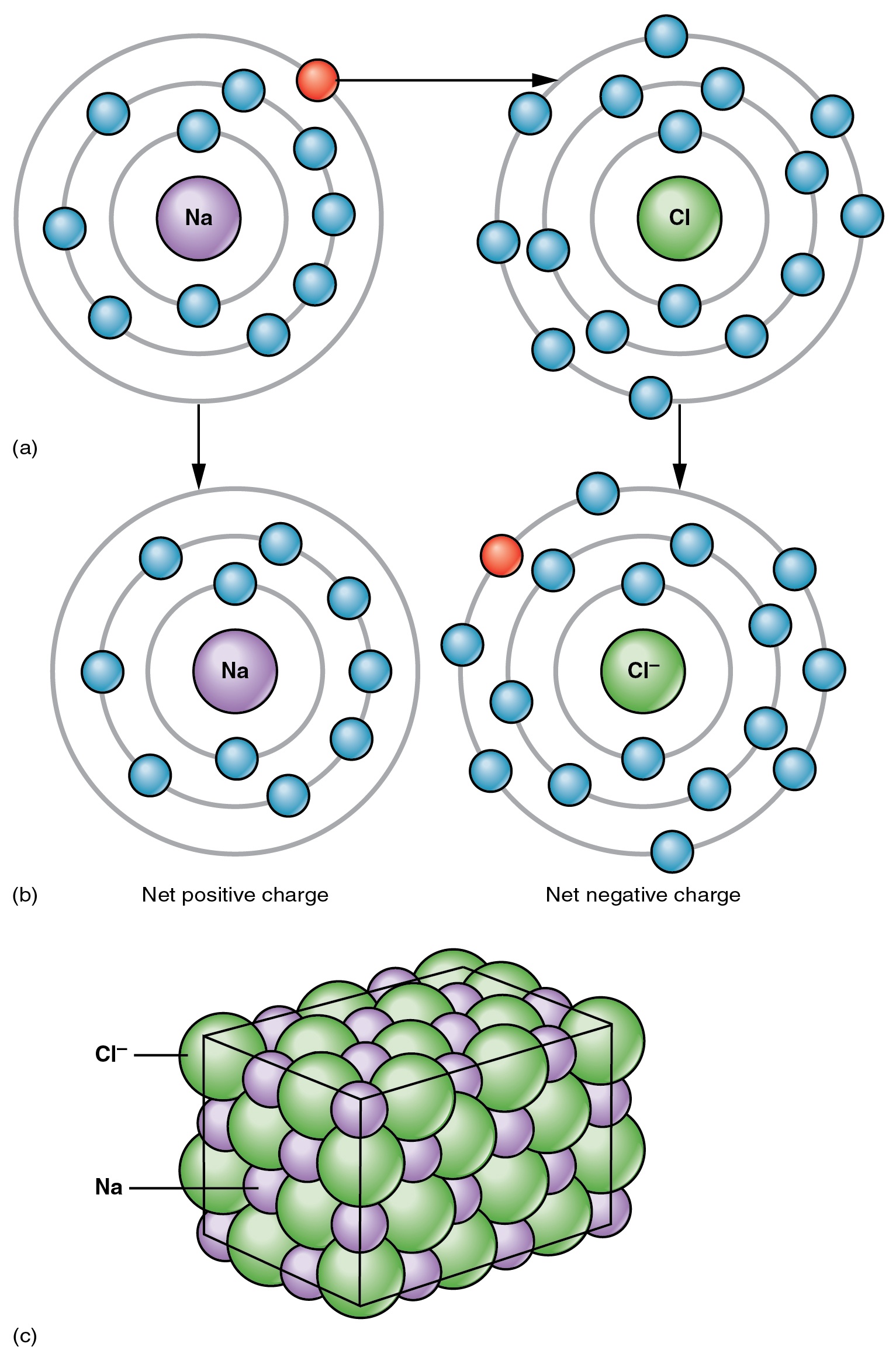
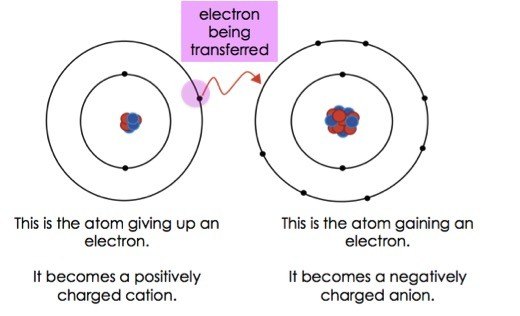
When an ionic bond forms, an electron is transferred from one atom to another.

Image source: By EliseEtc CC BY-SA 3.0, via Wikimedia Commons

Once the electron has been transferred, we end up with two ions: one with a positive charge and one with a negative charge.

The phrase "opposites attract" is true for atoms. The positively charged ion (cation) and the negatively charged ion (anion) are attracted to each other. It is this attraction, created by the transfer of electrons, that forms the ionic bond.

The ionic bond forms because the cation and anion have opposite charges and are attracted to each other.

Image source: By EliseEtc (modified by expii) CC BY-SA 3.0, via Wikimedia Commons

The transfer of one electron creates a single bond. The transfer of two electrons creates a double bond. The transfer of three electrons creates—you guessed it—a triple bond.

What Is an Ionic Compound?

Ionic compounds are the chemical compounds formed from ionic bonding between cations (positive ions) and anions (negative ions). Unlike in molecules, the attractions that keep ions in compounds together are weak electrostatic forces.

A popular example of an ionic compound is sodium chloride. Ever heard of it? You may not have heard it by that name, but you've surely heard it called by its more common name: salt. NaCl is what you put on your fries, soft pretzels, popcorn, and whatever else you eat when you want a salty snack.

Looking at the name, we can see that sodium chloride is made of one sodium atom and one chlorine atom. The name "chlorine" changes to "chloride" to let us know that it has become an anion. In other words, chlorine is gaining an electron from sodium, making it more negative.

This is an image of table salt, the ionic compound sodium chloride (NaCl).

Image source: By Henningklevjer~commonswiki CC BY-SA 2.5, via Wikimedia Commons

Polar Covalent Bonds vs. Ionic Bonds

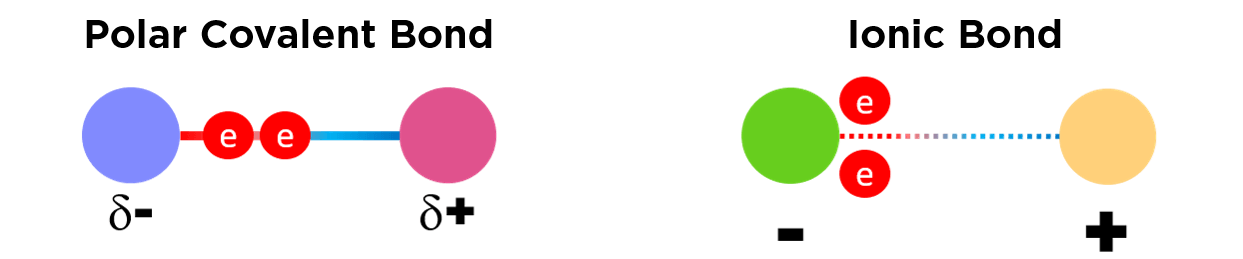
This image shows the difference in electron distribution between polar covalent/molecular bonds and ionic bonds.

Image source: By Valeri Natole

Both ionic bonds and polar covalent bonds involve some sort of charge. This can make it tricky to understand the differences between them. So, what are the differences?

First off, polar covalent bonds have partial charges on different parts of the molecule. Ionic bonds are formed when two oppositely charged ions attract each other. Sure, ions can have charges that are greater than +1+1 or less than −1-1, but these are all full charges. They're not the partial charges found on atoms in a polar covalent bond.

Second, ionic bonds are weaker than covalent bonds. In covalent bonds the electrons are shared, and the interaction between the participating species (atoms) is a balance between attractive and repulsive forces. In polar covalent bonds, the attractive and repulsive forces don't balance exactly, so you get polarity. But in an ionic bond, the attraction between participating species (ions) is a weak electrostatic force. Electrostatic interactions, also known as van der Waals interactions, are the attraction between oppositely electrically charged things.

Finally, molecules are made from covalent bonds, while compounds or salts are made from ionic bonds. Salts are a bunch of ions latticed together in a crystal structure. This is a very different three-dimensional shape than what molecules form.

Key Vocabulary:

  1. Ionic bond
  2. Ionic compound
  3. Ion
  4. Cation
  5. Anion

Video

(Video) Types of Chemical Bonds

by CrashCourse

This video explains the different types of chemical bonds.

In ionic bonding, atoms either take or give up electrons to form a compound. The atoms in the compound become either positively charged or negatively charged ions. A positive ion loses electrons while a negative ion gains electrons. Whether an atom will gain or lose electrons depends on its electronegativity. This is a measure of how strongly an atom wants electrons.

Type a concept, like “slope” or “photosynthesis”.

↑ ↓ to choose · Enter to openSearch explanations and problems