Interactive · 2 questions

+2 contributors

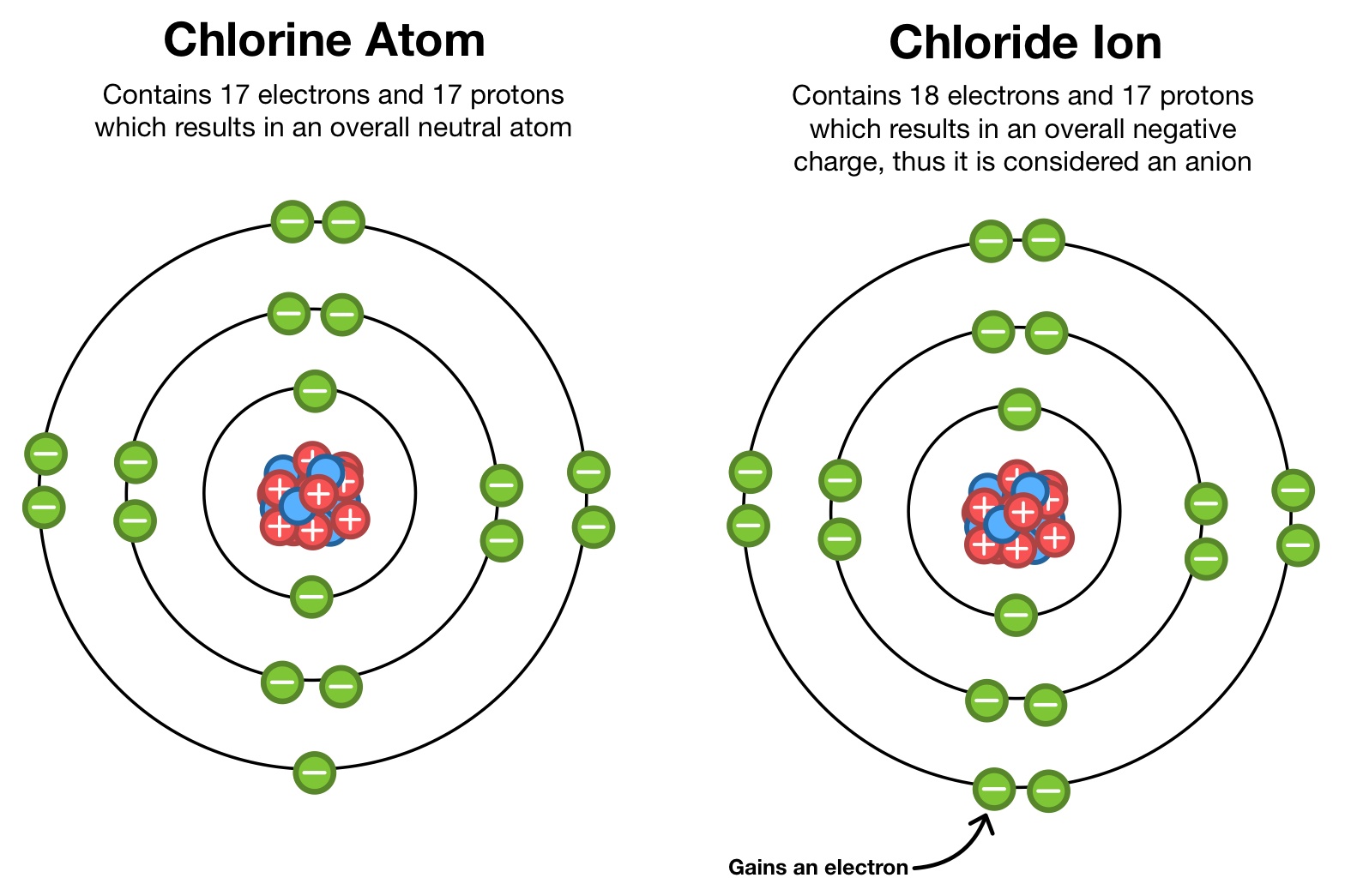
Typically atoms are electrically neutral. Why? They have the same number of protons and electrons. But atoms are capable of gaining and losing electrons. If they do, they form charged particles called ions. There are broadly two types of ions: cations and anions. Cations are positive, they have more protons than electrons. They are formed by the loss of electrons. Anions are negative, they have more electrons than protons. They are formed by the gain of electrons. We can easily determine the charge of an ion by subtracting the number of electrons from the number of protons.
Notation
Ions are written by using the chemical symbol of their parent atom(s) and putting the charge into the superscript. As an example, an oxygen atom that gains 2 electrons is written as . Observe how the magnitude is written first, then the charge. It is also acceptable (albeit uncommon) to write multiple charge symbols in order to indicate magnitude. So our oxygen anion could be written as . An important note is that if the magnitude is 1, then a number is omitted. As an example, if a sodium atom loses an electron, then the resulting cation is written as , and is never written as .
Polyatomic ions
Sometimes multiple atoms come together to form a larger charged particle called a polyatomic ion. In their charged state, they act in much the same way as normal ions, but they are composed of multiple atoms. However, many polyatomic ions are created by a neutral species gaining or losing a proton.
This means that if we tried to balance the charge by adding or subtracting electrons we would form a radical, a super reactive chemical with unpaired electrons. Some common examples of polyatomic ions are , , and . As a side note, polyatomic ions with oxygen form a special class called oxoanions. They'll be important when we study acids and bases, and neutralization reactions.
Cations are
Which option is not a properly written ion?