Interactive · 1 question

+3 contributors



Using Isotopes to Date Fossils

Image source: By Zissoudisctrucker CC BY-SA 4.0, via Wikimedia Commons
Have you ever wondered how scientists know how long ago dinosaurs lived? The answer lies in isotopes.
As we learned in the sections about atoms and elements, atoms contain protons, neutrons and electrons, and each atom's identity as a specific element is defined by its number of protons. Because protons are positively charged and electrons are negatively charged, any neutral atom has an equal amount of protons and electrons. But how do we know how many neutrons an atom has?
As it turns out, the same chemical element can contain different amounts of neutrons per atom. Two atoms with the same amount of protons but a different amount of neutrons are called isotopes.
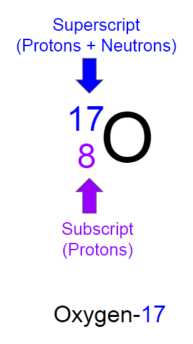
Two different isotopes of an atom have the same atomic number (proton count) but different mass numbers (sum of proton and neutron count). These mass numbers are usually written as superscripts before the element. For example, a carbon atom has six protons and its most stable form has six neutrons, resulting in a mass number of 12. Therefore, it is written as , with the mass number on top and the proton count on the bottom. You can find the number of neutrons by subtracting the top number from the bottom number.
As mentioned above, carbon usually has six neutrons. What does that mean? It turns out that elements tend to have a certain number of neutrons when they are most stable. While isotopes do exist, they tend to decay into this lighter and more stable form over time. Unstable isotopes that are likely to decay are called radioactive isotopes.
So, what does this have to do with dinosaurs or biology? Living things contain a lot of carbon, which you'll learn about more in depth later. While carbon tends to decay towards , called carbon-12, living organisms produce , or carbon-14. Since carbon-14 decays over time to carbon-12 and organisms no longer produce it after they die, scientists can predict how long ago a creature died by measuring the amount of carbon-14 present in a fossil. This process is called carbon dating.
Radioactive decay follows an exponential function. This means that when more of the radioactive material is present, it decays more quickly. In other words, it takes the same amount of time for half of the material present to decay, regardless of how much stuff that is. The amount of time that it takes for half the stuff to disappear is called a half-life. Carbon-14 has a half-life of 5,730 years, so if a fossil has exactly half of the carbon-14 that a living organism should contain, it died 5,730 years ago.
If an organism died 11,460 years ago, how much of its original carbon-14 should still be present in its fossils?