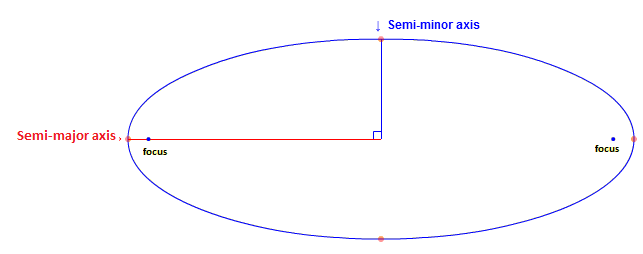
Kepler used the empirical data of Tycho Brahe to conclude that if T is the period and R is the average radius of a planet in orbital motion, then
T2∝R3.
Note that this law was merely an observation derived from analysis of emperical data. For example, if I had a table of periods and radii for various planets, I can construct a log-log plot of that data to find this relationship that Kepler pointed out.
Now let's look at how we get this result from Newton's Law of Gravity.
If m is the mass of the orbiting planet, M is the mass of the orbited planet, R is the average distance between m and the center of mass of the two-planet system, and G is the universal gravitational constant, then
Fg=R2MmG.
A planet orbiting around the larger planet experiences centripetal acceleration. So then if v is the average speed of the orbiting planet,
Rmv2=R2MmG.
We can then write that the speed of the planet as distance over time, or the circumference over the period. Thus v=T2πR, where T is the period. We now can make this substitution into the equation above:
T24π2mR=R2MmG.
With some rearranging, we find that
T2=M4π2GR3.
This derivation assumes approximately circular orbits however. The calculus for the derivation that uses elliptical orbits takes away from the simplicity of the argument made here (but if you are curious, feel free to look at this link: http://astro.physics.uiowa.edu/~srs/2961_12/Lec09_notes.pdf
The result in general happens to be that
T2=M4π2Ga3,
where a is the length of the semi-major axis.