Krebs Cycle (Citric Acid Cycle) — Steps & Diagram

Illustrated · 1 min

ATP Synthesis: Krebs Cycle

Cells need to make energy-rich molecules, like ATP and GTP, in order to carry out the processes necessary to stay alive.

The Krebs cycle (also called the citric acid cycle or TCA cycle) is just one part of ATP synthesis. The cycle is a set of reactions which produce a few ATP (or GTP) molecules and give off carbon dioxide. The reactions also produce a bunch of molecules of NADH and FADH2_2. These are electron carriers that play a key role in the electron transport chain, where most ATP is made.

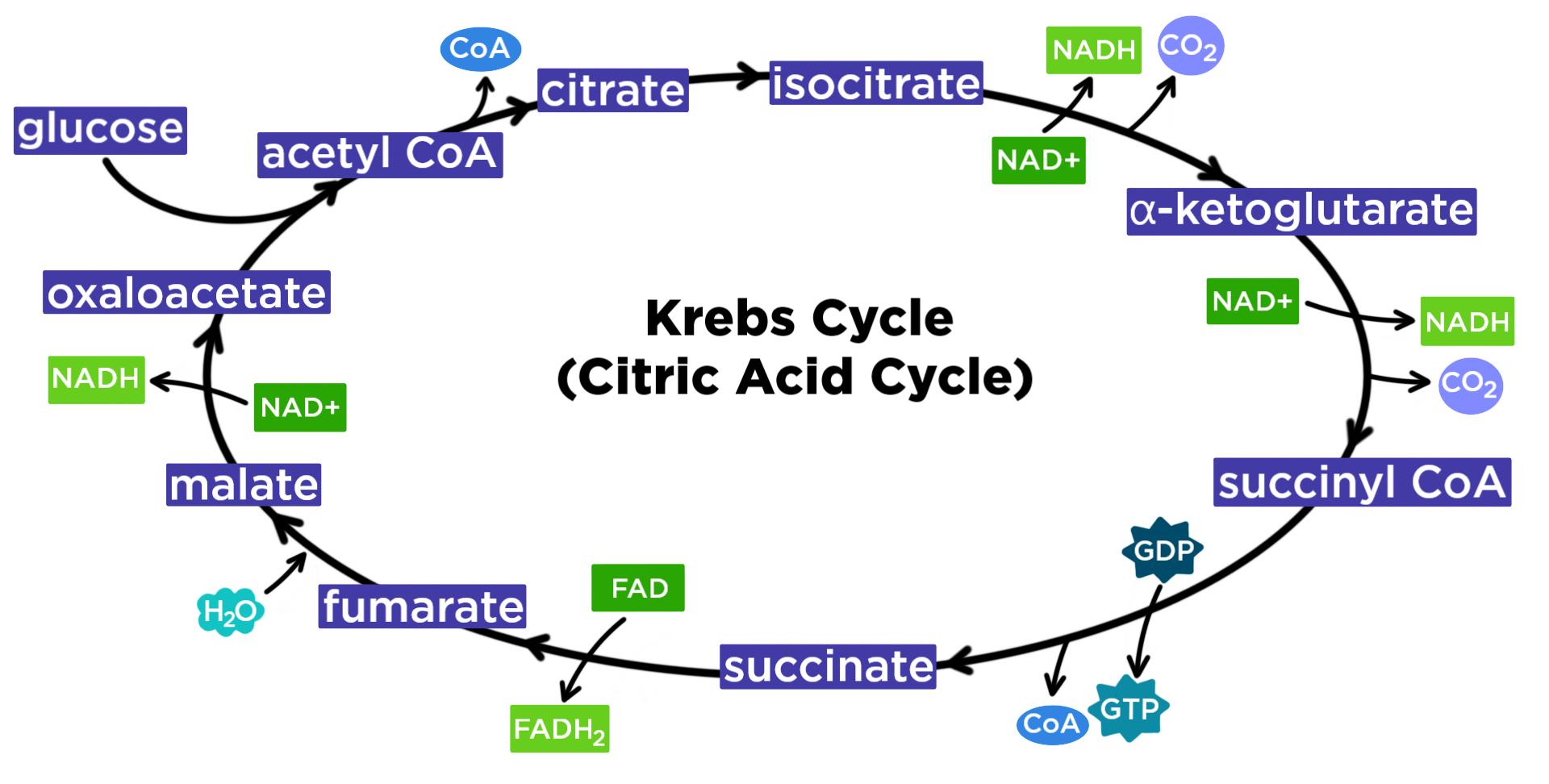
The chemical reactions that take place are pretty complex, but you can see an overview of the steps of the cycle in the diagram below.

Glucose enters the citric acid cycle and is converted to acetyl CoA. Acetyl CoA is converted to citrate and releases CoA in the process. Citrate is converted to isocitrate. Isocitrate is converted to alpha ketoglutarate. In the process, NAD+ becomes NADH and carbon dioxide is released. Alpha ketoglutarate is altered, forming succinyl CoA. In the process, NAD+ becomes NADH and carbon dioxide is released again. Succinyl CoA is converted to succinate. In the process GDP is used to make GTP and CoA is released. Succinate is converted to fumarate. In the process, FAD becomes FADH2. Fumarate is converted to malate. The reaction requires water. Malate is converted to oxaloactetate. In the process, NAD+ becomes NADH. Oxaloacetate is converted to acetyl CoA, and the cycle repeats.

Image source: By Gabi Slizewska

Illustrated · 2 min

Citric Acid Cycle

The second step in cellular respiration is called the citric acid cycle or the Krebs cycle.

The cycle requires oxygen, which means that it is an aerobic process. It takes place in the mitochondrial matrix. Recall that this is the liquid in the space between the folds of the inner membrane of the mitochondrion.

Mitochondrial membranes

Image source: By Charlie Jones CC0, via pixabay.com

Each pyruvate made in glycolysis goes through the cycle. Since there are two pyruvate molecules made from each molecule of glucose, this means that the whole cycle runs two times.

In the cycle, each pyruvate from glycolysis is harvested for its electrons. In the process, for every two pyruvate molecules, two ATP are produced.

The citric acid cycle produces one ATP per cycle.

One ATP is made for each turn of the cycle. The cycle goes around two times for each glucose we started with in glycolysis. So, there are a total of two ATP produced after these two turns. \\ Image source: By Hannah Bonville

Let's talk for a second about this business of harvesting electrons. There are two electron carriers at work. They take electrons off molecules in the citric acid cycle and carry them to the next step of cellular respiration. Think of them as little electron suitcases.

The names of the carriers are NAD+^+ and FADH. We know if they've got an electron with them because their names change slightly to NADH and FADH2_2.

These guys will become important in the next step of cellular respiration.

Electron carriers

Notice how the names of the electron carriers (suitcases) change slightly when they are carrying an electron. \\ Image source: Clker-Free-Vector-Images (modified by expii) CC0, via pixabay.com

For each turn of the cycle, three NAD+^+ are converted into three NADH, and one FADH is converted into one FADH2_2.

This means that for each glucose molecule we started with, we get a total of six NADH and two FADH2_2.

The cycle also produces (per turn) two molecules of carbon dioxide (CO2CO_2). You know the carbon dioxide you breathe out? This is where it comes from. Two acetyl groups each give up two carbon atoms, which are oxidized to create two molecules of CO2CO_2.

Let's add all of this onto our picture of the citric acid cycle. Keep in mind, all of the values need to be doubled since the cycle turns twice per glucose molecule (our starting molecule).

The citric acid cycle produces two CO2, three NADH, one ATP, and one FADH2.

Image source: By Hannah Bonville

Here's a summary for the entire cycle:

The citric acid cycle (Krebs cycle) occurs in the mitochondrial matrix, indirectly requires oxygen (is aerobic), turns twice for each glucose in glycolysis, and gains one ATP, three NADH, one FADH2, and two CO2 per turn.

Image source: By Hannah Bonville

Key Vocabulary

  1. Cellular respiration
  2. Citric acid cycle
  3. ATP
  4. Mitochondria
  5. Mitochondrial matrix
  6. Aerobic

Interactive · 2 questions

What Does the Krebs Cycle Produce?

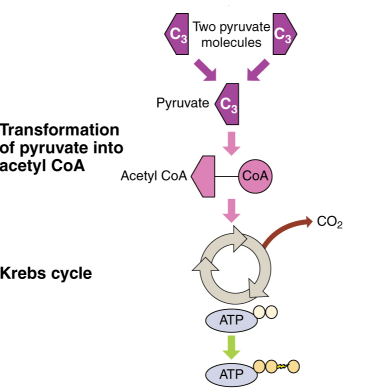
The Krebs cycle, also known as the citric acid cycle, is the next step in cellular respiration. During this step, the pyruvate molecules are further broken down into carbon dioxide while their energy is harvested.

The Krebs cycle happens after glycolysis.

Image source: By OpenStax College CC BY 3.0, via Wikimedia Commons

An enzyme known as coenzyme A grabs onto the acetic acid molecules and becomes acetyl-coenzyme A (acetyl-CoA). This coenzyme attaches the acetic acid molecule to another molecule in order to create citric acid.

This process kicks off when the pyruvic acid molecules pass from the cytoplasm, through the two membranes of the mitochondrion, and into the matrix of the mitochondrion. One carbon atom is then removed from the pyruvic acid and combined with two oxygen atoms to form carbon dioxide. The remaining two carbon atoms of the pyruvic acid rearrange themselves to form acetic acid (which you know as vinegar).

Where does the Krebs cycle take place?

Choose one answer

Video

(Video) The Citric Acid Cycle

by ndsuvirtualcell

This video gives a great visual explanation of the citric acid cycle and what is produced at each step.

Video

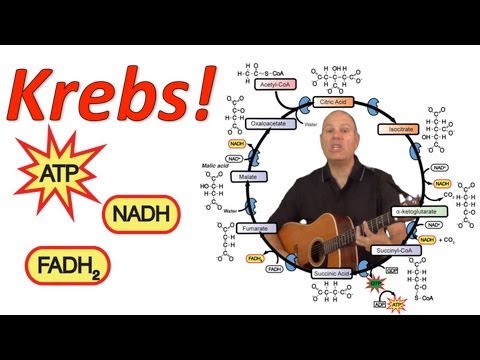
(Video) Krebs!

by sciencemusicvideos

Learn about the Krebs cycle through song in this great video by Mr. W.

Type a concept, like “slope” or “photosynthesis”.

↑ ↓ to choose · Enter to openSearch explanations and problems