What Does the Krebs Cycle Produce?
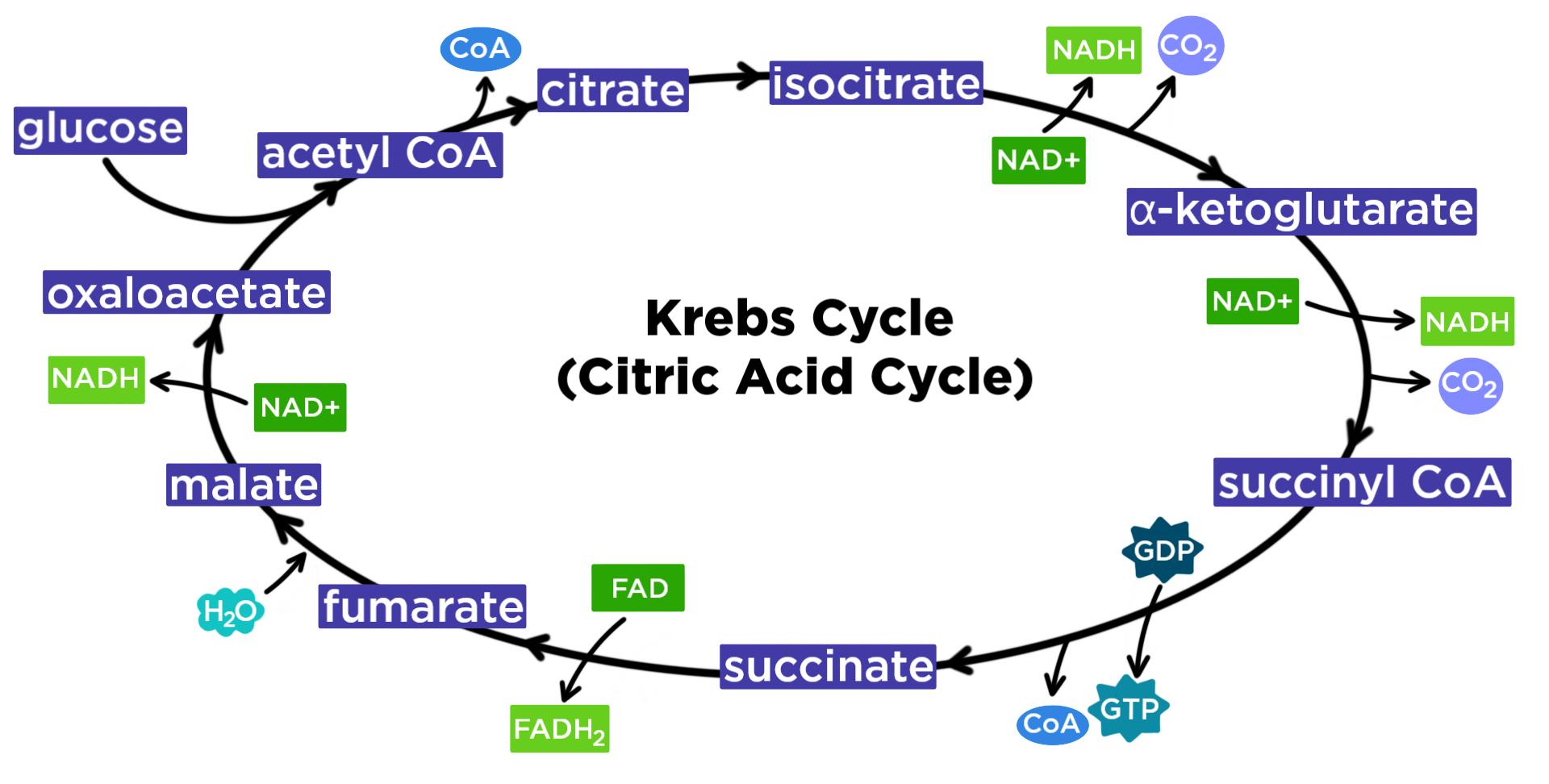
The Krebs cycle, also known as the citric acid cycle, is the next step in cellular respiration. During this step, the pyruvate molecules are further broken down into carbon dioxide while their energy is harvested.
An enzyme known as coenzyme A grabs onto the acetic acid molecules and becomes acetyl-coenzyme A (acetyl-CoA). This coenzyme attaches the acetic acid molecule to another molecule in order to create citric acid.
This process kicks off when the pyruvic acid molecules pass from the cytoplasm, through the two membranes of the mitochondrion, and into the matrix of the mitochondrion. One carbon atom is then removed from the pyruvic acid and combined with two oxygen atoms to form carbon dioxide. The remaining two carbon atoms of the pyruvic acid rearrange themselves to form acetic acid (which you know as vinegar).
Energy Extraction
The next step of the Krebs cycle is energy extraction. The six-carbon citric acid is broken into another four-carbon molecule, releasing two more carbon dioxide molecules while NAD+ grabs onto more electrons to become NADH. The electron carriers FAD and NAD+ grab high-energy electrons a few different times during the cycle.
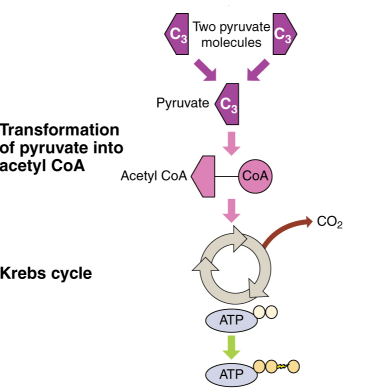
This NADH molecule is the same one needed to start the first step of the Krebs cycle. That's why it's called a cycle. If you look at the picture below, you'll see that ADP is turned into ATP once per cycle.
Each glucose molecule breaks down into two pyruvic acid molecules, so the Krebs cycle can be completed twice for each glucose present.
Vocabulary Review:
Glycolysis : A process that converts glucose molecules into usable energy
Cellular Respiration : A set of complex chemical reactions that provides a cell with energy
ATP : A molecule that stores energy in its bonds. The cell is able to break these bonds to release energy
Phosphorylation : Enzymes are able to break a bond between phosphate groups on ATP, turning it into ADP. This releases energy that the cell can use
Anaerobic : A reaction that needs oxygen to occur
Krebs Cycle : The first main part of cellular respiration where high energy electrons are moved to the electron transport chain
Electron Transport Chain : The final step of cellular respiration where 34 ATP molecules are made