Le Chatelier's Principle — Overview & Role in Equilibrium

Before this, knowWhat Is Equilibrium? — Definition & Overview

Interactive · 2 questions
This explanation is going to be structured somewhat differently from other explanations, it will be structured in the form of an overview of a lab experiment. Its purpose is to test Le Chatelier’s Principle by observing how certain factors affect the equilibrium of a chemical reaction.

Le Chatelier’s Principle states that a change in either temperature, concentration, or pressure, that describes a reaction at equilibrium produces an equilibrium shift that compensates for the changed variable. Changes in temperature and concentration will be analyzed in this "experiment".

Consider the reaction of the acid-base indicator methyl violet (MV). It can exist in two forms in solution: protonated (green\color{#50BF14}{\text{green}}) and deprotonated (violet\color{#A84CC5}{\text{violet}}). H(MV)(aq)⟺H(aq)++MV(aq)−H(MV)_{(aq)} \Longleftrightarrow H^{+}_{(aq)} + MV^{-}_{(aq)}

The temperature of a reaction, shown below, is manipulated where the hydrate [Co(H2O)6]2+[Co(H_2O)_6]^{2+} is at equilibrium with [CoCl4]2−[CoCl_4]^{2-}.

[Co(H2O)6](aq)2++4Cl(aq)−⟺[CoCl4](aq)2−+6H2O(l)[Co(H_2O)_6]^{2+}_{(aq)}+ 4Cl^{-}_{(aq)} \Longleftrightarrow [CoCl_{4}]^{2-}_{(aq)} + 6H_{2}O_{(l)}

When heat, denoted as delta (Δ\Delta), is added to an endothermic reaction, the equilibrium would shift the direction of the reaction to the right and when cooled, equilibrium would shift to the left.

[Co(H2O)6](aq)2++4Cl(aq)−+Δ⟺[CoCl4](aq)2−+6H2O(l)[Co(H_2O)_6]^{2+}_{(aq)}+ 4Cl^{-}_{(aq)} + \Delta \Longleftrightarrow [CoCl_{4}]^{2-}_{(aq)} + 6H_{2}O_{(l)} Endothermic Reaction\text{Endothermic Reaction}

However, if the reaction is exothermic, heating would move equilibrium toward the left while cooling would shift equilibrium to the right.

[Co(H2O)6](aq)2++4Cl(aq)−⟺[CoCl4](aq)2−+6H2O(l)+Δ[Co(H_2O)_6]^{2+}_{(aq)}+ 4Cl^{-}_{(aq)} \Longleftrightarrow [CoCl_{4}]^{2-}_{(aq)} + 6H_{2}O_{(l)} + \Delta Exothermic Reaction\text{Exothermic Reaction}

Based on how heating and cooling shifts the equilibrium between [Co(H2O)6]2+[Co(H_2O)_6]^{2+} and [CoCl4]2−[CoCl_4]^{2-}, it can be determined through the color change (pink indicating reactants and blue indicating products) whether the reaction is endothermic or exothermic.

When the molar concentration of hydrogen ions, [H+][H^+], (products) is increased, what do you think will happen to the color of the MV solution, according to Le Chatelier’s Principle?

Choose one answer

Interactive · 1 question

As Le Chatelier's Principle states, the equilibrium position tends to shift to counteract a change. Thus, if we increase the concentration of the products, the system will shift to reduce that change, which means it will move to the left.

reactants⇋products\text{reactants} \leftrightharpoons \text{products}

Two reactions are occurring at the same time. Think of this as two players in a game in which they push on a block from opposite sides.

Forward reaction: reactants→products\text{reactants} \rightarrow \text{products}

Reverse reaction: products→reactants\text{products} \rightarrow \text{reactants}

If the system is at equilibrium and we increase the concentration of the products, it would be analogous to giving the "forward" player an unfair advantage by helping him/her push on the block. The system recognizes this and gives the "reverse" player a similar advantage in order to restore equilibrium and move the block back to the position where it originally was.

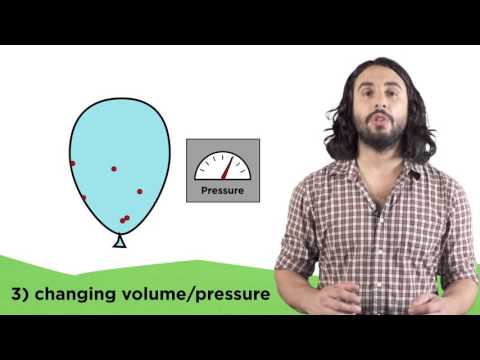
This principle also applies to other changes. A change in volume typically results in a change in pressure, since they are inversely proportional. Consider the general reaction equation:

A(g)+B(g)⇋C(g)\text{A}(g) + \text{B}(g) \leftrightharpoons \text{C}(g)

If we change the volume of the reaction, we are disrupting the equilibrium. If a decrease in volume (increase in pressure) is experienced by the system, there are too many molecules clustered together. As a result, the system will shift to the right, since there is only one molecule on the right (C(g)\text{C}_{(g)}), which takes up less space than the two molecules on the left (A(g)\text{A} (g) and B(g)\text{B} (g)). In general, the system moves to the side with fewer gaseous molecules if the volume is decreased and to the side with more gas molecules if the volume increases.

One exception exists, however. If an inert gas such as Ar(g)\text{Ar}_{(g)} is added to the system, the pressure inside the container will increase, since more gaseous molecules are present. However, this has no effect on the equilibrium position.

Consider the following reaction in a closed vessel at 1 atm:

2ClNO2(g)+NO(g)⇋NO2(g)+ClNO(g)2\text{ClNO}_2 (g) + \text{NO} (g) \leftrightharpoons \text{NO}_2 (g) + \text{ClNO} (g)

If the pressure inside the vessel is decreased to 0.5 atm, what will happen to the concentration of NO(g)\text{NO}_{(g)}?

Choose one answer

Video · + 2 min read

Le Chatelier's Principle

By: Professor Dave Explains

Le Chatelier's Principle states that a system in equilibrium resists changes acted upon it. If we change the concentration of a chemical species, that means we are either adding something in or taking something out. Let's consider the reaction below. A⇌BA \rightleftharpoons B If we add in more AA, then the system will resist this change by reacting A and changing it into BB. If we take away AA, then BB will react in order to replenish AA. The reverse happens when we take away or add in BB.

The underlying kinetics for this is fairly basic. When a reaction is in equilibrium, what is actually happening is that the forward reaction is occurring at the same rate as the reverse reaction. So if we add a little bit more of the reactants, this causes the forward reaction to happen at a faster rate, which causes the system to consume the reactant. Likewise, if we take away the reactant, we cause the forward reaction to go a little bit slower, which causes the system to make more of the reactant.

We can drive a reaction to proceed in a certain direction in many ways. The three most common ways are adding/removing a chemical, heating/cooling the system, and restricting the volume. When we add chemicals to the system, the system tries to consume the new chemicals. When we remove chemicals, the system tries to replace the chemicals. When we heat the system it drives the endothermic reaction, and when we cool it, it drives the exothermic. Finally, by restricting the volume to be small or large, we can favor the more or less dense direction respectively.

Le Chatelier's principle is primarily used in order to force reactions to proceed in a certain direction. This is why in many reactions chemists allow some reactants to be in a large excess. The more these reactants are in excess, the more that the limiting reagent will react. Using a large enough excess can result in nearly 100% yield, even though the reaction exists in equilibrium.

Illustrated · 1 min

Le Chatelier's Principle

The image is of a depressed scale where one side is much heavier than the other. In order to restore equilibrium in the scale, items from the right side would need to be moved to the left side. This image demonstrates Le Chatelier's Principle because of the movement needed to take to relieve the "stress" put on the system.

Image By: E. Burnham

Type a concept, like “slope” or “photosynthesis”.

↑ ↓ to choose · Enter to openSearch explanations and problems