Interactive · 1 question
+5 contributors




Before discussing Least Common Multiples, let's begin with the term multiples. What does it mean for a number to be a multiple of another number?
If we multiply a number by an integer, we get the multiples of . For example, is a multiple of because we can multiply by an integer to get . In this case that integer is . We can tell it's because . However, sometimes you have to deal with larger numbers. In this case you might need to solve an equation to figure out what number to multiply by.
We can also list the multiples of a number by "counting by" that number. For example, when we "count by " we are listing the multiples of These lists technically never end. However, we usually only write out a few numbers from the lists. Each number in that list is the result of multiplying by another whole number. That's why we call these numbers multiples of .
Similarly, if we were to count by i.e. , we are listing multiples of seven. If we are listing multiples of a positive number, the numbers increase as we go further along the list. If we are listing multiples of a negative number, the numbers decrease as we go further along the list.
Select all of the multiples of .
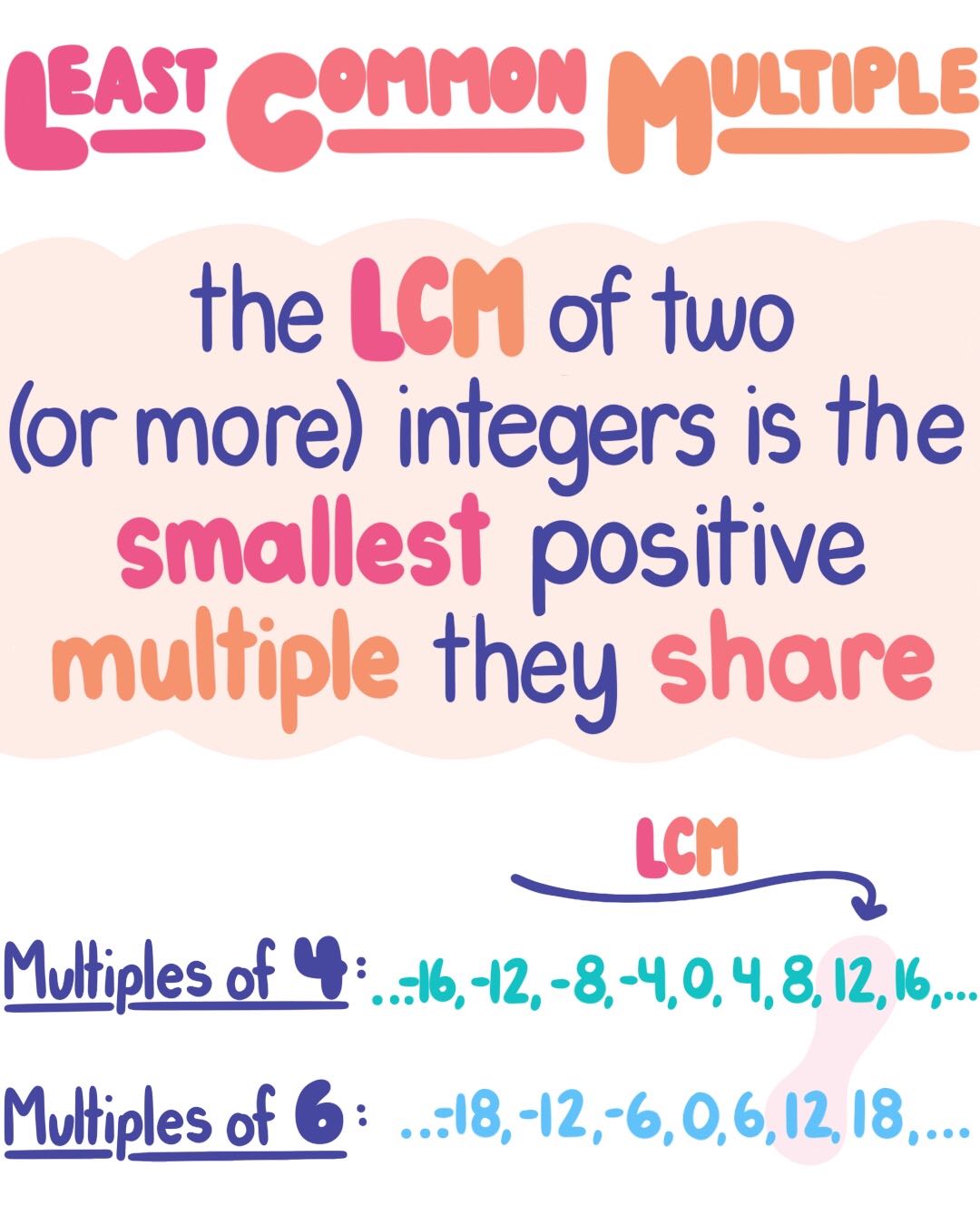
Now, let's consider the term Least Common Multiple (LCM). The LCM is the smallest multiple that two or more numbers have in common.
Common multiples can be found by listing the multiples of each number in question. The first multiple that each integer has in common is the LCM between those numbers.
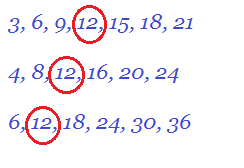
If we wanted to find the LCM between , , and we could list the multiples of each and find the LCM. Below is a list of some of the multiples of , , and . Notice that there are several different multiples that are in each list, however, the first integer that is in each list is . Thus, is the LCM of and